 Available in US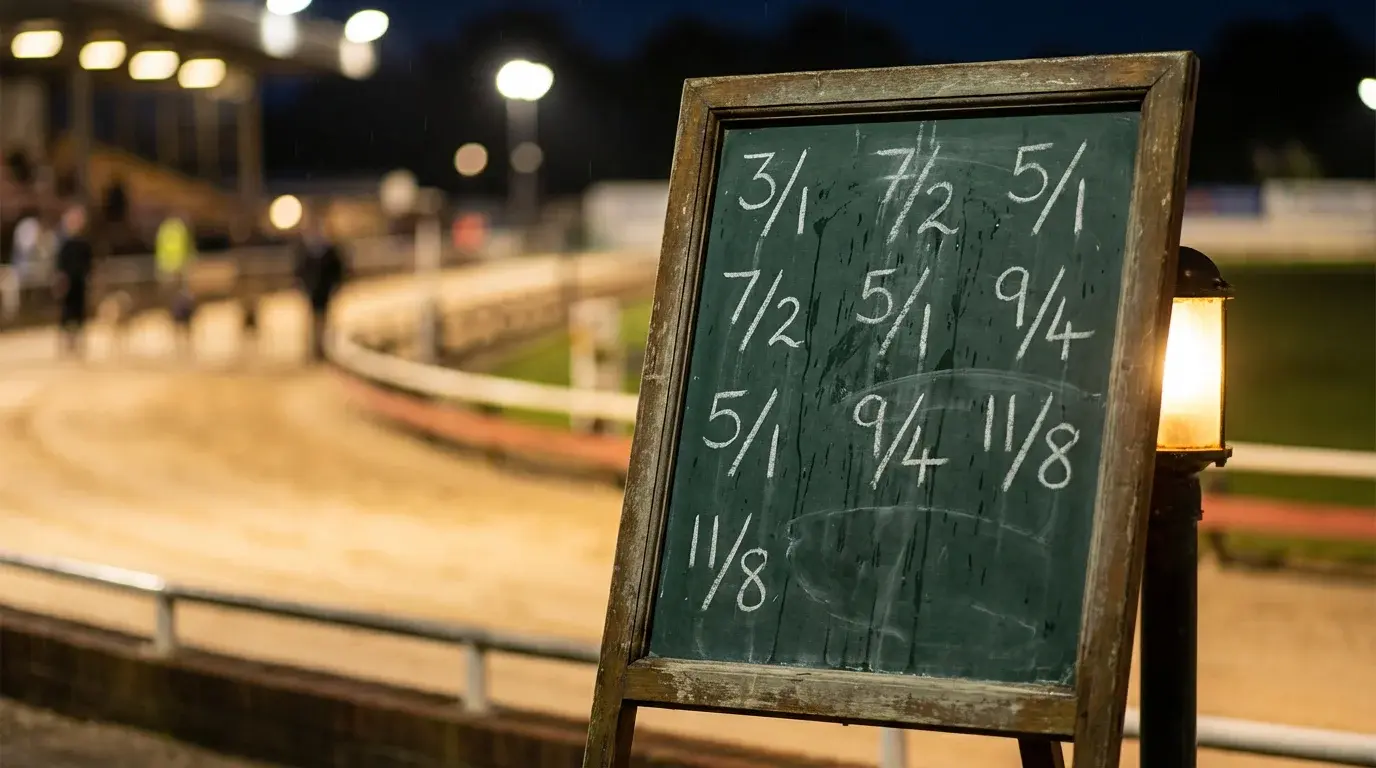
Greyhound odds are set later, move faster, and carry more quirks than any other UK sport. That is not a criticism — it is simply how the market works when six dogs line up behind mechanical traps at a sand track and the entire spectacle is over in thirty seconds. Football odds are published days in advance and adjusted gradually. Horse racing prices form across a morning market with significant liquidity. Greyhound odds, by contrast, often solidify minutes before the traps open, with the Starting Price determined in a window so narrow that most bettors barely register it happening.
Add tote pools with dividends that are unknown until after the result, Best Odds Guaranteed promotions that can change your payout after the race is run, and an overround that typically runs higher than horse racing, and you have a pricing environment that rewards the literate and punishes the casual. This article breaks down every pricing mechanism a UK greyhound bettor will encounter: fractional odds, decimal odds, Starting Price, BOG, tote dividends, implied probability, overround, market movements, and Rule 4 deductions. Each one affects what you get paid and when. Understanding them is not optional — it is the baseline.
Fractional Odds: The UK Standard
If you cannot convert 7/2 to a probability in your head, you are not yet ready to bet. Fractional odds are the traditional UK format, and they remain the default at on-course bookmakers, in betting shops, and across most UK bookmaker websites. The format expresses the profit relative to the stake: at 3/1, a one-pound stake returns three pounds profit plus the original pound, for a total of four pounds. At 7/2, a two-pound stake returns seven pounds profit plus the two-pound stake. The first number is profit; the second is the stake required to earn it.
Common greyhound prices range from odds-on (where the profit is less than the stake) through to long-shot outsiders. A 4/6 favourite means you stake six pounds to profit four — a total return of ten pounds from a six-pound outlay. At the other end, a 20/1 outsider returns twenty pounds profit for every pound staked. Greyhound races typically produce a market with one or two short-priced dogs between evens and 5/2, a couple of mid-range runners between 3/1 and 6/1, and one or two outsiders at 8/1 and beyond. The shape of the market reflects the bookmaker’s assessment of each dog’s chances and the money already placed.
Converting fractional odds to implied probability is the essential skill. The formula is: stake divided by (profit plus stake), multiplied by 100. At 3/1, that gives 1 / (3 + 1) = 25%. At 7/2, it gives 2 / (7 + 2) = 22.2%. At 4/6, it gives 6 / (4 + 6) = 60%. These percentages represent the probability implied by the odds — the chance the bookmaker’s price suggests the dog has of winning. If your own assessment of the probability is higher than the implied figure, the bet has value. If it is lower, the price is against you.
One trap that catches new bettors: fractional odds do not include your stake in the displayed number. At 3/1, you receive three pounds per pound staked, plus your stake back. This is different from decimal odds, where the displayed number is the total return including the stake. The distinction matters when comparing prices across formats, and it is a source of confusion that costs real money if you miscalculate your returns.
Decimal Odds and Betting Exchanges
Decimal is cleaner for calculation — fractional is embedded in UK culture. Decimal odds express the total return per unit staked, including the stake. A decimal price of 4.50 means that a one-pound bet returns four pounds fifty in total: three pounds fifty profit plus the one-pound stake. To convert from fractional to decimal, divide the first number by the second and add one: 7/2 becomes (7 / 2) + 1 = 4.50. To convert back, subtract one and express as a fraction: 4.50 – 1 = 3.50, or 7/2.
Decimal odds are the standard on betting exchanges — Betfair, Smarkets, and similar platforms — where bettors wager against each other rather than against a bookmaker. Exchanges are less widely used for greyhound racing than for horse racing or football, but they exist and occasionally offer better prices, particularly for popular BAGS meetings with decent liquidity. The exchange model also allows you to lay a dog — betting that it will not win — which is a tool that has no equivalent in traditional bookmaker betting and opens up additional strategic possibilities.
For pure calculation, decimal odds are superior. Comparing 4.50 with 3.80 tells you instantly which pays more. Comparing 7/2 with 11/4 requires a fraction of a second longer — and in markets where speed matters, that fraction counts. Most bookmaker websites now offer a toggle between fractional and decimal display, so the choice is largely one of habit. If you use exchanges at all, you will need to be comfortable with decimal. If you bet exclusively with traditional bookmakers, fractional is fine, but knowing how to convert between the two is a basic literacy requirement.
One practical note: exchange odds include the commission charged on winning bets, typically between 2% and 5%. A winning exchange bet at 4.50 with a 5% commission nets an effective decimal price of about 4.33. This commission reduces the apparent advantage of exchange prices, and any price comparison between bookmaker and exchange odds should factor it in.
Starting Price: How It Works and Why It Matters
Starting Price is the market’s final verdict — and it arrives seconds before the traps open. The SP is the official price at which a greyhound starts a race, and it serves as the settlement price for any bet placed at “SP” rather than at a fixed early price. In horse racing, SP is determined by an independent assessor reading the on-course bookmaker boards moments before the off. In greyhound racing, the mechanism is similar in principle but compressed in time — the market forms very late, often within the final few minutes before the traps open, because greyhound meetings move at fifteen-minute intervals and the betting window for each race is narrow.
The SP matters for two reasons. First, it is the price that settles all bets placed at Starting Price — a common option for bettors who choose not to take an early price. Second, it is the reference price for Best Odds Guaranteed promotions, which pay the higher of your early price or the SP. If you took 3/1 early and the SP comes in at 4/1, BOG pays you at 4/1. If the SP is 2/1, you keep your 3/1. In both cases, the SP is the benchmark.
The trade-off between early price and SP is one of the most important decisions a greyhound bettor makes for each individual bet. Taking an early price locks in your odds — you know exactly what you will be paid if the dog wins, regardless of how the market moves before the off. This is valuable when you believe the market will shorten as money arrives for the dog. However, if the dog drifts — if its price increases — you are stuck at the shorter early price while the SP offers better value. Without BOG, this is a genuine gamble. With BOG, the downside of taking an early price is removed: you can lock in the early price and still receive the SP if it is higher.
How does SP get set? In practice, it reflects the balance of money in the market. On-course bookmakers adjust their boards based on the bets they are receiving. If heavy money comes in for a particular dog, its price shortens. If a dog attracts little interest, its price drifts. The SP captures this equilibrium at the moment the race begins. Online bookmaker prices track the on-course market but are not identical — they reflect the bookmaker’s own liability and the volume of bets placed through their platform. The result is that SP can vary slightly between bookmakers, though the differences are usually marginal.
For most greyhound bettors, the practical advice is: if BOG is available, take the early price. You get the security of a fixed price with the upside of SP if it moves in your favour. If BOG is not available — some BAGS meetings and behind-closed-doors races are excluded — the decision depends on whether you expect the dog’s price to shorten or drift. If you have no strong view, SP is the neutral option. It is the market’s collective judgement, and while it is not always correct, it is at least informed by the full weight of money in the market.
Best Odds Guaranteed
BOG eliminates the early-price gamble — and any serious greyhound bettor should insist on it. Best Odds Guaranteed is a promotion offered by most major UK-licensed bookmakers on selected greyhound meetings. The mechanism is simple: if you take an early price on a dog and the Starting Price is higher, the bookmaker pays you at the SP instead. If the SP is lower than or equal to your early price, you keep the early price. You receive whichever is better.
This is, without exaggeration, the single most punter-friendly feature in greyhound betting. It removes the primary risk of taking an early price — the possibility that the market moves against you — and replaces it with a one-way advantage. You can lock in a price you consider fair, and if the market subsequently decides the dog deserves a longer price, you benefit from the correction without having to predict the movement in advance.
A worked example. You back a dog at an early price of 5/1 with a ten-pound stake. Between the time you place the bet and the off, the market moves: less money comes in on this dog than expected, and its Starting Price is returned at 7/1. Under BOG, your bet settles at 7/1 — ten pounds at 7/1 returns eighty pounds (seventy profit plus your ten-pound stake). Without BOG, your bet would settle at 5/1 — ten pounds at 5/1 returns sixty pounds. The BOG promotion has added twenty pounds to your payout for no additional cost or risk.
The limitations of BOG are worth noting. Not all meetings qualify. Some bookmakers restrict BOG to evening cards or feature meetings, excluding afternoon BAGS fixtures. The specific terms vary by operator, and they can change without notice, so checking before you place the bet is essential. Some bookmakers cap the maximum extra payout from BOG, meaning that if the SP drifts dramatically — from 3/1 to 10/1, for example — you may not receive the full SP. Maximum stakes may also apply. Read the terms, even if they are buried three clicks deep in the promotions page.
Despite these caveats, the strategic principle is clear: whenever BOG is available on a meeting, take the early price. There is no rational reason to bet at SP when BOG gives you the higher of the two. The only exception is if you are specifically targeting a dog you expect to shorten — in which case, watching the price move is part of your analysis, and you might choose to delay placement until you see confirmation of the shortening. Even then, the downside of taking early with BOG is minimal.
Tote Odds and Pool Dividends
Tote dividends are a black box until the result is official — and sometimes the box pays more. The tote operates on a pari-mutuel system: all stakes on a particular outcome are pooled together, a percentage is deducted by the operator (the takeout), and the remainder is divided among the winning tickets. The key difference from bookmaker betting is that you do not know your payout when you place the bet. The dividend is declared after the race, based on the final pool composition.
Pool size is the critical variable. In a large pool — generated by a well-attended evening meeting or a popular BAGS fixture — the dividends tend to be relatively stable and roughly comparable to bookmaker SPs. In a small pool — a quiet afternoon meeting with minimal interest — the dividends become volatile. A single large bet can distort the pool, pushing the dividend on the winning outcome significantly higher or lower than the bookmaker price. This volatility cuts both ways: a small pool can produce an outsider dividend that dwarfs the bookmaker SP, or a favourite dividend that pays substantially less.
The takeout — the tote’s house edge — varies by operator and pool type but generally runs between 15% and 28% of the total pool. This is applied before dividends are calculated, so every dividend already reflects the deduction. The takeout is the tote equivalent of the bookmaker’s overround: the built-in margin that ensures the operator profits regardless of the result. In percentage terms, the tote’s take is often comparable to or slightly higher than the bookmaker margin, though direct comparison is complicated by the fact that bookmaker margins are embedded in the odds while tote margins are deducted from the pool.
When does the tote pay better than the bookmaker? Most commonly when an outsider wins. If the favourite has attracted the majority of the pool money and a longer-priced runner crosses the line first, the tote dividend on that outsider can exceed the bookmaker SP because the favourite’s money inflates the pool that gets redistributed to a small number of winning tickets. Conversely, when the favourite wins, the tote typically pays less than the bookmaker because the pool is diluted across many winning bets. This asymmetry creates a practical guideline: if you are backing outsiders, check the tote dividend history at that track and consider placing your bet in the pool rather than with a bookmaker.
Exotic tote pools — Exacta (forecast), Trifecta (tricast), and multi-race pools like the Jackpot — follow the same pari-mutuel mechanics but with larger takeouts and greater variance. These pools can produce spectacular returns when the result confounds the market, but they are structurally harder to beat over the long term because the higher takeout compounds across every bet.
Tote vs Bookmaker: When to Choose Which
The choice between tote and bookmaker is situational — not habitual. There is no universal rule that says one is always better than the other. The right platform depends on the specific race, the specific selection, and the specific market conditions.
Use the bookmaker when: you are backing a favourite or a short-priced selection (the bookmaker price is almost always better than the tote dividend for favourites); BOG is available on the meeting (this gives you a one-way advantage that the tote cannot match); or you want price certainty at the point of betting. Use the tote when: you are backing an outsider at a meeting with a healthy pool size; the Exacta or Trifecta pool is large enough to produce meaningful dividends; or a Jackpot pool has rolled over and the carryover inflates the potential return beyond what individual-race betting can achieve.
A hybrid approach works for bettors who are comfortable managing two platforms. Place your win bet with the bookmaker under BOG, and place a separate place bet or forecast bet in the tote pool if the pool size supports it. This splits your exposure across two pricing mechanisms and lets each platform work where it has a structural advantage. The additional complexity is modest, and the potential for improved returns — particularly on outsider selections — makes it worth considering for any bettor who treats greyhound wagering as more than a casual flutter.
Implied Probability: Turning Odds into Percentages
Every set of odds contains a hidden tax — the overround — and knowing it changes how you bet. Implied probability converts odds into a percentage that represents the chance the bookmaker’s price assigns to that outcome. At 3/1, the implied probability is 25%. At evens, it is 50%. At 1/3, it is 75%. The formula is: stake / (profit + stake) x 100 — or, in decimal odds, simply 1 / decimal price x 100.
The useful application of implied probability comes when you sum the percentages for all six dogs in a race. In a theoretically fair market, those probabilities would add up to 100%. In reality, they never do. A bookmaker’s prices will sum to somewhere between 115% and 130% in a typical greyhound race. The amount by which the total exceeds 100% is the overround — the bookmaker’s built-in margin.
Consider a six-dog race priced at 2/1, 3/1, 4/1, 6/1, 8/1, and 12/1. The implied probabilities are 33.3%, 25%, 20%, 14.3%, 11.1%, and 7.7%, totalling 111.4%. The overround is 11.4%. This means the bookmaker has built an 11.4% margin into the market — if every dog were backed in proportion to its implied probability, the bookmaker would profit 11.4% of the total amount wagered. For the bettor, the overround is a headwind: it means that the odds on every dog are slightly shorter than the true probability justifies, making value harder to find.
Greyhound overrounds are typically higher than horse racing, which is itself higher than football. A Premier League football match might carry an overround of 105-108%. A horse racing field of ten runners might sit at 112-120%. A greyhound race with six dogs commonly runs at 115-130%. The difference is driven by market depth — greyhound markets attract less money and less scrutiny, so bookmakers widen their margins to protect against the higher uncertainty.
What does this mean in practice? Two things. First, finding value in greyhound markets requires a larger edge than in lower-margin sports. If the overround is 125%, the bookmaker is effectively extracting a larger cut from each race, and your probability assessment needs to overcome that margin to generate a positive return. Second, not all races carry the same overround. Feature meetings and popular evening cards tend to have tighter margins because they attract more money and more competition between bookmakers. Quiet afternoon BAGS fixtures can carry wider margins. If you are selective about which meetings you bet on, choosing lower-overround cards gives you a structural advantage before you even study the form.
How Odds Move and What Movements Mean
A price that shortens from 5/1 to 7/2 in ten minutes is telling you something — the question is whether to listen. Odds in greyhound racing are not static. They are set by bookmakers based on an initial assessment of each dog’s chances, then adjusted as money flows into the market. When a dog attracts heavy support, its price shortens — 5/1 becomes 4/1, then 7/2, then 3/1. When a dog is ignored or when money moves against it, its price drifts — 3/1 becomes 7/2, then 4/1, then 5/1. These movements carry information, but interpreting them correctly requires context.
A shortening price can indicate several things. Money from connections — the trainer’s kennel, the owner, people close to the dog — is the most significant signal. If a dog’s price shortens sharply in the final minutes before the off, it may reflect confidence from people who know the dog’s current condition and preparation. This is sometimes called a “gamble” or a “steam move,” and it is one of the few informational advantages that market watchers have over pure form analysts. However, not every shortening price is an insider signal. Public money from casual bettors can also cause prices to move, particularly on BAGS meetings where a single large bet in a thin market can shift the odds significantly.
A drifting price is often more informative. When a dog’s price lengthens in the face of market activity on its rivals, it suggests that informed money is going elsewhere. A dog that opens at 2/1 and drifts to 3/1 while another dog in the same race shortens from 5/1 to 3/1 is experiencing a market correction: the bookmaker’s initial assessment overrated it, or new information has emerged that reduces confidence.
How to monitor movement in practice: most bookmaker apps display a price history or a directional arrow indicating whether the price has shortened, drifted, or remained stable. Some third-party sites track price movements across multiple bookmakers in real time. The most actionable signals occur in the final fifteen minutes before the off — earlier movements are often noise, while late movements reflect the most informed money in the market. Watch for convergence: when multiple bookmakers move the same dog’s price in the same direction, the signal is stronger than a single bookmaker adjusting to manage their own book.
A word of caution: market movements are not predictions. A dog whose price shortens from 5/1 to 3/1 is still more likely to lose than to win. The movement tells you that the market’s collective assessment has shifted, not that the outcome is certain. Use market signals to supplement your form analysis, not to replace it. If a dog you have already identified as a strong selection shortens, that is confirmation. If a dog you have dismissed on form shortens, do not let the market talk you into abandoning your own work.
Rule 4 Deductions in Greyhound Racing
Rule 4 is rare in the dogs — but when it hits, the payout shrinks. Rule 4, formally Tattersalls Rule 4(c), applies when a runner is withdrawn from a race after betting has opened but before the race is run. The withdrawal changes the competitive dynamics of the race — one fewer dog means an altered probability landscape — and the rule compensates for this by applying a deduction to all winning bets.
The deduction scale is based on the withdrawn dog’s price at the time of withdrawal. If the withdrawn dog was a short-priced favourite — say, evens — the deduction is substantial, typically 45 pence in the pound. If it was a longer-priced outsider at 10/1, the deduction is much smaller, around 5 to 10 pence in the pound. The logic is straightforward: a favourite’s withdrawal changes the race more than an outsider’s, so the deduction is proportionally larger.
In practice, Rule 4 deductions are uncommon in greyhound racing compared to horse racing. The reasons are structural: greyhound races have smaller fields (six dogs versus twelve or more in horse racing), tighter timelines between declaration and the off, and fewer late withdrawals. Dogs are kennelled at the track before the meeting, veterinary checks happen early, and the compact meeting schedule leaves less time for pre-race issues to emerge. When a withdrawal does occur, it is usually due to a veterinary concern identified during the final inspection or, very occasionally, a trap malfunction.
The impact on your returns is mechanical. If you backed a dog at 4/1 with a ten-pound stake and a Rule 4 deduction of 15 pence in the pound applies, your return is reduced by 15% of the profit element. The full 4/1 return would be fifty pounds; the Rule 4 reduces the profit by fifteen percent of forty pounds (six pounds), giving a total return of forty-four pounds. It is not devastating, but it is a reduction that catches bettors off guard if they have not encountered it before. The deduction is applied automatically by bookmakers and the tote — you do not need to calculate it yourself, but you should understand why your return is lower than expected when it occurs.
The Price of Being Wrong
You cannot beat a market you do not understand — and greyhound odds reward the literate. Every section of this article describes a mechanism that affects what you get paid: fractional and decimal formats determine how you read the price, SP and early pricing determine when the price is set, BOG determines whether you benefit from favourable market moves, the tote determines whether the crowd’s money works for or against you, overround determines how much margin the bookmaker extracts, and market movements determine what the informed money is saying in the final minutes before the race.
None of these mechanisms are complicated individually. A bettor who understands fractional odds but ignores the overround is leaving money on the table. One who uses BOG but ignores tote dividends on outsiders is missing opportunities. One who reads market movements but cannot convert a price to an implied probability is interpreting signals without a framework for acting on them. The edge comes from understanding the full pricing landscape, not any single piece of it.
Odds literacy will not, by itself, make you profitable. You still need form analysis, track knowledge, staking discipline, and the patience to wait for value. But without odds literacy, none of those skills produce their full return. The pricing mechanisms are the infrastructure on which every greyhound bet is settled. Learn them, and the market becomes a tool. Ignore them, and the market is simply the place where your money disappears.
