 Available in US
Under floodlights that bleed orange into the night sky, six greyhounds crouch behind steel traps on a strip of raked sand. A mechanical hare whips past. The lids snap open. Thirty seconds later, somebody has won and most people have lost. That is greyhound racing at its most compressed, and it repeats itself a dozen times a night, at tracks across England, most evenings of the year.
Six dogs, thirty seconds, and more ways to lose your stake than most punters realise. Greyhound betting in Britain sits in a strange place. It is neither the spectacle of horse racing nor the cultural obsession of football, yet bookmakers depend on it heavily. The sport fills dead hours in betting shops, provides continuous content for live streaming platforms, and generates hundreds of races per week that the average punter barely registers until they place a bet. In the financial year 2024-25, bookmakers contributed 0.6% of their greyhound turnover to the British Greyhound Racing Fund, collecting a total of 6.75 million pounds — a figure that hints at the sheer volume of money moving through these markets.
The Greyhound Board of Great Britain currently licenses 18 stadia across England and Wales, down from more than seventy in the post-war years. Racing takes place almost every day. Many meetings run behind closed doors as part of the BAGS (Bookmakers Afternoon Greyhound Services) programme, meaning no public attendance — just cameras, dogs, and data streamed straight to online sportsbooks. For the casual bettor watching from a phone screen, the product looks simple. For anyone willing to look closer, the depth of form data, trap statistics, and market nuance available in greyhound racing is remarkable. And that gap — between what most punters see and what the sport actually offers — is precisely where this guide sits.
What follows is a working manual for UK greyhound betting: how the sport operates, how to read its data, which bets exist, where to place them, and what separates informed wagering from blind punts on the next race off.
UK Greyhound Racing at a Glance
There are 18 GBGB-licensed tracks in England and Wales. Racing takes place almost every day, with an estimated 800+ meetings per month across graded and open events. Greyhound betting accounts for a significant share of UK bookmaker activity — particularly in retail betting shops, where it fills daytime schedules alongside horse racing and virtual sports. Gambling Commission data for 2023-24 recorded betting shop turnover on greyhounds at 794 million pounds.
How UK Greyhound Racing Works
Greyhound racing in Britain runs on a system most casual bettors never bother to learn. That is a mistake. Understanding the mechanics — the surfaces, the distances, the grading, the structure of a meeting — is the foundation on which every useful betting decision rests.

Every licensed race in Britain takes place on a sand track. The surface is raked between races to maintain consistency, though conditions vary depending on weather, temperature, and the maintenance regime at each stadium. Dogs chase a mechanical lure — typically an artificial hare mounted on an outside rail — around an oval circuit. The lure stays ahead of the dogs throughout; it is never caught. Races are run from starting traps, and in standard UK greyhound racing there are six dogs per race. Each wears a colour-coded jacket that corresponds to its trap number: Trap 1 is red, Trap 2 blue, Trap 3 white, Trap 4 black, Trap 5 orange, and Trap 6 black and white stripes. These colours are universal across all GBGB tracks, which means a punter at any venue or watching any stream immediately knows which dog is which.
Distances vary by track and race type. Standard sprint distances sit around 260 to 285 metres, middle-distance races run from 400 to 500 metres, stayers' events push beyond 600 metres, and marathon races can exceed 900 metres. Not every track offers every distance — Romford is a tight circuit suited to sprints, while Towcester's wider layout accommodates the full range including the 500-metre Derby trip. Distance matters when assessing form: a dog that dominates over 225 metres at Romford may be outclassed over 480 metres at Monmore.
A typical race meeting consists of ten to fifteen races, spaced roughly twelve to fifteen minutes apart. The entire evening runs two to three hours. Before each race, the dogs are paraded so that trackside punters can assess their physical condition. This pre-race parade is one of the genuine edges that trackside bettors hold over those betting remotely — you can see whether a dog looks sharp or sluggish, carrying weight or moving freely.
BAGS — Bookmakers Afternoon Greyhound Services. BAGS meetings are races run behind closed doors, without public attendance, specifically for broadcast to betting shops and online platforms. They fill the daytime racing schedule when horse racing is not available and account for a substantial proportion of all UK greyhound meetings.
Graded Racing, Open Racing, and BAGS Meetings
The grading system is the backbone of UK greyhound racing and one of the features that makes it uniquely data-rich for bettors. Dogs are graded from A1 (the fastest and most competitive) down through A2, A3, and so on to A11 at the lower end. Each track operates its own internal grading based on a dog's recent form and finishing times. When a dog wins, it is typically promoted to a higher grade; when it loses consistently, it drops. The principle is simple — grading keeps races competitive by pitting dogs of similar ability against each other — but the execution varies from track to track, which is why understanding a specific venue's grading thresholds matters.
Within graded racing, you will also encounter D-grades (development races for younger or less experienced dogs) and puppy races for dogs in the early stages of their careers. These races carry lower prize money but often produce wide-open betting markets because form data is thin.
Open racing sits above the grading system entirely. Open races are the premier competitions — events like the English Greyhound Derby, the Greyhound St Leger, the Essex Vase, and the TV Trophy. These attract the top dogs from across the country (and Ireland), carry significant prize money, and generate the most public and betting interest. The 2026 Star Sports Orchestrate English Greyhound Derby at Towcester, for instance, runs from late April through to the final on 6 June, with a winner's purse of 175,000 pounds. Open race entries are not limited by grade; they are selected on merit, reputation, and qualification through earlier rounds.
Then there are BAGS meetings. Most greyhound racing in Britain happens behind closed doors during the afternoon, filmed by cameras and streamed to betting shops and online sportsbooks. These meetings exist because bookmakers need content — a continuous supply of races for punters outside the horse racing calendar. BAGS meetings use the same licensed tracks, the same dogs, and the same rules; the only difference is the absence of a live audience. For the bettor, they offer the same data, the same form, and the same markets as evening meetings.
Reading a Greyhound Race Card
A race card is not decoration — it is the single most valuable tool a greyhound bettor has. Every piece of data you need to assess a dog's chances is compressed onto a single page: its recent form, running style, trap record, finishing times, weight, trainer, and breeding. Most punters glance at a race card the way they glance at a bus timetable — scanning for the headline number and ignoring everything else. That is how money gets left on the table.

At the top of any UK greyhound race card, you will find the race header: the date, time, track name, race number, distance in metres, grade classification (A1 through A11, or OR for open race), and prize money breakdown. This header tells you immediately what calibre of race you are looking at and, by extension, how competitive the field is likely to be. An A1 race at Hove is a very different proposition from a D4 developmental race at Sunderland, and the betting approach should differ accordingly.
Below the header, each dog has its own entry block. This includes the trap number and corresponding jacket colour, the dog's name, the trainer's name, the owner, and a line of coded information: colour, sex, sire, dam, whelping date, and country of origin (typically Br for British-bred or Ir for Irish-bred). You will also see a career summary — total runs, first-place finishes, and second-place finishes — which gives a snapshot of the dog's overall consistency. Beneath this summary sits the form data: typically the last six runs, presented as individual lines packed with numbers and abbreviations.
Trap 1 (the red jacket) historically wins between 25% and 33% of graded races across UK tracks — a significantly higher rate than the 16.7% you would expect if trap position had no effect. The inside-rail advantage on bends is real, measurable, and one of the first things a serious greyhound bettor should factor into their analysis.
Understanding the Form Line and Split Times
Each line in a dog's form record represents a single race and contains, reading left to right: date, distance, trap drawn, split time, the dog's position at each bend and at the finish, the distance won or lost by (in lengths), the winner or runner-up name, venue abbreviation, running comments in abbreviated form, winning time, going adjustment, weight in kilograms, Starting Price, grade, and calculated time.
The split time is the dog's time from the trap to the first timing point — a direct measure of early pace. Dogs with consistently fast splits are front-runners; dogs with slower splits but strong finishing positions are closers that rely on stamina through the final straight. Knowing which type your selection is — and whether the trap draw suits that style — is fundamental to any informed bet.
The calculated time (CalcTm) adjusts the winning time for going conditions, allowing you to compare performances across different days and weather. A dog that ran 29.50 seconds on slow going might have a CalcTm of 29.20, reflecting what it would have clocked on a standard surface. When comparing dogs from different meetings, CalcTm is the only honest way to assess relative speed.
Bend positions tell you how the race unfolded. A dog recorded as 1-1-1-1 led from start to finish. A dog that ran 5-4-3-1 came from behind, picking off rivals through the race. These patterns repeat — dogs tend to race the same way, and recognising those habits is what separates a punter who reads form from one who merely checks finishing positions.
Common Race Card Abbreviations You Need to Know
Race card abbreviations describe a dog's running position and behaviour during a race. They are shorthand, and once you learn them, they tell a vivid story. Rls means the dog raced on the rails (inside); Mid means middle of the track; W means wide. Combinations like MidTRls (middle to rails) or MidToW (middle to wide) describe the dog's movement across the track during the race.
For race behaviour: EP means early pace (the dog showed speed from the traps); SAw means slow away (the dog was slow out of the traps — a red flag if it recurs); QAw is quick away. Crd means the dog was crowded during the race, and Bmp means it was bumped — followed by a number if it happened at a specific bend. ALd means the dog led for most of the race; ClrRun means it had a clear run without interference; EvCh means every chance — the dog was well-positioned but could not win, suggesting it ran to its limit. FcdW means forced wide, and DrewClear means the dog pulled away from the field decisively.
These abbreviations are the language of greyhound form. A dog that repeatedly shows EP, Rls, ALd is a front-running railer — it wants to break fast, hug the inside, and lead. A dog that shows SAw, W, RanOn is a slow starter that runs wide and finishes strongly. The trap draw, the pace of the field, and the track layout will determine which style prevails in any given race.
Types of Greyhound Bets
Understanding what you are betting is non-negotiable — and most punters skip this step. They default to win bets because win bets are simple, and simplicity is comfortable. But UK greyhound racing offers a betting menu that ranges from single-dog picks to multi-race pool wagers with four-figure returns, and knowing which bet fits which race is as much a part of strategy as reading form.
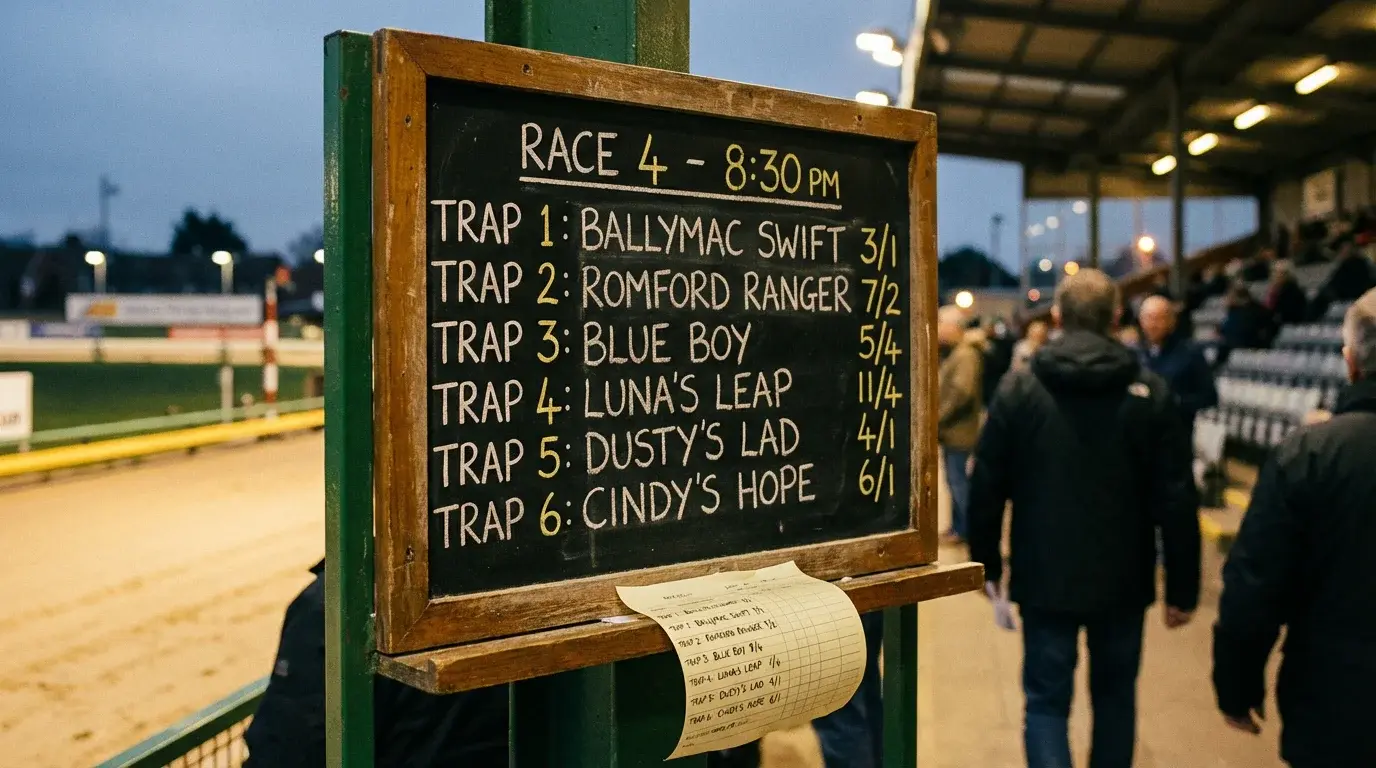
The bet types available at UK tracks and through online bookmakers fall into three broad categories: straight bets (win, place, each-way), combination bets (forecasts and tricasts), and pool bets (tote). Each has a different risk-reward profile, and each is suited to different race conditions. What follows is a working explanation of every bet type a UK greyhound punter is likely to encounter.
Worked Example: A 5-Pound Each-Way Bet at 7/2
Total stake: 10 pounds (5 pounds on win, 5 pounds on place).
If the dog wins: Win part returns 5 x 7/2 = 17.50 profit + 5 pound stake = 22.50 pounds. Place part returns 5 x 7/8 (quarter the odds) = 4.375 profit + 5 pound stake = 9.375 pounds. Total return: 31.875 pounds on a 10-pound stake.
If the dog places second: Win part loses (minus 5 pounds). Place part returns 5 x 7/8 = 4.375 + 5 = 9.375 pounds. Net result: minus 0.625 pounds — nearly all of your stake recovered.
If the dog finishes third or worse: Both parts lose. Total loss: 10 pounds.
Straight Bets: Win, Place, and Each-Way
A win bet is the simplest wager in greyhound racing: you back a dog to finish first. If it wins, you collect at the agreed odds. If it does not, you lose your stake. Win bets make the most sense when you have a strong conviction about a dog's chances — either because the form points clearly to one contender, or because you have identified value in the price. Backing a 1/3 favourite to win is technically a win bet, but the return barely justifies the risk in a six-dog field where a bump at the first bend can end any dog's chances.
A place bet backs a dog to finish first or second. In greyhound racing, place terms cover the top two finishers. The odds are shorter than for a win bet because the probability of a top-two finish is higher. Place bets suit situations where you are confident a dog will be competitive but cannot be sure it will win.
Each-way betting combines a win bet and a place bet into a single wager, split equally. The place portion is typically paid at one-quarter of the win odds. Each-way bets offer a safety net: if your selection finishes second, you recover most of your total stake through the place return. Each-way betting delivers its best value on outsiders with strong place records — a dog at 10/1 that consistently finishes in the top two represents better each-way value than a 2/1 favourite.
Each-Way Value Calculator: What the Place Half Really Pays
The advice you will read everywhere is that each-way betting suits outsiders. Run the numbers and the opposite holds. At quarter odds over two places, the place half of the bet only breaks even when the dog's chance of finishing in the first two reaches 4/(4+odds) — 28.6% for a 10/1 shot, 66.7% for one at 2/1. Enter the six starting prices below and the calculator strips the bookmaker's margin, models each runner's place chance, and shows you the price every dog would need before its place half stops losing money.
Forecast, Tricast, and Combination Bets
A straight forecast requires you to predict the first and second finishers in the correct order. Returns are calculated using the Computer Straight Forecast (CSF), an algorithm based on the starting prices of the first two finishers — meaning the payout is not fixed at the time of betting. A reverse forecast covers both possible orders of your two selections, costing twice the unit stake. It works well in races where two dogs clearly stand out but you cannot confidently separate them.
A tricast demands the exact first, second, and third finishers in order. Returns can be substantial — sometimes hundreds of pounds from a small stake — because the probability of nailing the exact 1-2-3 in a six-dog race is genuinely slim. A combination tricast covers all possible orders of your three selections: six bets at six times the unit stake. Tricasts offer their best value in competitive races where no single dog dominates and the Computer Tricast calculation generates generous payouts.
Tote Pool Betting and Jackpots
Tote betting works on a pari-mutuel system rather than fixed odds. All the money wagered on a particular pool is collected, a deduction is taken by the operator (typically 13% to 28% depending on pool type), and the remainder is divided among winning ticket holders. Your return depends not on the odds at the time of your bet, but on how much money was in the pool and how many other punters backed the winner.
Pool types include Win, Place, Exacta (tote forecast), and Trifecta (tote tricast). Tote payouts can exceed bookmaker odds when the majority of pool money has been wagered on the wrong dogs; conversely, when a heavily backed favourite wins, the tote return may be lower than SP.
Jackpot pools require picking the winner of six consecutive races. The difficulty is extreme, but rollovers can build prize pools into five figures. For most punters, jackpot bets are entertaining rather than strategic — the exception being when a significant carryover has accumulated and you have strong views on several races at the meeting.
How Greyhound Odds Work
Odds on greyhounds move fast and are set late — if you do not understand why, you are betting blind. Unlike football or horse racing, where markets open days or weeks before the event, greyhound odds are typically available only from the morning of the race (for evening meetings) or even later. The market is thin, the fields are small, and a single piece of late information — a weight change, a trap switch, a weather shift — can move a dog's price dramatically.
In the UK, greyhound odds are traditionally expressed as fractions: 3/1, 7/2, 5/4, and so on. A price of 3/1 means that for every pound you stake, you receive three pounds profit if the bet wins, plus your stake back. Decimal odds, more common on betting exchanges and some online platforms, express the same thing differently: 3/1 fractional equals 4.0 decimal (your total return per pound staked, including the stake). Both formats convey the same implied probability — at 3/1, the bookmaker is implying the dog has a 25% chance of winning.
Starting Price — the SP — is the final price at the moment the traps open, determined by the on-course market. If you place a bet at SP, you accept whatever price is returned at the off. Early Prices (EP) are odds offered by bookmakers before the SP is determined, sometimes on the morning of the race. Taking an early price gives you certainty, but you risk the SP being higher than the price you locked in.
This is where Best Odds Guaranteed becomes relevant. BOG guarantees that if you take an early price and the SP is higher, you will be paid at the higher SP. Not every bookmaker offers BOG on greyhounds, and terms vary, but where it is available, it is one of the clearest punter advantages in the sport.
Best Odds Guaranteed in Action
Step 1: You place a 10-pound bet on a dog at an Early Price of 5/1.
Step 2: The market moves. By the time the traps open, the Starting Price has drifted to 7/1 — the dog has attracted less money than expected.
Step 3: The dog wins. Without BOG, your return would be 10 x 5/1 = 50 pounds profit + 10 pound stake = 60 pounds.
Step 4: With BOG, the bookmaker pays at the higher SP. Your return becomes 10 x 7/1 = 70 pounds profit + 10 pound stake = 80 pounds.
Result: BOG adds 20 pounds to your return — for free. This is why taking early prices at BOG bookmakers is a core principle for regular greyhound bettors.
One further distinction worth understanding is the difference between bookmaker odds and tote odds. Bookmaker odds are fixed at the moment you place your bet (or adjusted by BOG at the off). Tote odds, as described in the previous section, are determined by the pool and are not known until after the race. The two can diverge significantly, and experienced punters compare both before deciding where to place their money.
Choosing Where to Bet: Track vs Online
The best place to bet on greyhounds depends entirely on what kind of bettor you are. The trackside punter and the online punter have access to the same races, the same dogs, and largely the same data — but the experience, the tools, and the edges available to each are different in ways that matter.
Trackside betting at a GBGB-licensed stadium gives you something no screen can replicate: the dog parade. Before every race, greyhounds are walked in front of the crowd. You can assess muscle tone, check whether a dog looks sharp or lethargic, and spot physical changes the race card cannot convey. On-course bookmakers set their own odds, which can differ from the online SP. The atmosphere at a live meeting is genuinely compelling, and for many punters it is the reason they bet on the dogs at all.
Online betting offers a different set of advantages. Best Odds Guaranteed is widely available online but rarely offered on-course. The range of bet types is broader, live streaming covers most UK meetings, and the better bookmaker apps provide integrated race cards and form data. Online accounts also give you access to responsible gambling tools — deposit limits, loss limits, self-exclusion — that are harder to enforce with cash betting at a track window.
| Factor | Trackside Betting | Online Betting |
|---|---|---|
| Odds type | On-course bookmaker prices or tote | Early prices, SP, BOG available |
| Live viewing | In person, including dog parade | Live streaming via bookmaker apps |
| Bet types | Win, place, forecast, tote pools | Full range including combination tricasts, multiples |
| Form data | Paper race card | Digital race cards with integrated form, replays, statistics |
| Responsible gambling tools | Limited — cash-based, self-managed | Deposit limits, loss limits, time-outs, self-exclusion via GAMSTOP |
| Atmosphere | Full live experience, crowd, parade ring | Private, data-focused, no crowd element |
Neither environment is inherently superior. The smartest approach, for those who have the option, is to combine both — use trackside meetings for the visual intelligence and atmosphere, and use online platforms for the pricing advantages and data tools. If you only bet online, make sure you are at least watching the streams, not just reading the numbers.
Greyhound Betting Strategy Fundamentals
Strategy in greyhound betting is not optional — it is the line between punting and gambling. The distinction matters. A punter studies form, identifies value, and places bets based on analysis. A gambler backs dogs because they like the name, the trap colour, or the fact that it is the next race off. Greyhound markets, because bookmakers price them with less granularity than football or horse racing, contain more exploitable inefficiencies — but only for those willing to do the work.
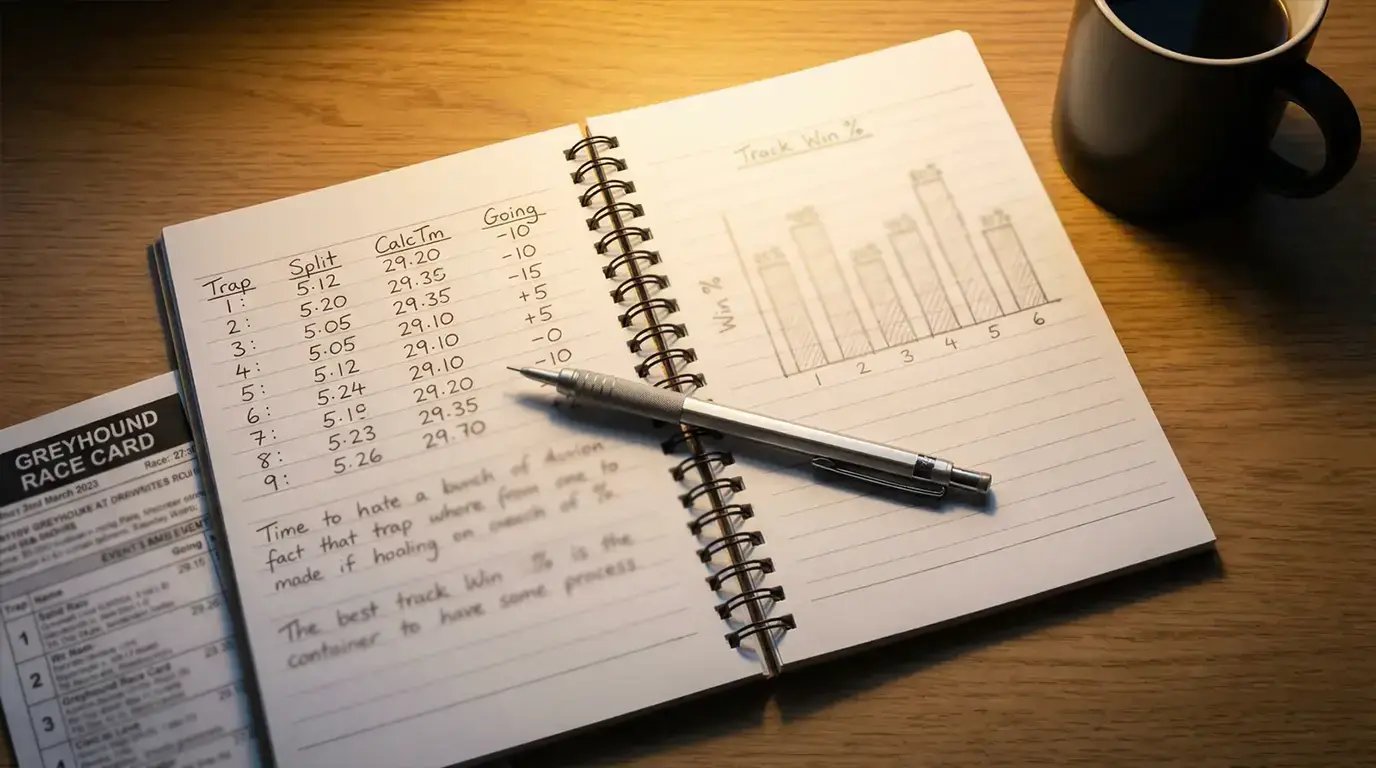
The first strategic principle is focus. Pick one track, learn it thoroughly, and resist the temptation to bet on every meeting. Dogs in the UK grading system race almost exclusively at their home track. A punter who knows Monmore — its rail bias, its sand conditions, which trainers are in form — will consistently outperform a punter who spreads bets across five tracks they barely understand.
The second principle is form depth. Study the last six runs, not just the last result. Look for patterns: is the dog improving or declining? Does it consistently show early pace? How does it perform from different traps? Has its weight been stable? A dog that has run 29.80, 29.65, 29.50 over its last three outings at the same distance is on an improving trajectory — that matters more than any single finishing position.
The third principle is value. Every bet should be placed because you believe the probability of the outcome exceeds what the odds imply. A dog at 4/1 has an implied probability of 20%. If your analysis suggests a 30% chance of winning, that is a value bet. If it suggests 15%, walk away. Price determines whether a bet is worth making.
Do
- Focus your analysis on one or two tracks where you can build genuine knowledge.
- Study the last six runs for each dog, not just the most recent result.
- Check weight changes between runs — a shift of more than 0.5 kg warrants attention.
- Use Best Odds Guaranteed whenever available to protect your early prices.
- Record every bet, track your profit and loss by track, and review monthly.
Don't
- Bet on every race at a meeting — selectivity is a strategic weapon, not a weakness.
- Ignore trap statistics, especially at tracks with known inside or outside bias.
- Chase losses by increasing stakes after a bad run of results.
- Rely on dog names, colours, or hunches as the basis for a wager.
- Assume that today's favourite is tomorrow's certainty — form in greyhound racing is volatile.
Trap Bias and Track-Specific Data
Trap bias is not a theory — it is arithmetic, and the data is freely available. Every GBGB track produces trap-by-trap win statistics, and services like Greyhound Data compile them into searchable databases. In a perfectly fair six-trap race, each trap would win approximately 16.7% of the time. In practice, no track is perfectly fair. Most UK circuits are left-handed ovals, which gives the inside traps — particularly Trap 1 — a natural advantage on the first bend. At some tracks, Trap 1 wins upwards of 25% of graded races. At others, the bias is less pronounced or shifts towards the middle or wide traps.
What constitutes an actionable bias? A deviation of five percentage points or more from the expected 16.7% over a sample of at least one hundred races at the same distance. Smaller samples are noise, not signal. Larger samples, filtered by distance and grade, reveal structural advantages worth incorporating into your selection process.
Track-specific knowledge matters because bias changes. Tracks re-sand their surfaces, adjust rail positions, and alter maintenance routines. A trap bias that held for two years can vanish after a resurfacing. The 2026 GBGB open race calendar features 50 category one and 27 category two competitions spread across multiple venues — each of those tracks has its own trap profile, and treating them as interchangeable is a shortcut to losing money.
Reading the Going and Weather Conditions
Track conditions in UK greyhound racing are described as fast, normal, slow, or wet, depending on the state of the sand surface. The going is affected by temperature, rainfall, humidity, and the time elapsed since the last maintenance. Fast going (hot, dry conditions) produces harder sand and quicker times. Slow going (cold, wet conditions) produces heavier sand and slower times. Wet going, after significant rainfall, can transform a race entirely.
Different running styles respond differently to conditions. Front-runners tend to perform best on fast ground, where the hard surface suits explosive early speed. Closers and wide runners often fare better on slower ground, where stamina matters more. This is not absolute, but it is a pattern borne out over large samples.
Checking the weather forecast before placing a bet is due diligence. A winter evening meeting will run on going that bears no resemblance to a midsummer BAGS card at the same track. The going adjustment on the race card tells you what conditions were like in the dog's previous run; comparing that to tonight's expected going tells you whether conditions suit.
UK Greyhound Tracks: Where the Dogs Run
Fewer than twenty tracks across England — and each one runs differently. That is not a quirk; it is a fundamental feature of UK greyhound racing. The circuit has contracted sharply from more than seventy licensed stadiums in the post-war era to the 18 GBGB-licensed stadia operating today. Three tracks closed in 2025 alone, and with Wales advancing legislation to ban greyhound racing entirely — the Prohibition of Greyhound Racing (Wales) Bill is currently progressing through the Senedd — the number may shrink further. But the tracks that remain offer a concentrated, knowable market for bettors willing to specialise.
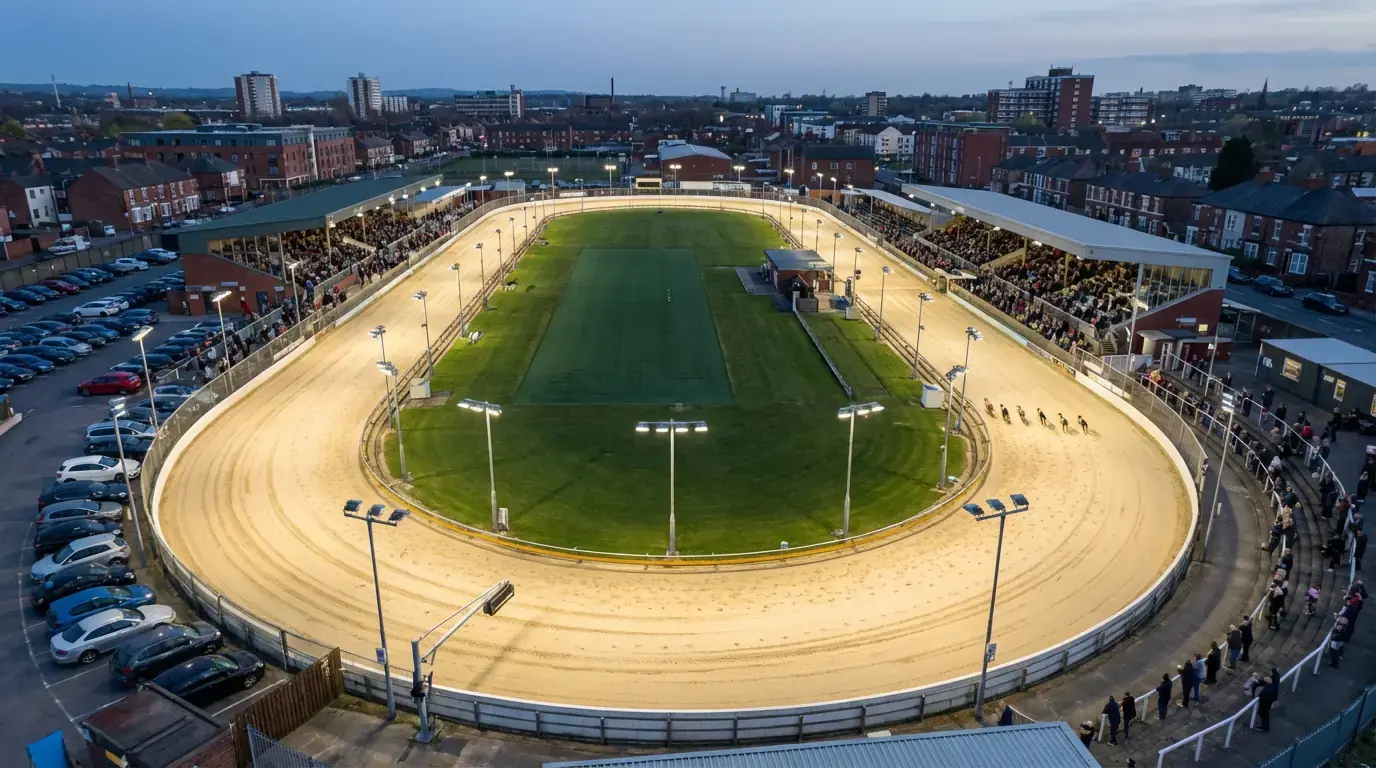
Each stadium has its own dimensions, trap configuration, sand composition, and racing character. A sprinter that dominates at Romford may struggle around the wider bends of Towcester. A wide runner that thrives at Sheffield may find a right-handed track an entirely different challenge. Understanding the physical characteristics of a track is not an optional extra — it is a prerequisite for serious form analysis.
Romford
Location: East London. Distances: 225m, 400m, 575m. A tight, fast circuit that favours early-pace dogs and railers. Regular evening and BAGS meetings make it one of the busiest tracks in the country. Strong trap 1 bias at sprint distance.
Towcester
Location: Northamptonshire. Distances: 260m, 480m, 500m, 655m, 686m, 906m. Home of the English Greyhound Derby and one of the few venues that hosts eight-dog races for select open events. Wide sweeping bends and a long run-in suit stamina dogs and finishers.
Hove
Location: Brighton, East Sussex. Distances: 285m, 500m, 695m, 880m. Premier evening cards and strong open-race programme. A well-maintained track with balanced trap statistics and a reputation for competitive graded fields.
Monmore Green
Location: Wolverhampton, West Midlands. Distances: 264m, 480m, 630m, 840m. A versatile circuit with a full range of distances. Popular for BAGS meetings and open races. Competitive middle-distance cards where form tends to hold up.
Sheffield (Owlerton)
Location: Sheffield, South Yorkshire. Distances: 280m, 480m, 660m, 900m. A wide track that accommodates all running styles. Known for a lively evening atmosphere and some of the best stayers' events on the circuit.
Dunstall Park
Location: Wolverhampton, West Midlands. Opened September 2025 as the successor to Perry Barr, which closed in August 2025 after nearly a century of racing in Birmingham. A newly built greyhound track situated within Wolverhampton Racecourse, operated by Arena Racing Company. Hosts classic events including the St Leger and the Laurels.
Beyond these six, the circuit includes Nottingham, Sunderland, Newcastle, Kinsley, Doncaster, Central Park (Sittingbourne), Yarmouth, Oxford, and others. Crayford and Swindon both closed in 2025, joining a growing list of lost venues. Each remaining track has its own personality. The practical lesson for bettors is straightforward: pick one or two, study them properly, and let the rest go. Breadth of coverage is the enemy of depth, and depth is what produces profitable betting.
Responsible Gambling and the Greyhounds
The dogs do not care whether you win — and your bankroll should not depend on whether they do. This section is not a lecture, and it is not filler. It is a practical framework for keeping greyhound betting within the bounds of entertainment rather than letting it become a problem.
Start with a bankroll: a fixed sum of money that you can afford to lose entirely. Not money you need for rent, bills, or groceries — money that, if it disappeared tonight, would not change your life. From that bankroll, stake between 1% and 2% per bet. On a 200-pound bankroll, that is 2 to 4 pounds per wager. This sounds small, and it is meant to. Small stakes over a large number of bets is the only approach that gives you enough runway to ride out losing streaks — and in greyhound racing, losing streaks are not exceptional, they are routine.
Track your bets. Every single one. Record the date, track, race, dog, trap, bet type, odds, stake, and result. At the end of each month, review the numbers. Are you profitable? If so, at which tracks and with which bet types? If not, where are the losses concentrated? Honest self-assessment is uncomfortable, which is why most punters avoid it — and why the ones who do it tend to survive longer.
Recognise the warning signs. If you are increasing stakes to recover losses, betting on races you have not analysed, borrowing money to gamble, or finding that betting is affecting your relationships, sleep, or mood, those are not signs of bad luck — they are signs that gambling has stopped being entertainment. The UK has well-established support infrastructure for problem gambling. GambleAware provides advice and support. The National Gambling Helpline (0808 8020 133) offers confidential assistance. GAMSTOP allows you to self-exclude from all UK-licensed online gambling sites in a single step.
Important: All UK-licensed bookmakers are required by the Gambling Commission to offer deposit limits, loss limits, reality checks, and self-exclusion tools. These are not suggestions — they are regulatory requirements. If greyhound betting stops being entertainment, use them. They exist because the industry recognises that some people need a structural barrier between impulse and action.
A note on greyhound welfare. GBGB tracks operate under rules that mandate injury reporting, veterinary oversight, and retirement planning for racing dogs. The Greyhound Commitment, introduced in 2018, set welfare standards including compulsory rehoming efforts for retired racers. The Welsh ban debate and similar discussions in Scotland reflect genuine public concern about animal welfare in racing. The regulatory framework exists, welfare reporting is mandatory at licensed tracks, and the debate is ongoing.
Frequently Asked Questions About UK Dog Track Betting
How many dogs run in a UK greyhound race?
Six dogs per race is the standard at all GBGB-licensed tracks in Britain. Each dog wears a colour-coded jacket corresponding to its trap number: red (1), blue (2), white (3), black (4), orange (5), and black with white stripes (6). Towcester is a notable exception, occasionally running eight-dog fields for select open race events, including the English Greyhound Derby. The six-dog format keeps fields compact and race cards readable, which is one of the reasons greyhound form analysis can be more precise than in larger-field horse racing.
What is the best trap position in greyhound racing?
Trap 1 historically wins between 25% and 33% of graded races at UK tracks, making it statistically the most advantageous position. The reason is straightforward: on left-handed oval circuits, the inside trap gives the shortest route to the first bend and the rail. However, trap bias is not uniform. It varies by track, by distance, and by the running styles of the dogs in each specific race. A strong wide runner drawn in Trap 6 at a track with generous bends can overcome the inside-trap advantage. The data matters more than the generality — always check trap statistics for the specific venue and distance before factoring position into your analysis.
Can you bet on greyhounds online in the UK?
Yes. All major UK-licensed bookmakers offer greyhound betting markets, covering both evening meetings and daytime BAGS races. Online platforms provide live streaming of most UK and Irish meetings, early prices, Best Odds Guaranteed promotions, and the full range of bet types including win, place, each-way, forecasts, tricasts, and tote pools. Tote pool betting is also available through selected online operators. To bet legally on greyhounds online in the UK, you need an account with a bookmaker licensed by the UK Gambling Commission.
The Rail and the Long Run
Greyhound racing in Britain turned one hundred years old in 2026 — a century since the first modern meeting at Belle Vue, Manchester, in 1926. The sport that once filled seventy stadiums and drew post-war crowds second only to football now operates from fewer than twenty venues, many of them running behind closed doors for an audience of cameras and betting terminals. That contraction is real, and it would be dishonest to pretend otherwise.
But there is a paradox in the decline. Fewer tracks means a more concentrated product. The dogs that race at the remaining GBGB stadiums are better monitored, better documented, and produce more accessible data than at any point in the sport's history. Digital race cards, split-time databases, and trap statistics are available to anyone with a phone and ten minutes of patience. The information asymmetry that once favoured kennel insiders and trackside regulars has narrowed. The tools are there. The question is whether you use them.
Everything in this guide points to the same conclusion: greyhound betting rewards specificity over volume. The punter who knows one track cold — its trap biases, its going patterns, its trainers, its grading quirks — will always outperform the one who bets ten meetings blind. That is not a guarantee of profit; nothing in betting is. But it is the only approach that gives you a genuine edge over the bookmaker, who prices greyhound markets with less precision than most bettors assume.
A hundred years of floodlit sand, and the rail still favours the prepared. Whether you are watching from the stands at Towcester on Derby night or following a BAGS card on your phone during a lunch break, the fundamentals do not change. Read the form. Study the trap data. Understand what you are betting and why. And if you are going to lose money — as most people do, most of the time — at least lose it with your eyes open.
