Best Greyhound Betting Sites – Bet on Greyhounds in 2026
Loading...
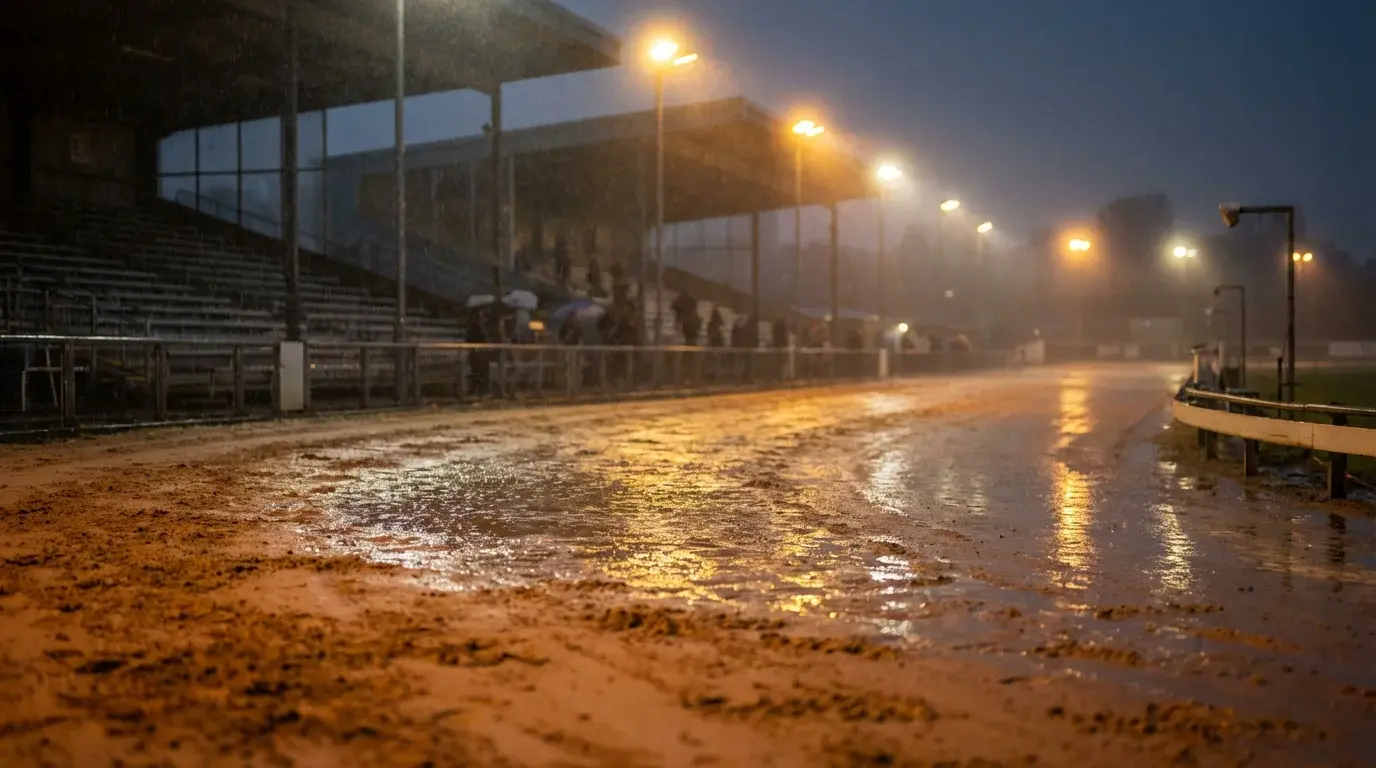
Every greyhound track in the UK is outdoors, and every racing surface is sand. That combination makes weather one of the most direct and measurable influences on race outcomes. A track that runs fast on a dry summer evening behaves differently when it is waterlogged in February. The same dog on those two surfaces is, for betting purposes, almost a different animal. Yet most casual bettors place their wagers without checking the forecast or understanding what a going adjustment on the race card actually tells them.
Weather is not a secondary factor in greyhound racing. It is a variable that changes the speed of the track, the advantage of certain running styles, and the reliability of form data. Bettors who account for it gain an edge over those who treat every race as if conditions are neutral.
Going Conditions: Fast, Normal, Slow, Wet
UK greyhound tracks categorise their surface conditions using a going scale that reflects how the sand is running on any given race day. The categories, from fastest to slowest, are Fast, Normal, Slow, and Wet. These correspond to the physical state of the track surface, which is primarily determined by temperature, rainfall, and the track maintenance performed before the meeting.
Fast going occurs in warm, dry conditions, typically during summer months or on dry winter evenings when the sand has been compacted by maintenance rolling. The surface is firm and provides excellent grip. Dogs can reach higher top speeds and maintain them through bends with less effort. Race times on fast going are shorter, and track records are most likely to be broken in these conditions. The going adjustment on the race card, shown as a positive number (e.g., +0.30), indicates that the surface is running faster than the standard baseline.
Normal going represents the baseline condition against which all going adjustments are measured. It indicates a surface that is neither unusually fast nor unusually slow. The going adjustment is zero or close to it. Form recorded on normal going is the most transferable across race days because it represents the track at its expected standard.
Slow going occurs in cold, wet conditions. Rain softens the sand, making it heavier and reducing the grip available to the dogs. Race times increase, and dogs that rely on explosive acceleration are at a disadvantage because the surface absorbs more energy with each stride. The going adjustment is shown as a negative number (e.g., -0.40), indicating that the surface is running slower than baseline. In extreme wet conditions, the going may be classified as Wet or Heavy, meaning the track is waterlogged or close to it. Meetings can be abandoned if conditions deteriorate beyond a safe threshold.
The going is assessed before the meeting begins and may be revised during the card if conditions change, such as rain starting mid-meeting. Bettors should check the going report as close to race time as possible rather than relying on a morning assessment that may have been overtaken by afternoon weather.
How Weather Changes Running Styles
Different running styles thrive in different conditions. This is the central reason weather matters for betting: it does not just make races faster or slower, it shifts the competitive balance between dogs with different physical attributes and racing preferences.
On fast ground, early-pace dogs and railers have an amplified advantage. The firm surface rewards quick acceleration out of the traps and provides the grip needed to hold position on the inside rail through bends. Dogs that lead from the front are harder to catch on fast going because the surface allows them to maintain their speed without tiring as quickly. If a dog shows consistently strong split times and early-pace remarks in its form (QAw, EP, Ld), fast going enhances its chances.
On slow or wet going, the advantage shifts toward finishers and dogs that run from behind. The heavier surface penalises early speed more than sustained effort. Dogs that burn energy getting to the front may tire earlier because each stride costs more on a sodden track. Meanwhile, dogs that settle into a rhythm and close in the final straight can capitalise on the leaders’ fatigue. Wide runners also fare better in wet conditions because the outside of the track is often less churned up than the inside rail, where the majority of the field has already run.
Stayers, dogs that race over 630 metres and beyond, generally cope better with slow going than sprinters. Their physiology is built for sustained effort, and the heavier surface does not penalise them as severely. Sprinters, who depend on explosive power over a short distance, lose a proportionally larger amount of their advantage on slow going because the first few strides, which are the most energy-intensive, are the most affected by a soft surface.
Weight also interacts with going. Heavier dogs may handle wet conditions better because their power-to-weight ratio is suited to driving through soft ground. Lighter dogs, while faster on firm surfaces, can struggle for traction when the sand is loose or waterlogged. This is not an absolute rule, but it is a factor worth considering when evaluating a field on an afternoon where rain has been falling steadily.
Using Going Adjustments in Form Analysis
The going adjustment, printed on every race card next to each dog’s recent runs, is a correction factor applied to the winning time to account for track conditions. A positive adjustment means the surface was fast and the raw time was quicker than it would have been on normal going. A negative adjustment means the surface was slow and the raw time was slower. The calculated time (CalcTm) on the race card is the winning time after the going adjustment has been applied, giving a normalised figure that allows comparison across different race days.
This normalisation is essential for accurate form analysis. Without it, you might look at a dog’s last six runs and see a time of 29.50 seconds on one day and 30.10 on another, and conclude the dog was half a second slower. In reality, the slower time might have been run on heavy going with a -0.50 adjustment, meaning the calculated time is 29.60, almost identical to the faster run. The going adjustment reveals that the dog’s actual performance was consistent. The raw time difference was caused by the surface, not the dog.
When comparing dogs in an upcoming race, use calculated times rather than raw times. This gives you a like-for-like comparison that strips out the going variable. If two dogs have similar CalcTm figures over the same distance at the same track, they are comparable runners regardless of whether their times were recorded on fast or slow going. If one dog’s CalcTm is consistently half a second faster than the other’s, that difference reflects genuine ability rather than surface conditions.
There is one caveat. Going adjustments normalise for overall track speed but do not capture the differential effect of conditions on different running styles. A going adjustment of -0.40 tells you the track was slow, but it does not tell you that finishers gained an extra advantage or that railers were disproportionately penalised. You need to assess that qualitative dimension separately by looking at the type of dogs that won and placed on the same card. If the race card for a meeting shows that railers dominated every race, the going was likely fast regardless of the precise numerical adjustment. If finishers and wide runners feature prominently in the results, the conditions were probably softer than the number alone suggests.
Checking Conditions Before You Bet
The going is publicly available information, and checking it is a minor habit that pays disproportionate dividends. Most bookmaker apps and racing data sites display the going report for each meeting as part of the race card information. The report is typically published a few hours before the meeting and updated if conditions change.
Beyond the official going report, check the weather forecast for the track location. If rain is expected during the meeting, conditions may deteriorate from the first race to the last. A meeting that starts on normal going may be running on slow going by the eighth or ninth race. If your bet is on a late race, the going at the time of the off may be different from the going reported before the first race. Adjusting your assessment accordingly, particularly for dogs whose form is heavily skewed toward one type of going, can be the difference between a profitable selection and a losing one.
Temperature matters too, especially in winter. A track that was waterlogged during the day may freeze overnight, creating a hard and fast surface for an evening meeting. Conversely, a warm day following overnight frost can produce a surface that is fast early and slows as the frost melts and moisture seeps in. These transitions are not always captured in the going report, particularly if the report was compiled before conditions fully settled.
The most disciplined approach is to develop a simple pre-bet checklist that includes the going report and the local weather forecast alongside your form analysis. If the going favours your selection’s running style, that is a positive factor. If it works against it, you either adjust your confidence level, reduce your stake, or skip the race entirely. Weather is not the only variable that determines a race outcome, but it is one of the few you can assess objectively before the traps open, and ignoring it is a choice that costs money over time.