 Available in US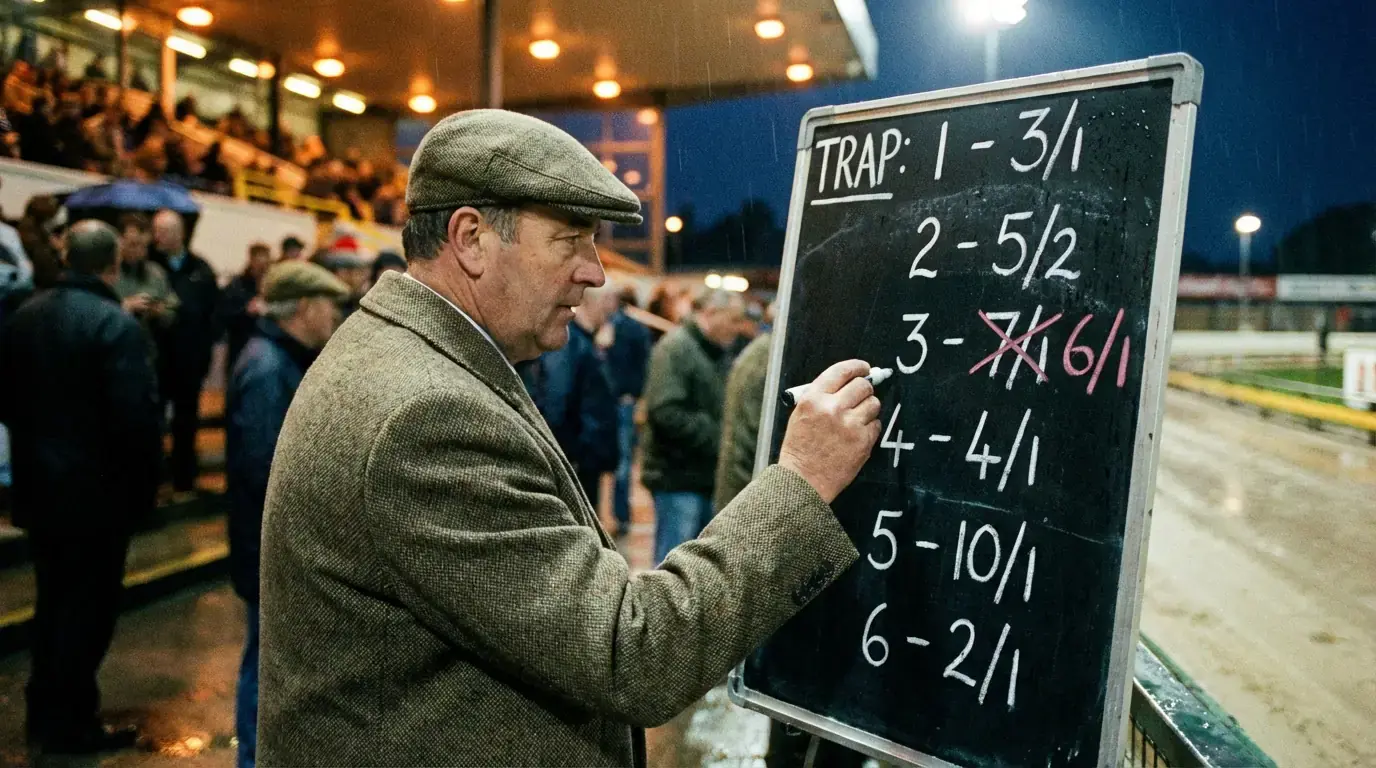
Starting Price is the official price at which every dog in a race begins the contest, and it arrives late. In horse racing, the SP is the culmination of a betting market that has been active for hours or even days. In greyhound racing, the market is compressed. Early prices are published hours before the off, but the SP is determined in the final minutes, sometimes the final seconds, before the traps open. That compressed timeline changes how SP works, what it represents, and how bettors should use it.
SP is not just a number on a result slip. It is the market’s final consensus on each dog’s chances, arrived at under time pressure and with limited liquidity. Understanding how that consensus forms, and where its weaknesses lie, is a practical advantage for any greyhound bettor.
How SP Is Determined at UK Tracks
At GBGB-licensed greyhound meetings, the Starting Price is derived from the prices offered by on-course bookmakers at the moment the race begins. An independent SP compiler assesses the available prices on the bookmaker boards at the track and determines the official SP for each runner. This is the same basic process used in horse racing, adapted for the greyhound environment.
The critical difference is timing. Horse racing SPs reflect a market that builds over an extended betting period, with substantial money flowing in from both on-course and off-course bettors. Greyhound SPs reflect a market that forms quickly and with less total money. On-course bookmakers at greyhound meetings typically put up their boards just a few minutes before the off. The betting window is short, the money is thinner, and the prices are more susceptible to late movements.
This means greyhound SPs can be more volatile than horse racing SPs. A dog might be priced at 4/1 by online bookmakers three hours before the race, but the on-course bookmakers may open it at 5/1 or 3/1 based on the money they see in the final minutes. A single large bet placed on-course can move the SP noticeably in a greyhound race, in a way that the same bet would barely register in a major horse racing market. This volatility is both a risk and an opportunity. It is a risk because SP is less predictable. It is an opportunity because SP mispricings are more common.
At behind-closed-doors meetings, where there is no on-course public and no trackside bookmakers in the traditional sense, the SP mechanism works differently. The prices are typically determined by the betting activity on online platforms rather than a physical bookmaker board. The same principle applies — the SP reflects the market at the time of the off — but the composition of that market is exclusively online rather than a blend of on-course and off-course money.
Early Price vs Starting Price: The Trade-Off
Taking an early price means committing to a specific set of odds before the race. The advantage is certainty. You know exactly what you will be paid if the dog wins. The disadvantage is that the price might drift before the off, meaning you accepted a shorter price than was ultimately available. Conversely, the price might shorten, meaning you locked in a better price than the SP. Without Best Odds Guaranteed, early-price betting is a bet within a bet: you are wagering on the outcome of the race and, implicitly, on the direction of the price movement.
Betting at SP means accepting whatever price is declared at the off. The advantage is that you avoid committing to a price that might not represent fair value. The disadvantage is that you surrender any opportunity to lock in a generous early price before the market moves against you. If a dog is available at 6/1 in the morning and shortens to 3/1 by the evening, an SP bettor receives 3/1. An early-price bettor who took 6/1 in the morning receives 6/1, regardless of the SP.
The trade-off is sharpest in greyhound racing because the early market and the SP can diverge more than in other sports. A dog’s early price is set by bookmaker traders based on form analysis, grade, trap draw, and an estimate of likely market interest. The SP is set by actual money. If the traders’ estimate of market interest was wrong, the gap between early price and SP can be wide. Dogs that attract unexpected late support shorten dramatically. Dogs that fail to attract interest drift beyond their opening price.
For bettors with access to BOG, this trade-off is largely resolved: take the early price and let the promotion handle any drift. For bettors without BOG on a specific meeting, the decision is more nuanced. If your analysis suggests the dog is fairly priced or overpriced at the early stage, taking the early price makes sense. If you believe the market has not yet fully assessed the field and the SP may offer a better picture, waiting is reasonable. The risk of waiting is that the price shortens and you receive worse odds. The risk of betting early is that the price drifts and you receive worse odds. Neither approach dominates in all conditions.
SP on BAGS Meetings and Behind-Closed-Doors Racing
BAGS meetings, run behind closed doors without spectators, represent a significant portion of the daily UK greyhound schedule. These meetings exist primarily to provide content for bookmaker markets and live streaming. There is no trackside crowd, no on-course bookmaker boards in the traditional sense, and the atmosphere is entirely commercial rather than sporting. The important question is how the SP is formed in this environment.
On BAGS meetings, the SP is typically derived from the online betting market rather than on-course boards. This means the SP reflects the aggregate activity of online bettors on the major bookmaker platforms. The pool of money shaping the price is different in character: it is predominantly recreational rather than a mix of recreational and professional. Fewer sharp punters focus on afternoon BAGS cards compared to evening open meetings, and the total volume of money is lower.
Lower volume means less price efficiency. SPs on BAGS meetings can be less accurate reflections of true probability than SPs on high-profile evening cards. This is not because the mechanism is flawed, but because the market has less information priced into it. A dog that would be 3/1 at a well-attended evening meeting might be 4/1 or 5/2 at a BAGS meeting depending on how the limited money flows. For anyone who does their form analysis thoroughly, BAGS meetings offer more frequent mispricings than prestige events.
Some bookmakers do not offer early prices on all BAGS meetings. When only SP is available, you have no choice but to accept whatever the market delivers at the off. In this case, monitoring the indicative prices as they develop can give you a sense of where the SP is likely to land, but there are no guarantees. Late money on BAGS meetings can move the SP significantly in either direction because the pool is small enough for individual bets to have a visible impact.
Why SP Knowledge Gives You an Edge
SP is the reference point against which all greyhound bets are ultimately measured. Whether you bet at early prices, at SP, or through the tote, the Starting Price defines the market’s final view on each dog’s chances. Understanding how that view is formed, and where it is likely to be wrong, is a structural advantage.
The bettors who consistently profit from greyhound racing tend to share one characteristic: they have an opinion on each dog’s true probability that differs from the market’s opinion, and they act on it before the SP is finalised. When that opinion is correct more often than it is wrong, the result is a positive long-term return. SP knowledge helps in two ways. First, it helps you identify when to bet early versus at SP based on the likely direction of price movement. Second, it helps you evaluate your own performance by comparing your selections’ early prices and SPs to their actual finishing positions over time.
Keeping a simple record of the early price you took, the SP at the off, and the result gives you a dataset that reveals whether you are systematically beating the market or being beaten by it. Over 100 or more bets, the pattern becomes clear. If your selections consistently start at a higher SP than the price you took, you are identifying value that the market eventually agrees with. If the opposite is true, your analysis is either too early in the cycle or out of step with the market’s assessment. Either way, the SP is the benchmark, and knowing how to read it is not academic. It is the measure of whether your betting is working.
