Best Greyhound Betting Sites – Bet on Greyhounds in 2026
Loading...
Every greyhound track has a personality, and trap bias is its most measurable trait. At some venues, Trap 1 wins a third of all races. At others, the outside draws hold their own. These are not random fluctuations. They are structural features built into the geometry of each circuit — the tightness of the bends, the length of the run to the first turn, the camber of the track surface. Trap bias exists because tracks are not symmetrical experiences for dogs starting from different positions, and any bettor ignoring it is ignoring one of the few genuinely quantifiable edges in the sport.
The data is available. The question is whether you use it properly or whether you let it mislead you into false confidence.
What Trap Bias Is and Why It Exists
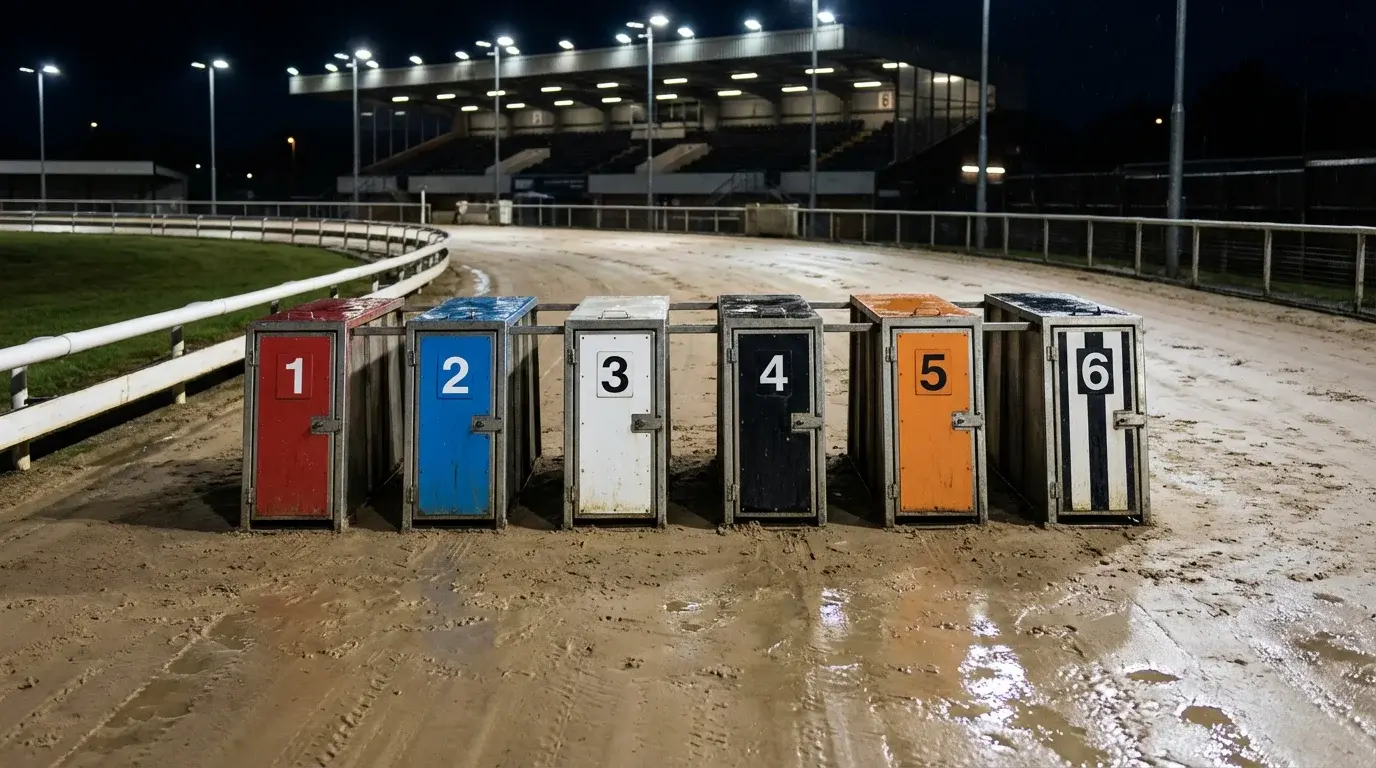
In a perfectly neutral six-dog race, each trap would win approximately 16.7 percent of the time. In reality, no track produces anything close to that distribution. Trap 1, the innermost position closest to the rail, consistently outperforms the theoretical average at virtually every UK venue. The reason is geometric. The inside runner covers the shortest distance around every bend. On an oval track with two bends per lap, that distance saving accumulates. A dog in Trap 1 that secures the rail early runs a shorter race than a dog in Trap 6 that runs wide through both turns.
The magnitude of this advantage depends on the track’s physical layout. Tracks with tight, sharp bends amplify the inside advantage because the difference in distance between the rail and the outside is greater on a tight curve than on a sweeping one. Tracks with longer straights and wider bends dilute it, giving outside runners more time and space to compensate. The distance from the traps to the first bend also matters. A short run-in means the field arrives at the first turn bunched together, with inside dogs already in position. A longer run-in allows faster dogs from wider traps to establish position before the first bend, reducing the inside advantage.
Track surface and maintenance play a role too. If the inside rail is consistently faster or slower due to how the sand is raked and watered, that creates a secondary bias independent of geometry. Some tracks develop a faster strip along the inside because it receives less traffic and remains more compacted. Others see the inside churn up more quickly, especially in wet conditions, reducing the rail advantage as the meeting progresses.
Track-by-Track Trap Win Rates
The numbers tell different stories at different venues, and treating all tracks as interchangeable is one of the most common errors in greyhound betting.
At tighter tracks like Crayford and Romford, Trap 1 win rates historically sit between 25 and 33 percent over standard distances. That is roughly double what random chance would predict. Trap 2 typically comes next, with win rates in the low twenties. The outside traps, particularly Trap 5 and Trap 6, win noticeably less often, sometimes dropping below 12 percent. At these venues, the inside bias is strong enough to be a primary factor in race assessment. A moderate dog drawn in Trap 1 at Crayford is a more serious contender than the same dog drawn in Trap 6.
At wider, more galloping tracks like Nottingham and Towcester, the distribution is flatter. Trap 1 still wins more often than the theoretical average, but the gap narrows. Win rates across all six traps might range from 14 to 22 percent rather than the 10 to 33 percent spread seen at tighter circuits. At these tracks, form and fitness matter more relative to trap draw, and outside runners can compete without a structural handicap.
Distance also modifies trap bias within the same track. Sprint races typically show a stronger inside bias than standard or stayers’ distances because the race is shorter and there is less time for positional changes. A dog drawn wide in a 270-metre sprint has almost no opportunity to recover from a slow start or a wide run through the first bend. Over 680 metres, the additional bends and distance give wide runners more chances to find a racing line and make up ground.
The data is publicly accessible through racing statistics sites and track-specific results archives. Building a simple spreadsheet of win percentages by trap number at your most-betted tracks, broken down by distance, takes a few hours of work and produces a reference that informs every bet you place at that venue. It is one of the highest-return investments of time available to a greyhound bettor.
How to Analyse Trap Data Without Overfitting
The danger with trap bias statistics is the same danger that afflicts any small-sample analysis: you see patterns that are not really there. A track might show Trap 3 winning 28 percent of sprint races over a two-month window, and a bettor might conclude that Trap 3 has a hidden advantage at that distance. In reality, the sample might contain 40 races, meaning Trap 3 won 11 of them. That is not a statistically significant deviation from the expected rate. It is noise.
Reliable trap bias analysis requires a meaningful sample size. As a working threshold, you need at least 200 races at a given distance before the win percentages by trap become reasonably stable. Below that, individual results — a particularly strong dog happening to be drawn in Trap 4 for three consecutive meetings — can distort the picture. The more races in your dataset, the more the random variation washes out and the structural bias emerges.
Time frame matters too. Tracks undergo maintenance, surface changes, and configuration adjustments. A trap bias measured over the last five years may not reflect the current state of the track if the surface was relaid or the bends were modified two years ago. The most useful data is recent enough to reflect current conditions but large enough to be statistically meaningful. A rolling 12-month window of results, updated monthly, strikes a practical balance for most bettors.
Another common error is applying track-wide trap bias to every race without considering the specific field. Trap bias tells you that Trap 1 wins more often than Trap 6 across all races at a given track. It does not tell you that Trap 1 will win this specific race. If the Trap 1 dog is a slow breaker with a wide running style while the Trap 5 dog is a fast-breaking railer, the structural advantage of Trap 1 is partly or fully negated by the mismatch between the dog’s style and its draw. Bias is a population-level statistic. It increases probability, not certainty.
Integrating Trap Bias Into Your Selections
Trap bias is most powerful as a tiebreaker and a filter, not as a standalone selection method. If you have two dogs in a race that your form analysis rates equally, and one is drawn in Trap 1 at a track with a strong inside bias while the other is in Trap 5, the bias tips the balance toward Trap 1. That is a legitimate and data-supported use of the statistic. Backing Trap 1 in every race regardless of the dog’s form, speed, or running style is not a strategy. It is a lottery with slightly better odds on one number.
The most effective approach combines trap bias with running style analysis. A dog that is a natural railer (form shows Rls or RlsRn) drawn in Trap 1 or Trap 2 at a track with a strong inside bias is in the optimal position. Its natural tendency and its trap draw are aligned, and the track geometry supports both. This is a selection where three independent factors point in the same direction, which is as close to a reliable edge as greyhound betting gets.
Conversely, a natural railer drawn in Trap 6 at a tight track faces a compounding disadvantage. It needs to cross five rivals to reach the rail, losing ground on every bend until it gets there. At a tight track where inside position is critical, this is a significant negative. The dog might still win if it is substantially better than the rest of the field, but the draw is working against its preferred style and the track is amplifying the penalty. In this scenario, trap bias is telling you to be cautious, not to rule the dog out entirely, but to adjust your confidence and possibly your stake.
For forecast and tricast betting, trap bias can help narrow the field of likely place finishers. If Trap 1 and Trap 2 win roughly half the races at a given track and distance, those traps are also disproportionately likely to finish in the first two places. Building forecasts around inside-drawn dogs at high-bias tracks is a systematic approach that the data supports over large samples.
The discipline is to let the statistics inform your thinking without replacing it. Trap bias is one input in a multi-factor assessment that includes form, going, distance, running style, and grade. When the bias aligns with your other analysis, bet with more confidence. When it conflicts, ask why and adjust accordingly. The numbers are real. The edge is real. But it is an edge, not a guarantee, and treating it as such is what separates useful analysis from superstition.