Best Greyhound Betting Sites – Bet on Greyhounds in 2026
Loading...
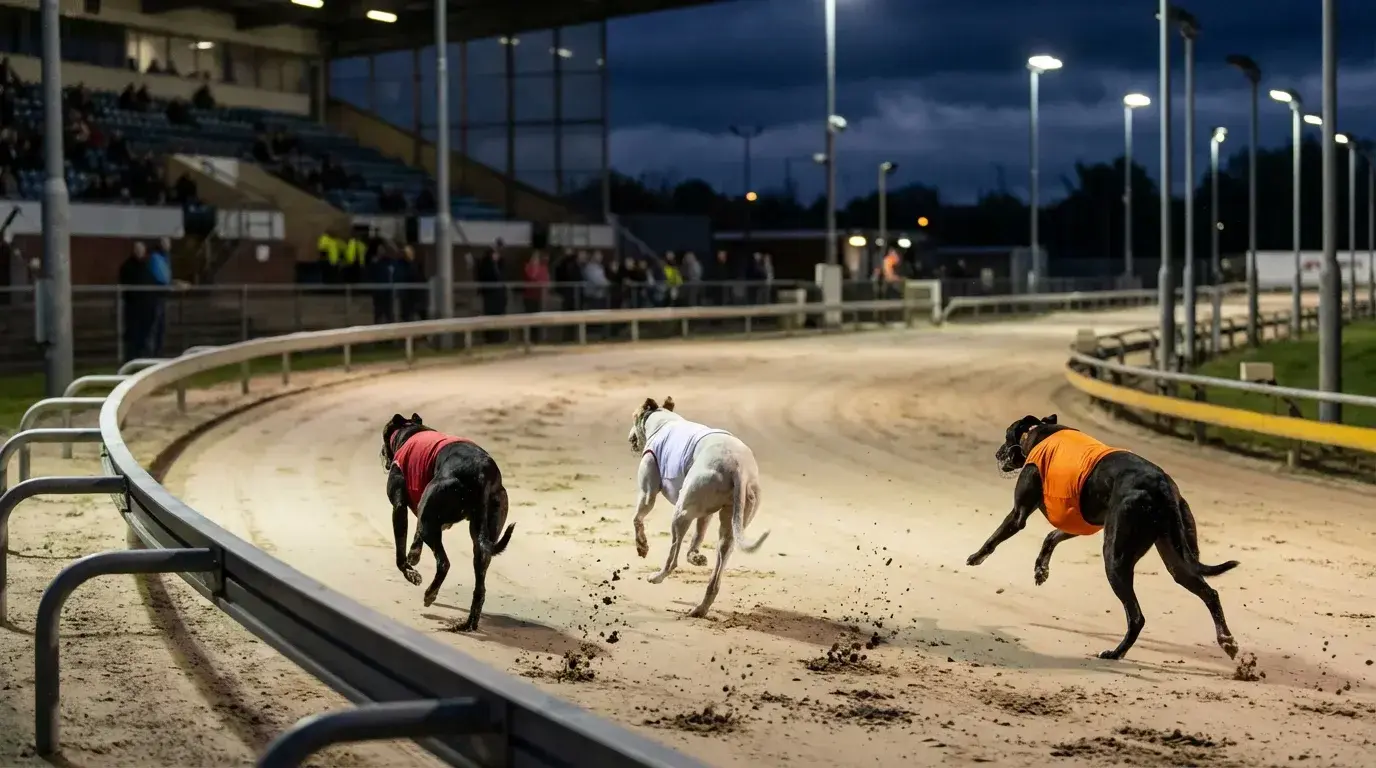
Every greyhound has a preferred way of running a race, and that preference is expressed through the line it takes around the track. Some dogs hug the inside rail, covering the shortest possible distance at the cost of being hemmed in by rivals. Others run wide, giving themselves space to accelerate but adding metres to every bend. A third group occupies the middle ground, literally and figuratively. These preferences are not random. They are ingrained tendencies shaped by the dog’s early training, its physical build, and its temperament under racing conditions.
Racing lines are recorded on every race card and visible in every replay. Understanding them transforms a race from a blur of coloured jackets into a tactical contest where position, line, and space determine the outcome as much as raw speed.
The Three Racing Lines
A greyhound track has three informal zones that dogs occupy during a race. The rails, the middle, and the wide. These are not marked lanes. Dogs move between them throughout a race depending on the pace, the positions of other runners, and the dog’s natural inclination. But most greyhounds show a clear preference for one zone over the others, and that preference is consistent enough to be a reliable form indicator.
Rails runners, marked Rls or RlsRn on the race card, race as close to the inside fence as possible. They cover the shortest distance around every bend, which is a meaningful advantage over 480 metres with two or more turns. The trade-off is that the rail is the most congested zone. If the dog immediately ahead slows, the railer has nowhere to go. It cannot move inside because the fence is there. Moving outside requires a sudden change of direction that costs momentum. Rails runners succeed when they have a clear run from the traps to the first bend and can maintain position without interference. They struggle when they are boxed in by a slower dog ahead or a faster dog alongside.
Wide runners, marked W or Wd, take the opposite approach. They run around the outside of the field, giving themselves space to accelerate without obstruction. The advantage is clear air. A wide runner is almost never blocked by another dog because there is nobody outside it. The disadvantage is distance. On every bend, the wide runner covers more ground than the railer. Over a standard race with two full bends, a consistently wide runner may travel three to five lengths further than a rails runner. That extra distance must be compensated by superior speed or stamina, and not every dog has the physical reserves to do it.
Middle runners, marked Mid, sit between the two extremes. They do not commit fully to the rail or the outside, instead finding a path through the field that balances distance with space. Middle runners are often the most adaptable dogs in a race. They can move inside if a gap opens or swing wide if the rail is blocked. The downside is that the middle of the track is the most tactically complex zone. A middle runner may find itself squeezed between a railer drifting out and a wide runner coming in, with limited room to maintain speed. Dogs that run well from the middle tend to be those with good racing intelligence — the ability to read the pack and find gaps without losing momentum.
How Track Shape Affects Running Lines
Not all tracks reward the same running style, and the physical configuration of the circuit determines which line is most advantageous.
Tight tracks with sharp bends amplify the rail advantage. The tighter the bend, the greater the distance difference between the inside and outside. At a track like Crayford, where the bends are tight and the straights are short, a railer covers noticeably less ground than a wide runner on every lap. The geometric advantage is so significant that rail position often overrides small differences in form and fitness. At these tracks, railers win disproportionately, and bettors should weight running line heavily in their analysis.
Wider, more galloping tracks with sweeping bends reduce the rail advantage. At Nottingham or Towcester, the bends are gentler and the straights are longer. The distance difference between rail and wide is smaller per bend, and the longer straights give wide runners more room to use their speed without the constant penalty of extra distance on the turns. At these venues, running line matters less relative to raw ability, and wide runners can compete on more equal terms with railers.
The run from the traps to the first bend is another track-specific factor. A short run-in means the field reaches the first bend quickly and in close formation. There is less time for dogs to sort themselves into their preferred lines, and the first bend becomes a crowded, competitive space where positional advantage is determined in fractions of a second. A long run-in gives dogs more time and distance to establish position before the first bend, reducing the intensity of first-bend crowding and allowing wider-drawn dogs to use their speed to compensate for their starting position.
Reading Racing Lines from Form
The race card tells you a dog’s running line preference through its comment abbreviations and, more importantly, through the consistency of those comments across multiple races. A single race where a dog ran wide tells you what happened that day. A pattern of Rls entries across six consecutive runs tells you who the dog is.
Look at the positional comments from the first bend onwards. If a dog shows Rls at the first bend, Rls through the back straight, and Rls at the final bend across most of its recent runs, it is a committed railer. This dog will attempt to secure the inside line regardless of its trap draw. From Trap 1 or 2, that is efficient. From Trap 5 or 6, it means the dog must cross the field early, losing ground and risking interference in the process.
A dog showing W or Wd at the first bend in most of its runs is a committed wide runner. The practical question with a wide runner is whether its speed compensates for the extra distance. Check the CalcTm. If a wide runner consistently posts CalcTm figures competitive with the railers in the same races, it has the engine to overcome the distance penalty. If its CalcTm is consistently a few tenths slower, the wide running is costing it races, and only a weaker field or ideal conditions will produce a win.
Mixed comments, where a dog shows Rls in some races and Mid or W in others, indicate an adaptable runner or one whose line is determined by circumstances rather than preference. These dogs are harder to predict because their running line depends on the pace, the trap draw, and the behaviour of the dogs around them. They are best assessed on a race-by-race basis, considering the specific trap draw and the running styles of the other five dogs in the field.
Race replays are the most reliable way to confirm a dog’s line preference. The abbreviations on the card are written by a steward or commentator in compressed shorthand. Watching the actual race shows you exactly where the dog ran, how it handled the bends, and whether it was pushed wide by rivals or chose the wide line voluntarily. If you are betting seriously on a dog whose line you are uncertain about, watching its last two or three replays takes five minutes and removes the ambiguity.
Matching Racing Lines to Track Conditions
Going conditions do not affect all running lines equally, and this asymmetry creates opportunities for bettors who account for it.
On fast going, the rail is at its most advantageous. The firm surface provides excellent grip, which means dogs can maintain speed around tight bends without losing traction. Railers benefit disproportionately because the inside line is already the shortest path, and fast going ensures they can exploit it at full speed without the surface working against them. Wide runners benefit less from fast going in relative terms because their extra distance is not compensated by any improvement in conditions — they are still running further.
On slow or wet going, the dynamics shift. The inside rail, particularly at tracks where the majority of the field runs close to the fence, can become churned up during a meeting. The sand is softer, the footing less secure, and the inside strip deteriorates faster than the middle or outside. By the later races on a wet card, the rail may actually be the slowest part of the track. Railers who depend on consistent footing find themselves struggling on a surface that has been cut up by the dogs in earlier races. Wide runners, running on less trafficked ground, may encounter a more intact surface.
This creates a specific betting angle: on wet-going cards, consider whether the race is early or late in the meeting. In the first few races, the rail is likely still in reasonable condition and railers retain their advantage. By race eight or nine, the inside may have deteriorated enough to shift the balance toward middle and wide runners. Checking the results of the earlier races on the card — did railers dominate or did wider runners start to prevail? — gives you a real-time read on how the surface is changing.
Weight interacts with running line on soft ground too. Heavier dogs running on the rail have more mass pressing into softer sand, which can slow them through the bends. Lighter dogs, particularly lighter bitches, may handle the inside on soft going more effectively because they press less deeply into the surface. This is a fine-grained factor that will not apply to every race, but on genuinely heavy going at a tight track, it is worth considering when two dogs with different weights and different running lines are otherwise closely matched on form.
The overarching principle is that a dog’s racing line is not fixed in value. Its advantage or disadvantage varies by track, by conditions, and by the specific field it faces. A railer is valuable at a tight track on fast going. The same railer is less valuable at a wide track on heavy going. The form card tells you the dog’s preference. The track and the weather tell you whether that preference will be rewarded today.