Best Greyhound Betting Sites – Bet on Greyhounds in 2026
Loading...
Betfair Exchange is a different animal from a traditional bookmaker, and greyhound betting on the exchange follows different rules, produces different dynamics, and rewards different skills. On a conventional bookmaker, you bet against the house. On the exchange, you bet against other punters. The bookmaker is removed from the equation entirely. Betfair acts as the platform, matching backers with layers and charging a commission on winning bets. The odds are set by the market participants, not by a trading team in an office.
This peer-to-peer structure creates opportunities that bookmaker markets do not offer, but it also introduces challenges — particularly in a sport where market liquidity is thinner than in horse racing or football.
How Betting Exchanges Work for Greyhounds
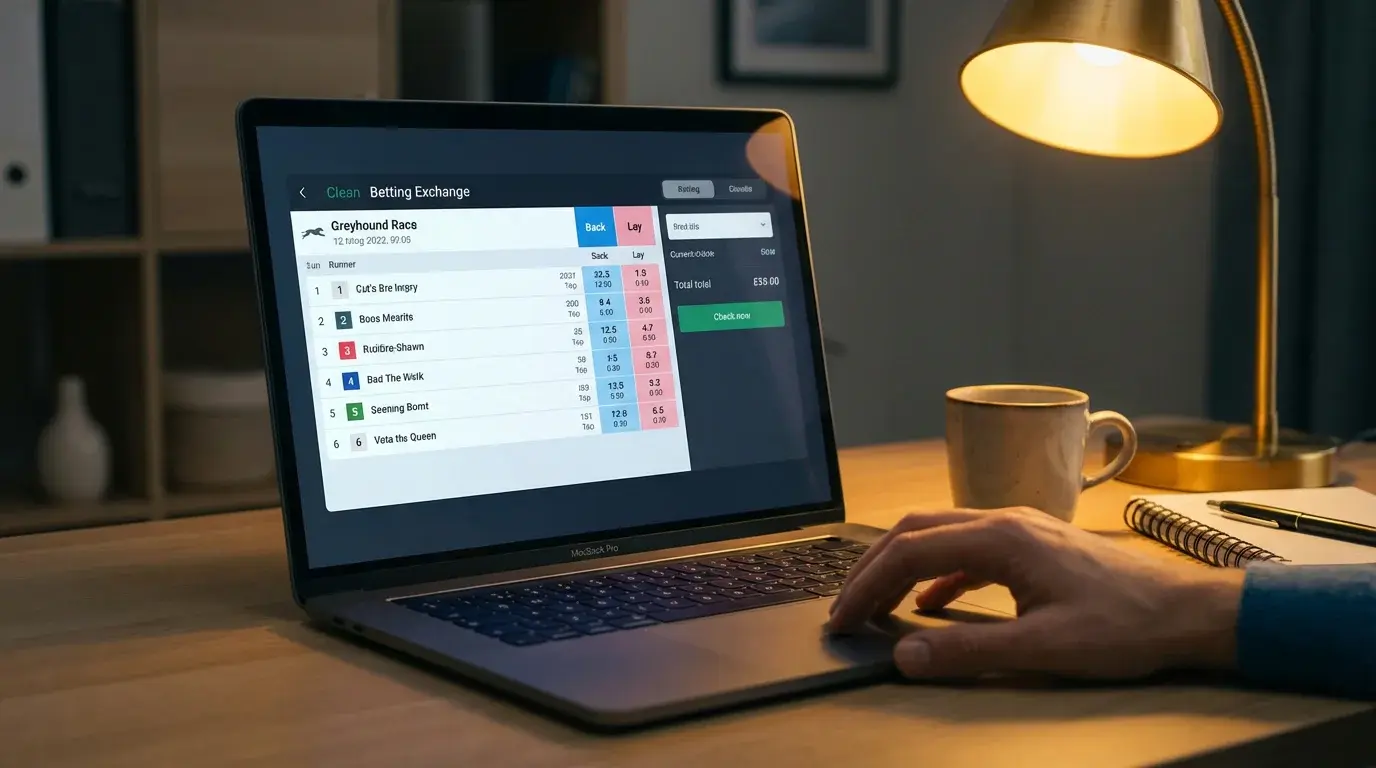
On the Betfair Exchange, every greyhound market has two sides: the back side and the lay side. If you want to back a dog to win, you place a back bet at the available price, or request a higher price and wait for someone to match it. If you want to bet against a dog, you place a lay bet, taking the opposite position. Back and lay bets are matched by the exchange when the prices meet, and the bet is executed between the two parties with Betfair holding the funds.
The prices displayed on the exchange are set by market activity, not by Betfair. When punters think a dog is likely to win, they offer lower back prices and the price shortens. When they think a dog is unlikely to win, they offer higher back prices and the price drifts. The exchange price at any given moment represents the current balance of opinion between people who want to back and people who want to lay that dog.
Commission is Betfair’s revenue model. Rather than building a margin into the odds, Betfair charges a percentage of net winnings on each market. The standard commission rate is five percent, though active users may qualify for reduced rates. This means the effective odds you receive are slightly lower than the displayed price, but the exchange typically offers better value than traditional bookmakers because there is no overround built into the market. The combined implied probabilities of all runners on the exchange are usually closer to 100 percent than the 115-130 percent typical of a bookmaker’s greyhound market.
Settling is automatic. Once the result is declared, Betfair settles all matched bets, deducts commission from winning positions, and credits account balances. Unmatched bets — those placed at a price that no one accepted — are voided and the stake returned.
Backing vs Laying: Core Concepts
Backing on the exchange is functionally identical to backing with a bookmaker. You select a dog, stake money at the available odds, and win if the dog finishes first. The difference is that your bet is matched by another punter rather than accepted by a corporate bookmaker. The practical experience is the same; the counterparty is different.
Laying is the distinctive feature of exchange betting and the concept that most newcomers find unfamiliar. When you lay a dog, you are betting that it will not win. You are, in effect, acting as the bookmaker for that specific bet. If the dog loses, you keep the backer’s stake (minus commission). If the dog wins, you pay the backer at the agreed odds.
The liability on a lay bet is what makes it different from a back bet. When you back a dog at 5.0 (4/1 in fractional odds) for ten pounds, your maximum loss is ten pounds. When you lay a dog at 5.0 for ten pounds, your maximum loss is forty pounds (the backer’s ten-pound stake times the odds minus one). The liability is always (odds minus one) times the backer’s stake. This asymmetry matters. Laying short-priced dogs involves small liability: laying a dog at 2.0 (evens) for ten pounds means a maximum loss of ten pounds. Laying outsiders at 10.0 for ten pounds means a maximum loss of ninety pounds. The relationship between price and risk is inverted compared to backing.
In greyhound racing specifically, laying is useful when you have a strong view that a particular dog will not win but do not have a strong opinion on which dog will win instead. In a six-dog race, there are many scenarios where one runner is overpriced or appropriately priced while another is clearly too short. Laying the dog you believe is too short provides a profit if any of the other five dogs wins, which is a broader outcome set than backing a single selection.
Liquidity and Market Depth in Greyhound Markets
Liquidity is the exchange’s critical weakness in greyhound racing. Betfair’s greyhound markets carry significantly less money than their horse racing or football equivalents. A typical Premier League football match will have millions of pounds matched across all markets. A typical greyhound race at a BAGS meeting may have a few hundred pounds matched, and even an evening open race at a major track may not exceed a few thousand.
Low liquidity creates several practical problems. You may not be able to get your full stake matched at the price you want. If you want to back a dog at 6.0 for 20 pounds but only 5 pounds is available at that price, you must either accept a worse price for the remaining 15 pounds, leave the unmatched amount as a pending offer, or reduce your stake. In fast-moving greyhound markets where prices shift in the final minutes before the off, unmatched bets can be left stranded.
The thin markets also mean that the prices themselves are less reliable as indicators of true probability. In a deep market with thousands of pounds matched, the price reflects a broad consensus. In a shallow market with 200 pounds matched, the price may reflect the opinion of three or four punters. A single 50-pound bet can move the exchange price by several ticks, creating apparent market movements that carry little informational value.
Liquidity improves for higher-profile races. Evening meetings at major tracks attract more exchange activity. Derby heats and major open races generate deeper markets. BAGS meetings and lower-grade races at smaller tracks have the thinnest liquidity. If you plan to use the exchange for greyhound betting, focus on the meetings and races where sufficient liquidity exists to execute your strategy without excessive slippage between your intended price and the price you actually receive.
Exchange Strategies for Dog Racing
The exchange enables strategies that bookmaker markets cannot support, and the most effective ones exploit the structural advantages of the platform rather than trying to replicate bookmaker-style betting at better odds.
Laying overbet favourites is the foundational exchange strategy in greyhound racing. The betting public systematically overbets favourites in six-dog races. Short-priced favourites in greyhound racing win at a rate that, while higher than the base rate, is often lower than their price implies. If a dog is priced at 1.5 (1/2) on the exchange, the implied probability is 66.7 percent. If historical data shows that greyhound favourites at this price win approximately 58-62 percent of the time, there is a persistent edge in laying them. The margin is small per race, but over hundreds of races, it accumulates.
This strategy requires discipline and a meaningful sample size. You will lose individual lay bets frequently — favourites do win, after all — and the losses on individual bets can be larger than the gains because of the liability structure. The edge exists in the aggregate, not in any single race. A bankroll large enough to absorb the variance and a commitment to consistent staking are prerequisites.
Trading is another exchange-specific strategy. Because exchange prices move before and during the race, it is possible to back a dog at a high price and then lay it at a lower price (or vice versa) to lock in a profit regardless of the race outcome. This is analogous to buying and selling a financial instrument for a spread. In greyhound racing, trading opportunities arise when a dog’s price shortens after you back it, typically because late market activity supports the selection. You can then lay the dog at the shorter price, locking in a guaranteed return across all outcomes.
In-play trading, where you back or lay during the race itself, exists on Betfair for greyhound racing but is extremely challenging. Greyhound races last around 30 seconds. The in-play market is active for perhaps 15 to 20 of those seconds after the traps open. The price movements are rapid and the execution window is narrow. In-play greyhound trading is a specialist activity that requires fast connectivity, experience reading races in real time, and an acceptance that the execution risk is high. It is not a starting point for exchange newcomers.
The most pragmatic exchange approach for most greyhound bettors is selective: use the exchange when the available back price genuinely exceeds what any bookmaker is offering, or when you want to lay a specific dog that you believe is overpriced. Use bookmakers with BOG when the bookmaker price is competitive. There is no obligation to use the exchange exclusively. The best results often come from using both platforms opportunistically, selecting whichever offers the better deal on each individual bet.