Best Greyhound Betting Sites – Bet on Greyhounds in 2026
Loading...
Two chances to collect. That is the pitch, but the maths tells a more nuanced story. Each-way betting is the most widely used safety mechanism in greyhound wagering, and the logic is simple enough on the surface: your stake is split in half, with one portion backing the dog to win and the other backing it to place. If the dog wins, both halves pay out. If it finishes second, you lose the win half but collect on the place portion. If it finishes third or worse, you lose everything.
The appeal is obvious. Each-way bets reduce the all-or-nothing nature of a straight win bet. But they also halve your effective stake on the outcome you actually believe in. Whether each-way betting represents smart bankroll management or a diluted conviction depends entirely on when and how you deploy it. This is not a bet type you should use on every selection. It is a tool, and like any tool, it works best when applied to the right situation.
How Each-Way Bets Work in Greyhound Racing
Each-way is not one bet. It is two, and each half has its own maths.
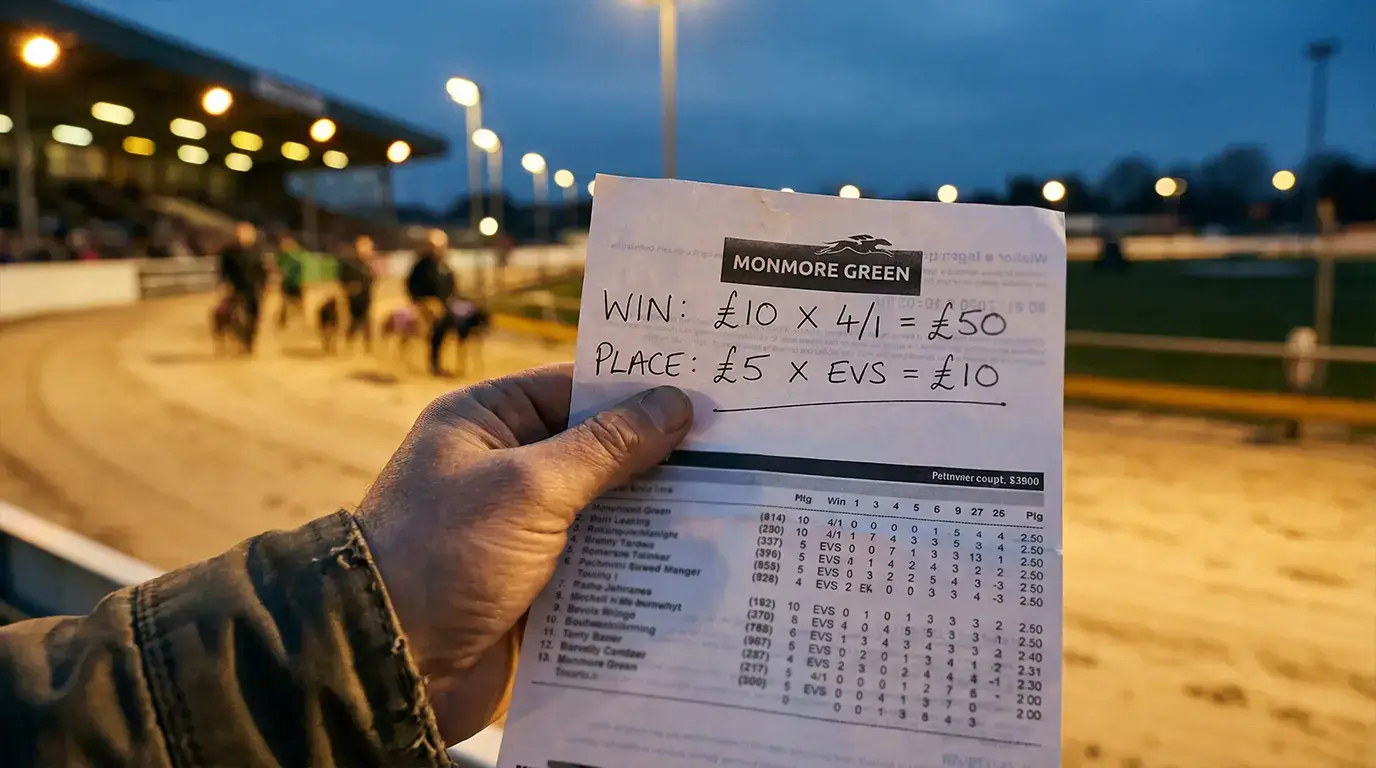
The win portion works exactly like a standard win bet. You back the dog at the advertised odds. If it finishes first, you receive the full payout at those odds plus your stake back. The place portion is a separate bet at reduced odds, typically one quarter of the win odds, and it pays out if the dog finishes in the top two positions. In UK greyhound racing, the standard place terms are 1/4 odds for first or second place in a six-dog race.
Here is how the numbers work in practice. Suppose you place a five-pound each-way bet on a dog at 7/1. Your total outlay is ten pounds: five on the win, five on the place. If the dog wins, the win portion returns five pounds times seven, which is thirty-five pounds profit, plus your five-pound stake. The place portion pays at one quarter of 7/1, which is 7/4. Five pounds at 7/4 returns eight pounds seventy-five, plus your five-pound stake. Your total return for a winning dog is fifty-three pounds seventy-five from a ten-pound outlay.
If the dog finishes second, the win portion is lost. The place portion still pays: five pounds at 7/4 equals eight pounds seventy-five profit, plus your five-pound stake returned. Total return is thirteen pounds seventy-five from a ten-pound outlay. You make a net profit of three pounds seventy-five. Not life-changing, but you have not lost your entire stake either.
If the dog finishes third or worse, both portions lose. Ten pounds gone. The maths is clean, but notice the implication: to break even on an each-way bet where the dog only places, you need the place return to cover both the lost win stake and the place stake. At 7/1 and 1/4 odds place terms, the break-even point works. At shorter prices, it does not always cover. A dog at 3/1 each-way returns only 3/4 on the place portion, meaning five pounds at 3/4 gives three pounds seventy-five profit plus five-pound stake. Total from the place portion: eight pounds seventy-five. Against a ten-pound total outlay, that is a net loss of one pound twenty-five even when the dog places. At short prices, each-way is a losing proposition unless the dog wins.
When Each-Way Offers Value
Each-way value lives on the fringes, not at the head of the market. The maths makes this unavoidable. When you back a short-priced favourite each-way, the place return is negligible because one quarter of a small price is a very small number. There is almost no cushion if the dog runs second. Each-way betting on favourites is, in the majority of cases, a waste of half your stake.
Where each-way comes into its own is at longer odds. A dog priced at 8/1 or above returns a meaningful place dividend at 2/1 (one quarter of 8/1). If that dog has a pattern of finishing in the top two without consistently winning, the place portion of an each-way bet starts to carry its own weight. You are not just hoping the dog wins. You are making a genuinely profitable bet on its ability to place, with the win half as a bonus.
Look for dogs that meet a specific profile: consistent top-two finishes in recent form, competitive at the distance and track, but perhaps lacking the early pace to lead from the front. These are dogs that typically run into a place through strength in the second half of the race. They may not be flashy, and they rarely top the betting market, but their reliability in placing makes each-way an efficient vehicle. A dog that places in four of its last six races but has only won once is an each-way candidate. A dog that has won three of its last six and failed to place in the other three is a win-only proposition.
Competitive fields with no clear favourite also favour each-way. When five of the six dogs in a race are priced between 3/1 and 7/1, the market is saying it cannot separate them. In that environment, each-way on a dog with solid recent form at 6/1 gives you a reasonable return whether it wins or places, without requiring you to identify the single best dog in an open race.
Grade drops are another trigger. When a dog that has been running in higher grades is moved down, it often places easily even if it does not dominate. The each-way bet captures that scenario neatly: you profit if the class edge delivers a win, and you still collect if the dog needs a race to adjust to the new opponents.
Each-Way vs Win-Only: A Bankroll Decision
The choice between each-way and win-only is not personal preference. It is bankroll management.
Win-only betting concentrates your entire stake on one outcome. When you are right, the returns are higher because you have not diluted your stake across two bets. Over a long series of bets, a punter who backs winners at fair or better odds will generate more profit from win-only stakes than from each-way stakes, assuming the same strike rate. The maths is unambiguous on this point.
But strike rate is the critical variable. Win-only betting demands a higher proportion of winners to stay profitable, because every loser costs you the full stake. Each-way betting generates returns on a wider range of outcomes, reducing the impact of losing runs. For a punter whose selections frequently place without winning, each-way converts those near-misses into partial returns rather than total losses. Over a long sequence, that cushion can be the difference between a bankroll that survives and one that empties during a cold streak.
The pragmatic approach is a hybrid. Use win-only bets when your analysis identifies a strong selection at fair or generous odds, where you have a clear reason to believe the dog wins rather than merely places. Use each-way when the selection is less certain to lead but has a reliable placing profile, particularly at odds of 5/1 or higher where the place return carries meaningful value. This is not a rigid rule. It is a framework that matches bet type to conviction level, and it keeps your bankroll working more efficiently than a blanket approach to either strategy.
Each-Way Doubles and Multiples
Each-way multiples compound both the opportunity and the exposure. An each-way double is two each-way bets linked together, and the mechanics matter.
In an each-way double, you have two separate bets: a win double and a place double. Your unit stake is multiplied by two. A two-pound each-way double costs four pounds total. If both dogs win, both the win double and the place double pay out. If both place but neither wins, only the place double pays at combined place terms. If one wins and the other only places, the win double loses and only the place double pays out.
Each-way doubles can produce surprisingly large returns when both selections win at reasonable prices, because both the win double and the place double pay out simultaneously. However, the doubled cost is significant. If your first dog loses entirely, both bets are dead. There is no partial recovery from the double if neither dog places.
Each-way trebles follow the same principle with two bets per unit stake: a win treble and a place treble. Each-way accumulators scale further. The returns escalate dramatically when every selection wins, but the cost and risk escalate in lockstep. For greyhound betting, where fields are small and individual race outcomes are relatively volatile, each-way multiples carry substantial variance. They are best treated as occasional speculative bets with small stakes rather than a core strategy.
The discipline required is simple: treat each-way multiples as what they are, which is a series of interconnected bets with a high failure rate and a high ceiling. Size your stakes accordingly. If you would not be comfortable losing the full outlay without flinching, the stake is too large.