Best Greyhound Betting Sites – Bet on Greyhounds in 2026
Loading...
Every number on a greyhound race card has a purpose — and ignoring any of them costs money. That is not an exaggeration. A UK greyhound race card packs more usable data into a smaller space than almost any horse racing equivalent, and it does so without mercy. There are no helpful footnotes, no tooltips, no beginner mode. The card assumes you already know what you are looking at. If you do not, you are guessing — and guessing at the dogs is an expensive habit.
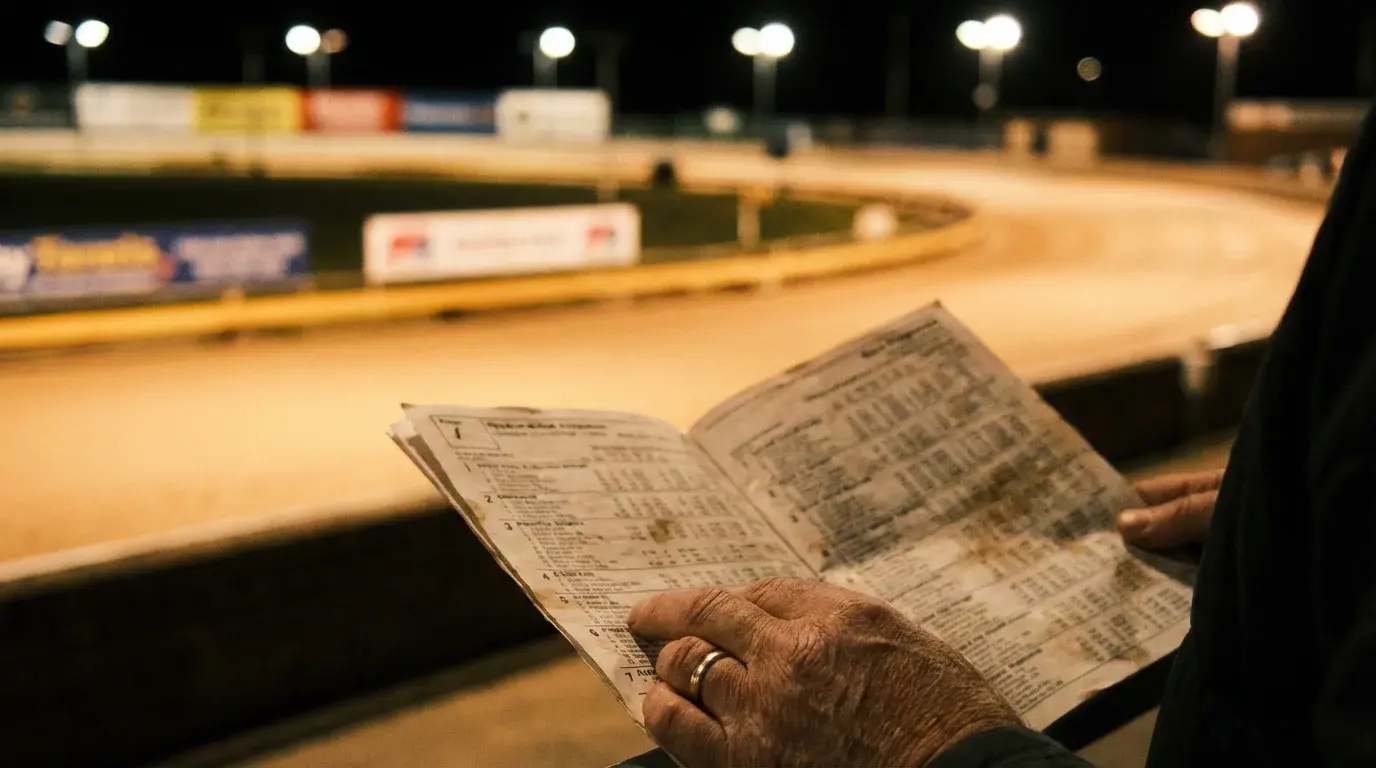
A race card is the single document that tells you everything officially recorded about each dog in a given race: its trap position, form over the last six runs, split times, finishing positions, weight, going adjustments, and the shorthand remarks that describe how each race unfolded. It is available trackside in printed form, and digitally through the Racing Post, Timeform, Sporting Life, and most major bookmaker apps. Whether you are standing under floodlights at Romford or scrolling through a BAGS card on your phone at lunchtime, the data is the same.
This guide breaks down every element of the UK greyhound race card from the header line to the final abbreviation. It is written for bettors who want to stop relying on dog names and trap colours, and start making selections based on what the form actually says. The race card is not decoration. It is not background material. It is the foundation of every informed greyhound bet placed in Britain, and learning to read it properly is the single most useful skill a dog racing punter can develop.
The Header: Race Information at a Glance
The top line tells you what kind of race this is before you look at a single dog. Every race card begins with a header block, and reading it properly takes about five seconds — five seconds that most casual bettors skip entirely.
The header contains the meeting date, the race number within that meeting (typically 1 through 12 or 15), and the scheduled off time. Next comes the distance, always given in metres. UK greyhound distances range from around 210 metres at the shortest sprint tracks to 900 metres and beyond for marathon events, though the most common distances sit between 400 and 480 metres. The distance matters enormously for form comparison — a dog’s time over 400 metres at Monmore tells you nothing useful about its 480-metre performance at Hove.
After the distance, you will find the grade classification. This is the system that determines the quality of the field. GBGB grading runs from A1 at the top to A11 at the bottom, with variations for distance categories: D1 through D5 for sprint races, S1 through S6 for stayers, and OR for open races that accept entries regardless of grade. Open races tend to attract the best dogs and carry the highest prize money. Below the grade, the card lists the prize money breakdown — first, second, third, and sometimes fourth — along with the BGRF (British Greyhound Racing Fund) contribution, a compulsory welfare levy added to every race.
You will also see whether the race is classified as flat or hurdles. The overwhelming majority of UK greyhound races are flat. Hurdle events were once a regular feature at tracks like Crayford and Central Park (Sittingbourne), but following the closure of multiple stadiums in 2025, hurdle racing has effectively ceased in British greyhound racing. The header may also note whether the meeting is a BAGS fixture — Bookmakers Afternoon Greyhound Services — which means the races are run behind closed doors, solely for broadcast to bookmakers and online streaming. BAGS races dominate the weekday calendar, and if you are betting on afternoon or early evening greyhounds, you are almost certainly betting on a BAGS card.
Individual Dog Entries: What Each Line Tells You
The entry line is the dog’s CV — compressed into a single row. Below the race header, each of the six runners is listed with a block of identifying information that appears before the detailed form lines. This is where you learn who the dog is, who trains it, and what its career numbers look like at a glance.
First comes the trap number and its associated colour: Trap 1 (Red), Trap 2 (Blue), Trap 3 (White), Trap 4 (Black), Trap 5 (Orange), Trap 6 (Black/White Stripes). The colour coding exists so that spectators, commentators, and bettors can identify each dog during the race. Next to the trap number sits the dog’s registered name, followed by the trainer’s name and, on some cards, the owner. The trainer is worth noting — certain trainers have measurably better records at specific tracks, and repeat form patterns within a kennel can signal preparation quality.
Below the name, the card displays the dog’s colour, sex, and breeding. You will see abbreviations like “be d” (brindle entire dog, meaning an uncastrated male), “bk b” (black bitch), “dkbd d” (dark brindle dog), or “wbk b” (white and black bitch). After this, the sire (father) and dam (mother) are listed, followed by the whelping date — the dog’s date of birth. Country of origin appears as “Ir” for Irish-bred or nothing for UK-bred dogs. Irish-bred greyhounds make up a large proportion of UK runners, particularly in the higher grades.
The entry block concludes with the dog’s career record, shown as total runs, first-place finishes, and second-place finishes. A line reading “47 12-8” means the dog has raced 47 times, won 12, and finished second 8 times. This gives you an instant strike rate — in this example, roughly 25% wins, 42% top-two finishes — but it tells you nothing about the level of competition or recency of those results. For that, you need the form lines below.
Some digital race cards also include a two-line summary above the form, noting the dog’s best recent time at the meeting’s distance, any notable comments from the trainer, and whether the dog is running up or down in grade compared to its last race. This summary is useful as a quick filter, but it should never replace reading the full form.
Decoding the Form Line: Six Races in Six Rows
Form is history — and history, in greyhound racing, is the closest thing to a crystal ball. Beneath each dog’s entry information sit up to six lines of form, one per recent race, listed in reverse chronological order with the most recent run at the top. Each line is dense with information, and reading it accurately is what separates the informed bettor from the hopeful one.
A typical form line reads, from left to right: the date of the race, the distance in metres, the trap number the dog ran from, and the split time. The split time — sometimes called the sectional time — records how long the dog took to reach a specific point on the track, usually the first bend or the finishing line on the first circuit. This is distinct from the overall race time and is one of the most important numbers on the card for identifying early-pace dogs versus closers.
After the split comes a sequence of positional numbers separated by dashes. These represent the dog’s position at key points during the race: typically after the first bend, through the back straight, at the third bend, the fourth bend, and at the finish. A form line reading “3-2-2-1-1” tells you the dog was third early, moved to second through the middle of the race, hit the front at the fourth bend, and won. A line reading “1-1-1-2-3” tells a very different story — an early leader that faded. These position sequences are the narrative of the race, compressed into five or six numbers.
Next comes the finishing distance — how far the dog won or lost by. This is given in lengths or fractions of a length. Winning distances in greyhound racing are usually measured from a quarter of a length up to ten or more lengths. A dog winning by five lengths in an A5 race is dominating its grade; a dog beaten by a neck in an A1 race is running at a very high level. Context matters here. Following the distance, the card shows the name of the winner (if the dog lost) or the runner-up (if the dog won), plus the venue abbreviation for the track.
The remarks column comes next, and this is where the race card speaks in abbreviations. You will find shorthand for the dog’s running line (Rls for rails, Mid for middle, W for wide), early pace (EP for early pace, SAw for slow away, QAw for quick away), in-race incidents (Crd for crowded, Bmp for bumped, FcdW for forced wide), and late-race action (RanOn, DrewClear, StbFnl for stumbled at the finish). These abbreviations describe what actually happened, not just the result, and they are essential for understanding whether a poor finish was the dog’s fault or the product of racing luck.
After the remarks, the card records the race’s winning time in seconds, the going adjustment (a positive or negative number reflecting track conditions that day), the dog’s weight in kilograms, the Starting Price, the race grade, and finally the calculated time — CalcTm. The weight, going adjustment, and calculated time together form a trio of secondary data points that most casual bettors overlook entirely. They should not. A dog whose weight has jumped by 1.5 kilograms since its last run, or whose CalcTm is half a second slower than the grade average, is sending signals that the headline form number alone does not capture.
To put all of this together with an example: suppose a form line reads “14Jan 400 1 3.87 1-1-1-1-1 5L Blaze Runner Rom Rls,EP,ALd 24.52 +20 31.2 5/2f A3 24.32”. This tells you the dog ran on 14 January over 400 metres from Trap 1, posted a 3.87-second split, led at every point, won by five lengths over Blaze Runner at Romford, ran the rail with early pace and led throughout, finished in 24.52 seconds on going that was +20 (two-tenths of a second slow), weighed 31.2 kilograms, started at 5/2 favourite, ran in an A3 race, and has a calculated time of 24.32. That is a very strong form line. Reading it took fifteen seconds. Ignoring it takes less — and costs more.
What Split Times and Calculated Times Actually Mean
Split times separate the fast starters from the finishers — and that distinction drives every forecast bet. The split time records the dog’s time from the moment the traps open to a measured point on the track, usually the first timing beam. At most UK tracks, this covers the run to the first bend, typically around 80 to 100 metres. A split of 3.75 seconds at Romford, for example, is rapid — it indicates a dog that breaks cleanly and reaches the bend ahead of its rivals. A split of 4.10 from the same trap suggests a slower starter that will need to find room later in the race.
Why does this matter? Because the first bend in greyhound racing is where most trouble happens. Dogs that reach it first have the pick of the racing line and avoid the crowding, bumping, and checking that plagues the pack behind. A dog with a consistently fast split from Trap 1, running the rail, is a dog that avoids trouble and controls the race. Conversely, a wide runner from Trap 6 with a moderate split may rely on a clear run around the outside — and clear runs are never guaranteed.
Calculated time — CalcTm — is the other number that deserves more attention than it gets. CalcTm takes the race’s winning time and adjusts it for the going on that day, producing a standardised time that allows meaningful comparison across different dates and conditions. If two dogs both posted a winning time of 24.60 seconds over 400 metres, but one ran on fast going (+0) and the other on slow going (+30), their raw times are identical but their CalcTm figures will differ. The dog on slow going has the better adjusted time, because it achieved the same raw result on a slower surface. When assessing form across several weeks, CalcTm is more reliable than the headline winning time. An asterisk next to a CalcTm denotes the dog’s best recent performance at that distance — a useful shortcut when scanning multiple entries.
Together, split times and CalcTm give you the two most analytically useful numbers on the form line. The split tells you about early pace and tactical position; the CalcTm tells you about overall ability adjusted for conditions. Neither is perfect, but both are far superior to judging a dog by its finishing position alone.
Race Card Abbreviations: Complete UK Reference
Abbreviations are the language — learn them or get left behind. The remarks column on a greyhound race card uses a standardised set of shorthand codes to describe how each dog ran. These are not optional extras. They tell you what happened between the traps and the finish line in a way that positional numbers alone cannot. A dog that finished third might have been crowded at the second bend and forced wide at the third, or it might have had a clear run and simply lacked the pace. The abbreviation tells you which.
Running positions are described relative to the track: Rls means the dog ran along the rails (the inside), Mid means middle, and W means wide (the outside). Compound positions exist too — MidTRls indicates a dog running in the middle but drifting towards the rail, while MidToW means the opposite, a dog that moved from middle to wide. These matter because running lines are linked to trap positions and track geometry. A railer from Trap 1 is running its natural line. A railer from Trap 5 had to cut across the field to get there, which implies either exceptional early speed or a mess at the first bend.
Early-pace abbreviations include EP (early pace — the dog showed speed from the traps), QAw (quick away — a particularly sharp break), and SAw (slow away — the dog was sluggish from the box). SAw is one of the most important codes to look for. A dog that was slow away may have lost several lengths before the first bend, making its eventual finishing position more impressive than it appears. Two or three SAw entries in a row, however, suggest a habitual slow starter — a pattern worth noting before you back it from a tight inside trap.
In-race incidents generate their own abbreviations. Crd means the dog was crowded — squeezed between other runners — which typically costs time and momentum. Bmp indicates a bump, either given or received, with numbers sometimes appended to specify the bend (Bmp1, Bmp2, Bmp3, Bmp4). FcdW means forced wide, usually by another dog pushing out on a bend. VW denotes very wide, meaning the dog ran significantly off the rail for much of the race. CkBmp means checked and bumped — the dog had to alter its stride after contact, a more severe version of a standard bump.
Finishing abbreviations describe the final phase. Ld or ALd means the dog led, or led throughout, from early on. ClrRun indicates the dog had a clear run with no interference. DrewClear means it pulled away from the field in the closing stages. RanOn suggests the dog was finishing strongly, gaining ground in the final stretch. EvCh means the dog had every chance — a clear run and good position — but still could not win, which often implies the dog was outpaced on ability rather than unlucky. StbFnl means stumbled at the finish, which can affect the margin of defeat but may not reflect underlying ability. FnlSt means the dog finished strongly, a positive indicator for longer-distance races.
Build a habit of reading the remarks column for every dog in a race, not just the one you fancy. A dog with ClrRun that finished fourth was beaten on merit. A dog with Crd,FcdW,Bmp3 that finished fourth was beaten by circumstances — and circumstances change.
Weight, Going, and What the Numbers Between the Lines Mean
Weight and going are the numbers most bettors skip — and the numbers that most often decide the race. They sit quietly on each form line, overshadowed by finishing positions and split times, but they carry information that the headline data does not.
Weight is recorded in kilograms for every run. Greyhounds typically race at somewhere between 25 and 38 kilograms, depending on sex and build, and most dogs maintain a relatively stable racing weight once they are mature. GBGB Rule 52 requires that a dog be withdrawn from a race if its weight varies by more than 1.0 kilogram from its last recorded racing weight. This is a welfare measure, but it also has a practical betting application: a weight change within that threshold — say, a gain of 0.8 kilograms or a loss of 0.9 — is permitted and can signal a shift in condition. A dog that has gained weight might have been rested and fed up, possibly returning from a break with improved muscle condition. A dog that has lost weight might have been trialled hard or could be carrying a minor issue. Neither scenario is definitive, but weight stability over the last three or four runs is generally a positive indicator.
Going adjustment is the other number that needs attention. Every race card records the going as a positive or negative value in hundredths of a second. A figure of +20 means the track was two-tenths of a second slower than the standard time for that distance on that surface. A figure of -10 means it was a tenth quicker. The going is determined by the racing manager based on sand condition, moisture, temperature, and recent weather, and it is applied uniformly to every race in that meeting.
Why does going matter? Because a dog that posted 24.60 on a +30 going day was effectively running faster than a dog that posted 24.60 on a -10 day. The first dog ran on a slow track and still hit the same raw time, meaning its adjusted performance was substantially better. This is exactly what CalcTm captures, but if you are scanning cards quickly, the going number itself can tell you whether a particular run was achieved in favourable or unfavourable conditions.
For betting purposes, the key patterns to watch are: consistent weight across the last four to six runs (stability is good); a sudden weight shift of more than half a kilogram (investigate why); strong form on heavy going if rain is forecast for the meeting you are betting on; and deteriorating CalcTm figures despite steady going numbers, which can indicate declining fitness or the onset of a niggling injury. Dogs returning from breaks of more than three weeks may show weight changes and unfamiliar going conditions — both of which increase uncertainty and should temper confidence in any selection.
None of these numbers tell the full story on their own. But together — weight trend, going adjustment, CalcTm — they form a secondary layer of analysis that catches changes the finishing positions might not reflect yet. The bettor who checks them has an edge over the one relying on headline data alone.
Digital Race Cards vs Paper: What Has Changed
The paper card still exists — but the digital version lets you watch the proof. All the data covered so far — form lines, weights, going adjustments, abbreviations — is presented identically whether you are holding a printed card or scrolling on a screen. What changed with the digital transition, which began in earnest around 2021 when several circuits adopted electronic displays and online-first publication, is not the information itself but the tools that surround it. Today, the digital race card is the default for the majority of bettors, accessible through the Racing Post website, Timeform, Sporting Life, and the greyhound sections of major bookmaker apps.
The data on a digital card is identical to the paper version: trap numbers, form lines, split times, weights, going adjustments, abbreviations, CalcTm. What changes is the presentation and the surrounding tools. Digital cards often include embedded race replays, allowing you to watch a dog’s last run directly from the form entry. Some platforms add dog photographs, which are marginally useful for trackside identification but more importantly confirm that you are looking at the right animal when cross-referencing entries. Colour-coded performance indicators — green for improving form, red for declining — appear on some services, though these are editorial overlays rather than official GBGB data.
The practical advantage of digital cards is speed. Scrolling through six dogs’ form takes less time on a screen than hunting through a folded paper card, especially if you are comparing two or three specific entries side by side. Mobile apps also make it possible to study the card for a 7:40pm BAGS meeting at Crayford while sitting on the train home, something the paper format never offered. The disadvantage, such as it is, is that digital cards can encourage superficial scanning. The data is all there, but the screen encourages quick glances rather than the line-by-line reading that paper used to force. The discipline of reading every form line, every abbreviation, every weight figure, is the same regardless of format — and it remains the standard that turns raw data into informed selections.
What the Race Card Cannot Tell You
The card gives you everything that is recorded — but races are not won on records alone. For all its density, a greyhound race card has blind spots, and knowing what those are is as important as knowing how to read the data it does contain.
The most significant gap is physical condition on the day. A dog might show six strong form lines and arrive at the track carrying a minor muscle strain that will not show up until the traps open. The card cannot tell you about changes in a dog’s temperament — whether it has become kennel-shy, lost enthusiasm for chasing, or developed a habit of running green in the early stages. It cannot tell you about recent training form, trial results that were not officially recorded, or whether the trainer has changed the dog’s preparation in the days leading up to the race.
This is where trackside attendance offers a genuine advantage. The dog parade, held before each race, gives you a live look at each runner. Experienced trackside bettors look for muscle tone, coat condition, alertness, and general demeanour. A dog that looks flat, lethargic, or uncomfortable in the parade ring is sending a signal that no form line captures. Likewise, a dog that looks fizzing with energy and is pulling its handler towards the traps may be sharper than its recent form suggests.
Beyond the parade, supplementary information exists in trainer interviews, racing press columns, and social media posts from kennel connections. None of this is systematic, and much of it should be taken with considerable scepticism, but it can occasionally flag a dog that is about to improve or one that connections are quietly losing confidence in. The race card is the bedrock. It is comprehensive, standardised, and official. But it is not omniscient, and the bettor who treats it as the only source of information is leaving potential insight on the table.
From Card to Bet: A Final Read
A race card is not a tip sheet — it is raw material, and what you build from it is your edge. Everything in this guide points to the same conclusion: the greyhound race card is the most information-dense document a UK bettor has access to, and the ability to read it accurately is the minimum entry requirement for making selections based on evidence rather than instinct.
Start with the header to understand the race’s level and distance. Read each dog’s entry for career context and breeding. Work through the form lines one column at a time, building a picture of how each dog has been running, where it prefers to race, how quickly it breaks, and how it handles different conditions. Check the weights for stability, the going adjustments for context, and the CalcTm for true performance comparison. Read the abbreviations to understand what happened in each race, not just what the result was. And then, once you have done all of that, cross-reference what you have found with trap bias data and track-specific patterns.
This is not quick work. Reading a full six-dog card properly takes ten to fifteen minutes. But those minutes are the difference between a bet placed on analysis and a bet placed on hope. The dogs have been running in Britain for a century, and for a century the race card has been the document that tells you everything you need to decide whether to bet — and on whom. The only question is whether you are willing to read it.