 Available in US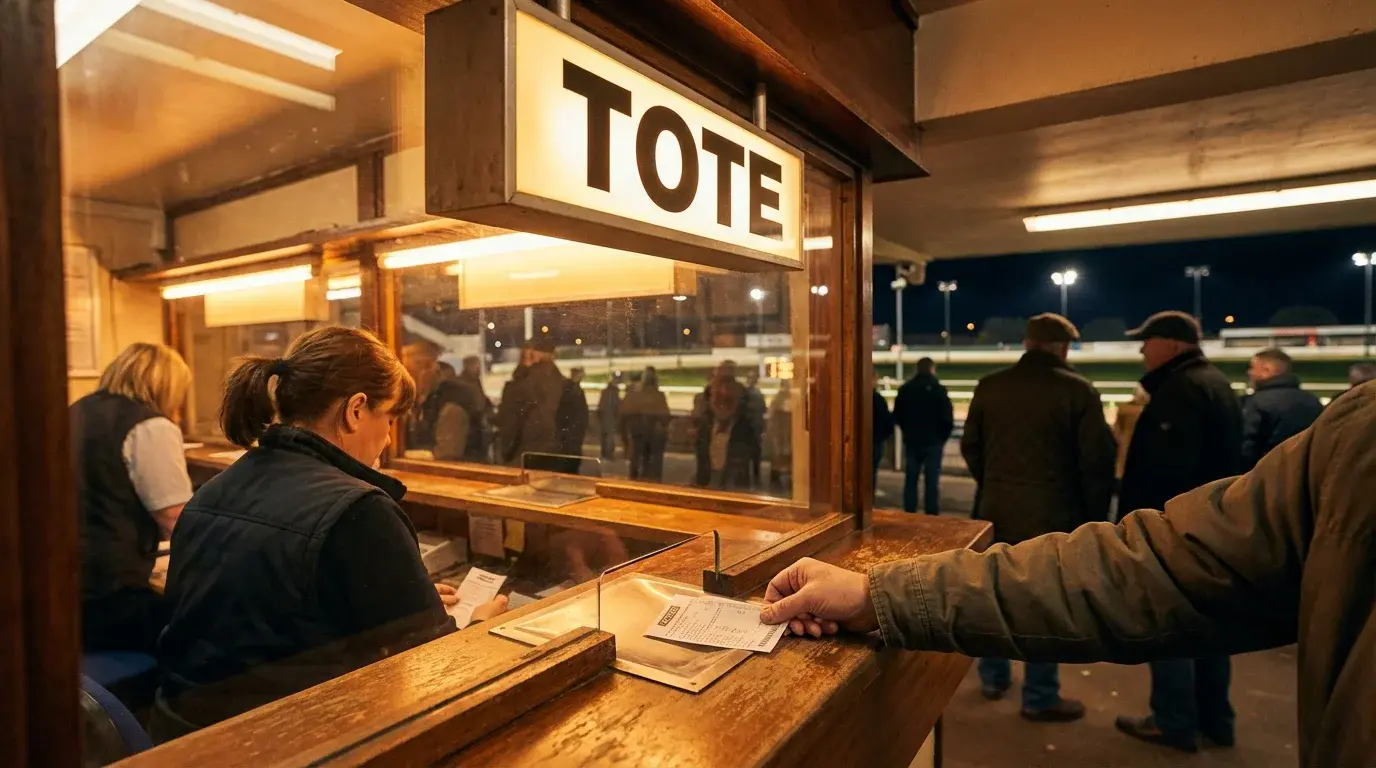
The tote is not a bookmaker. It does not set odds, does not take a position on any dog, and does not profit when you lose. It is a pool. Every pound wagered into a tote pool is combined with every other pound in that pool, and after the track takes its percentage, the remainder is divided among the winners. Your return is not determined by a price on a screen. It is determined by how much total money was bet, and how many other people picked the same dog you did.
This is a fundamentally different mechanism to fixed-odds betting with a bookmaker, and it produces different outcomes. Sometimes the tote pays less than the bookmaker would have. Sometimes it pays more. Understanding when and why is the key to using it well.
How Pari-Mutuel Pools Work
The pari-mutuel system, which underpins every tote bet at UK greyhound tracks, follows a straightforward principle. All bets of a particular type on a particular race flow into a single pool. After the race, the pool operator deducts a percentage, known as the take-out or house commission, and distributes the remainder to winning bettors in proportion to their stake.
Suppose a Win pool on a six-dog race collects a total of one thousand pounds. The take-out is, say, 30 percent. That leaves 700 pounds to distribute. If 200 pounds of the original total was bet on the winning dog, the dividend is calculated by dividing the net pool (700) by the amount on the winner (200), giving 3.50. For every one pound staked on the winning dog, the return is three pounds fifty, inclusive of the original stake. That is the tote dividend, and it is declared after the race as the official payout.
The take-out percentage varies by pool type and by operator, but it is always disclosed. At UK greyhound tracks, the standard take-out is typically around 30 percent across all pools, though it may be reduced for major events. Win and place pools sometimes carry lower deductions than exotic pools like forecasts and tricasts.
The key implication for bettors is that tote odds are not known in advance. The final dividend depends on how much money is in the pool and how it is distributed across the runners. Indicative odds are displayed on the tote board during the betting period, but these are estimates based on current pool composition and can shift right up to the off. A late surge of money on one dog will shorten its indicative tote odds and increase the dividend on every other dog. This makes tote betting inherently dynamic and, at times, unpredictable in a way that fixed-odds betting is not.
Pool Types: Win, Place, Forecast, Tricast
UK greyhound tote operations offer several pool types, each covering a different bet structure.
The Win pool is the simplest. You select one dog to finish first. If it wins, you receive the declared dividend. The Place pool requires your dog to finish first or second. The dividend is typically lower than the Win pool because two dogs share the payout, but the probability of collecting is higher. At most UK tracks, the Place pool pays on the first two finishers.
The Forecast pool asks you to predict the first and second dog in the correct order, identical in concept to a bookmaker’s straight forecast but paid from the pool rather than at CSF. The tote Forecast dividend can differ significantly from the CSF because it is driven by pool composition rather than a mathematical model. In races where heavy money goes on one specific forecast combination, the tote Forecast dividend on that combination will be compressed. In races where the winning forecast was lightly backed, the dividend can be surprisingly generous.
The Tricast pool extends the principle to the first three finishers in exact order. Tricast pools at greyhound tracks tend to be smaller than Win or Forecast pools because the bet is harder to win and attracts fewer participants. Smaller pools produce more volatile dividends: the returns can be enormous when an unexpected combination lands, but they can also be modest when a popular selection comes in and most of the pool is concentrated on the winning combination.
Each pool operates independently. Money bet into the Win pool does not affect the Forecast pool or vice versa. You can bet into multiple pools on the same race, effectively hedging or diversifying your exposure. A common approach is to place a Win bet with a bookmaker at fixed odds and a Forecast bet in the tote pool, capturing the best of both systems on the same race.
The Jackpot and Pick 6
Jackpot pools are the biggest-paying tote bets available at UK greyhound tracks. The standard Jackpot requires you to pick the winner of six consecutive races on a single meeting card. Get all six right and you share the Jackpot pool. Get fewer than six right and you lose your stake.
The minimum unit stake for a Jackpot is typically one pound. You can make multiple selections per race (covering more than one dog in any given leg), but each additional selection multiplies your total stake. Covering two dogs in two of the six legs and one dog in the remaining four produces a total of four combinations, costing four pounds. Covering two dogs in every leg produces 64 combinations at 64 pounds. The cost of broad coverage escalates fast.
The Jackpot’s appeal lies in its rollover mechanism. If no one selects all six winners on a given meeting, the pool rolls over to the next meeting. After several rollovers, the accumulated pool can reach substantial sums, and that is when the value proposition changes. A Jackpot pool that has rolled over three or four times contains money from previous meetings’ losing bets, effectively inflating the potential dividend beyond what the current meeting’s contributions alone would support. Monitoring rollover levels is a legitimate part of Jackpot strategy: a large carryover pool can justify a wider selection pattern and a higher total stake.
Pick 6 bets operate on a similar principle at some venues, requiring the winner of six nominated races (not necessarily consecutive). The mechanics are the same: pool contributions, take-out, and dividend sharing among winners. The difference is primarily in which races are included and how the pool is structured.
Tote vs Fixed Odds: Decision Framework
The choice between tote and bookmaker is situational, not habitual. Neither is universally better. Each has conditions where it pays more.
Fixed-odds betting with a bookmaker offers certainty. You know your price before the race. If you take 5/1 and the dog wins, you receive 5/1 regardless of what happens in any pool. This is valuable when you identify value in the early market and want to lock it in. Best Odds Guaranteed promotions enhance this further: you get the better of your early price and the SP, which means fixed-odds betting with BOG is almost always the superior option when backing favourites or dogs at the shorter end of the market.
The tote tends to offer better value on outsiders. When a longer-priced dog wins and the majority of the pool was concentrated on one or two favourites, the tote dividend for the winner can exceed the bookmaker’s SP. This is because the bookmaker’s SP reflects the overall market view including the bookmaker’s margin, while the tote dividend is a direct function of pool distribution. Lightly backed winners in large pools get paid more by the tote than by the bookmaker.
For Forecast and Tricast bets, the comparison between tote and CSF is less predictable. CSF is calculated by algorithm, and the tote dividend is determined by pool composition. Sometimes CSF is more generous. Sometimes the tote pays better. There is no consistent rule, and the difference depends entirely on the specific race and the specific pool. If you routinely bet forecasts, comparing tote dividends to CSF returns over a sample of 50 or more bets will give you a clear picture of which system pays better for your selection style.
Jackpot and Pick 6 pools have no bookmaker equivalent in fixed-odds form. These are tote-exclusive products, and their appeal is entirely a function of pool size, rollover accumulation, and the bettor’s willingness to accept a high-variance, low-probability bet with an occasionally massive payout. They occupy a different part of the betting spectrum from standard Win and Forecast bets, and should be treated as a distinct activity with its own bankroll allocation.
