 Available in US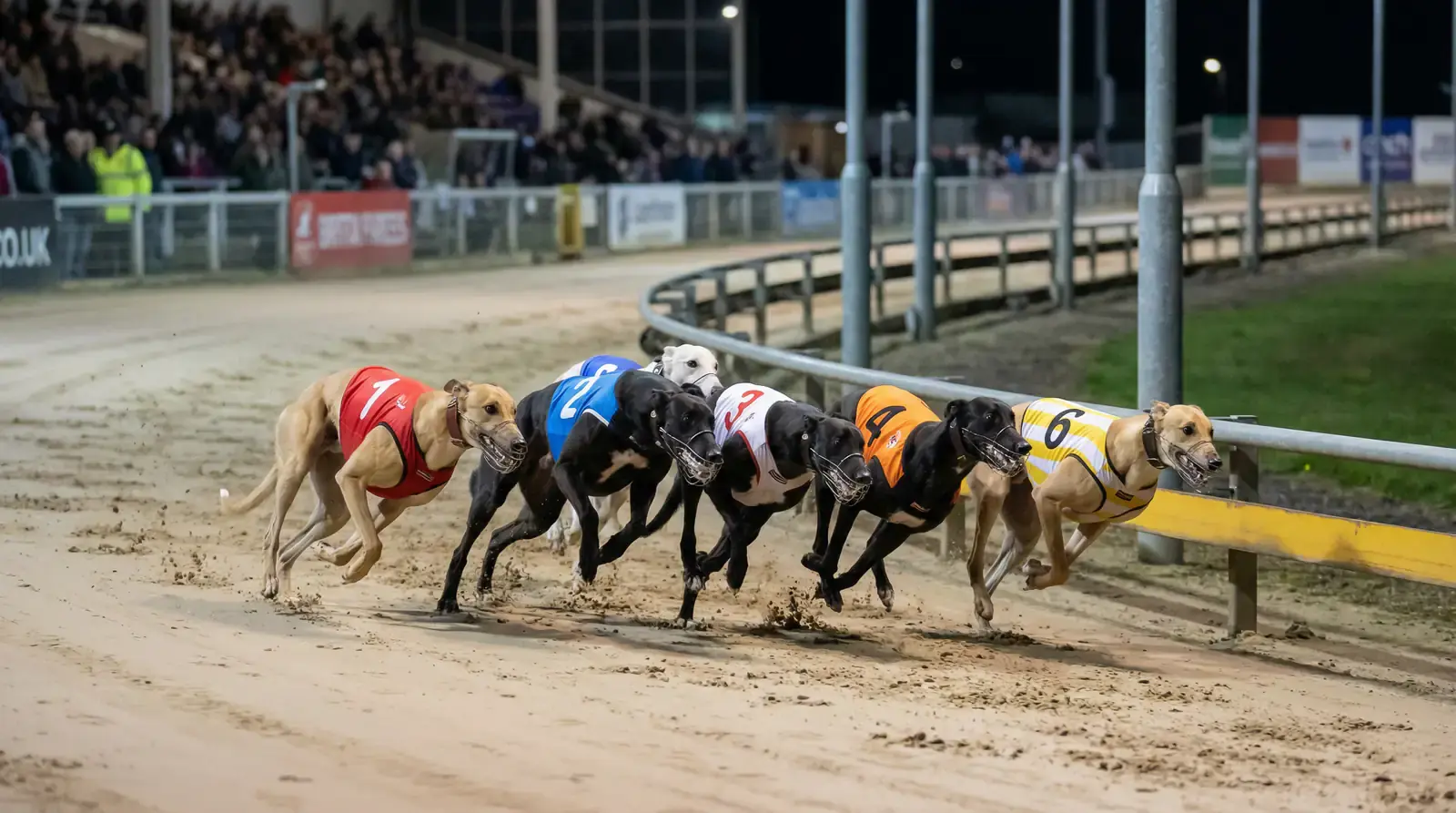
A grade tells you more about the field than any tip sheet. Every greyhound registered at a GBGB-licensed track in the UK is assigned a grade that reflects its recent racing performance. The system works like a league table: dogs are promoted when they win, demoted when they underperform, and clustered with rivals of comparable ability. The result is that each graded race features a field of roughly similar quality, which in turn shapes the competitiveness, the odds, and the betting opportunities available.
Understanding grades is not optional. A dog’s grade tells you the level of competition it faces, whether it is trending upward or downward, and how the market is likely to price the field. Ignoring the grading system means ignoring the single most reliable framework for assessing the quality of a race.
The Grading System: A1 Through A11
Grading is mechanical. Performance goes up, the grade follows. At each GBGB track, greyhounds are assigned to grades labelled A1 at the top through to A11 at the bottom. A1 contains the highest-performing dogs at that track. A11 contains dogs that are either young and unproven, returning from a break, or simply not fast enough to compete at higher levels. Not every track uses all eleven grades. Smaller venues may only run races from A1 to A6 or A7, while larger tracks with more registered dogs can fill races across the full range.
Promotion and relegation are determined by results. When a dog wins a race, it typically moves up one grade. When it consistently finishes out of the places, it moves down. The exact rules vary slightly between tracks, but the principle is universal: performance dictates placement. A dog that wins two consecutive A5 races will be promoted to A4 and find itself racing against faster opponents. A dog that fails to place in three or four A3 races will drop to A4 and face weaker competition.
This creates a natural balancing effect. Dogs that dominate a grade quickly move out of it. Dogs that struggle at a higher level return to where they are competitive. The system means that most graded races are genuinely competitive, because every dog in the field is there on recent merit rather than reputation.
Prize money correlates with grade level and event category. The GBGB classifies events by prize structure, from Minor races (minimum first prize of around 150 pounds) through Category 4, Category 3, Category 2, and Category 1 events with escalating purses. At the top end, the English Greyhound Derby carries a first prize of 175,000 pounds. Higher grades at prestigious tracks naturally fall into higher prize categories, which attracts better-quality dogs and sharper competition.
Each track maintains its own grading system independently. An A1 dog at Romford is not necessarily the same standard as an A1 dog at Kinsley. The strength of a particular grade depends on the overall quality of the dogs registered at that track. This is an important distinction for bettors: a dog transferring from one track to another may find itself regraded based on trial performances at the new venue. Its previous grade is a reference point, not a guarantee of equivalent standing.
Open Racing vs Graded Racing
Open racing is where home advantage disappears, and analysis must go deeper. Unlike graded races, which are restricted to dogs registered at a specific track, open races invite entries from dogs based at any GBGB venue. Open events are typically higher quality, carrying bigger prize money and attracting the best dogs from across the country.
The major greyhound competitions in Britain, including the English Greyhound Derby, the Greyhound St Leger, the Essex Vase, and the TV Trophy, are all open events. These races draw dogs from multiple tracks who may have no history of racing at the host venue. This changes the equation significantly. In graded racing, you can study a dog’s record at its home track and draw reliable conclusions about how it handles the bends, the distance, and the surface. In open racing, a significant proportion of the field may be running at an unfamiliar venue for the first time.
Open races also attract ante-post betting markets, where you can wager on the outcome before the final field is confirmed. Ante-post odds on major greyhound events can offer value because the market is pricing a wider field and the early prices may not fully account for late withdrawals, trap draws, or trial performances. The trade-off is that ante-post bets are typically non-refundable if your selection does not make the final. You are betting on both the dog’s ability and its participation.
The grading system does not apply to open races in the same way. Dogs are not slotted into A1-A11 for an open event. Instead, the entry criteria are based on recent form, race times, and qualification through heats or previous rounds. The result is a field that can feature dogs from A1 at three different tracks alongside open-class specialists who compete almost exclusively in invitation events.
Puppy Races, Stayers, and Sprint Classifications
Distance and age are not just categories. They are performance predictors that sit alongside the grading system and further segment the racing programme.
Puppy races are restricted to greyhounds under 24 months of age. These races serve as an introduction to competitive racing and are typically run at shorter distances. The dogs are still developing physically, and their form can be volatile. A puppy that shows explosive early pace may lack the stamina for standard distances. One that finishes strongly may not have the early speed to lead from the trap. Betting on puppy races requires a different lens than betting on mature graded events, because the form book is thin and improvement rates vary widely between individuals.
Sprint races cover the shortest distances, typically 250 to 300 metres depending on the track. These are pure speed contests where early pace and trap position dominate. Dogs between 21 and 30 months tend to be best suited to sprints, when their raw acceleration is at its peak. Standard distances, around 480 metres at most tracks, are the bread and butter of the racing calendar and the most common distance for graded races. These require a balance of speed, stamina, and racing intelligence.
Stayers’ races cover 640 to 700 metres, and marathon events push beyond 840 metres. These distances favour older, more experienced dogs who can sustain effort through four or more bends. Experts generally consider greyhounds to be at their peak between 30 and 36 months of age, with experienced dogs of three to four years performing best in longer races where tactical awareness and pacing matter more than raw speed. The Greyhound St Leger, run over 730 metres, is the premier stayers’ event and consistently rewards dogs with both stamina and consistency.
How Grades Shape Your Betting Approach
A dog dropping a grade is not a dog getting worse. It is a dog being placed for a win, and recognising that distinction is one of the more reliable edges available in greyhound betting.
Lower grades are more unpredictable. The dogs have less distinguished form, the margins between runners are wider, and individual races are more susceptible to disruption from a slow start, a crowded bend, or an unexpected burst of pace. For bettors, this means higher odds, wider forecast returns, and greater variance in outcomes. Backing favourites in lower grades is less profitable over time because the favourite win rate drops as you move down the grades. The fields are more open, the market is less efficient, and the results are harder to predict.
Higher grades offer more form consistency. The dogs have longer track records, clearer running styles, and established competitive levels. Markets are tighter, with shorter-priced favourites, and value is harder to find because the form is more widely studied. Straight win bets in top-grade races tend to produce lower returns per winner, but the strike rate is more reliable. For disciplined bettors who prioritise steady returns over occasional windfalls, higher-grade racing offers a more predictable environment.
The most interesting betting opportunities often sit at the transition points. A dog being promoted after consecutive wins faces an immediate test: is it good enough for the next level? If the market assumes the dog’s winning form will continue, it may be overbet at its new grade, offering value on its opponents. Conversely, a dog that has been relegated after a poor run at a higher grade may be underestimated at its new level. If the reason for the demotion was a bad draw, a track issue, or a one-off crowding incident rather than a genuine decline in ability, the drop in grade can represent a significant advantage.
Watching for grade drops is particularly effective in forecast betting. A dog that drops from A3 to A4 may not be the clear favourite in its new grade, but it is highly likely to place. Combining a grade-drop dog with a strong local contender in a forecast often produces value that the market has not fully priced. The grading system creates these opportunities continuously. Every week, dogs move up and down the ladder, and every movement shifts the competitive balance of the races they enter.
The discipline is to treat grades as data, not decoration. They are a quantified summary of where each dog sits in the competitive hierarchy at its track, updated after every race. Used correctly, they narrow the field of analysis and highlight the runners most likely to outperform or underperform their market position.
