 Available in US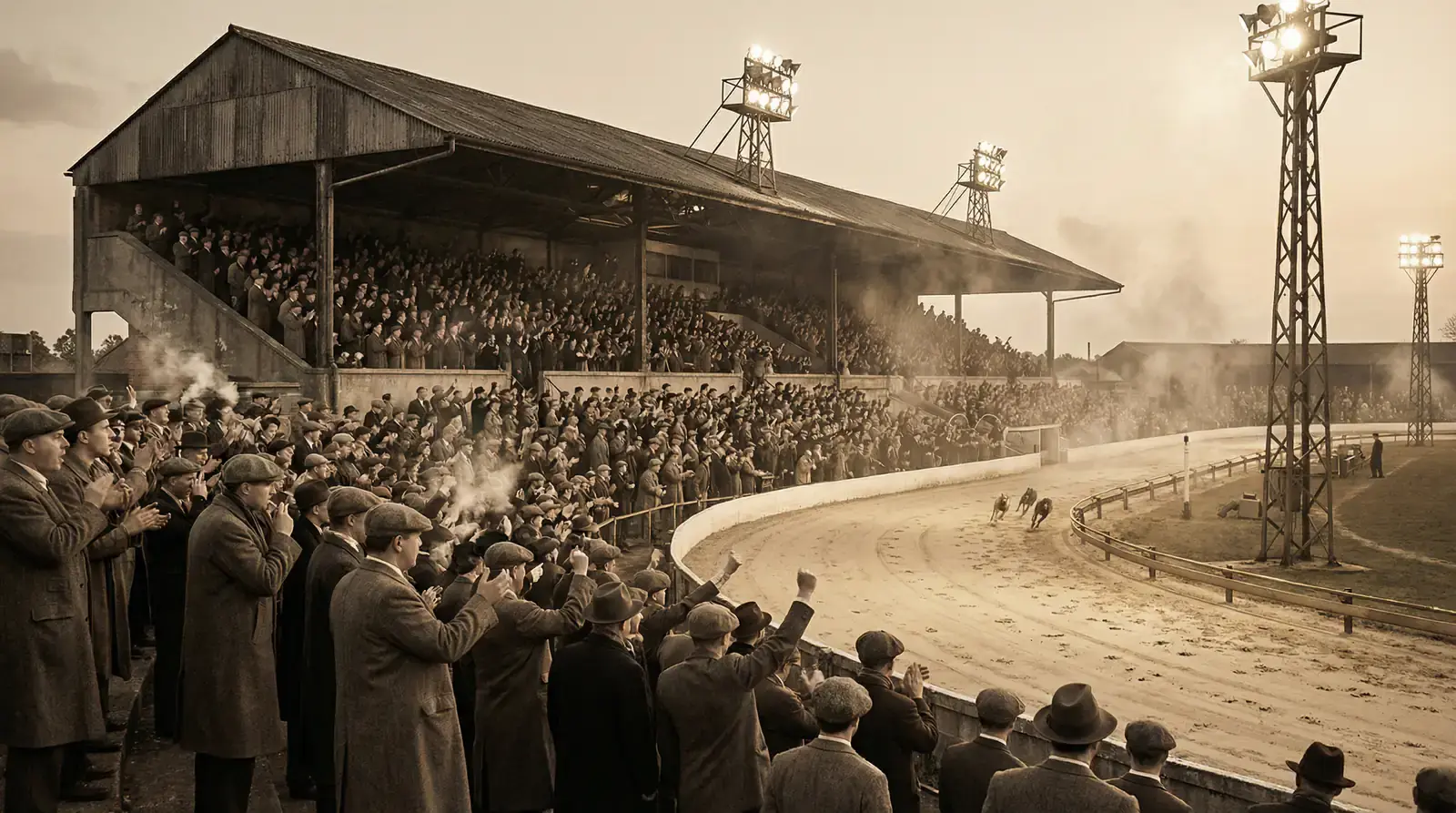
Greyhound racing arrived in Britain in 1926 and within a decade had become one of the country’s most popular spectator sports. At its peak, it drew tens of millions of spectators annually, rivalling football for attendance and embedding itself in the social fabric of working-class Britain. The trajectory since then has been one of sustained decline — stadiums demolished, attendance dwindling, cultural relevance fading — punctuated by moments of adaptation that have kept the sport alive, if much diminished, into the present day.
Understanding this history is not essential for placing a bet, but it provides context for the sport’s current structure, its regulatory framework, and the commercial pressures that shape the racing calendar every bettor interacts with.
1926: Belle Vue and the Birth of the Sport
The first regulated greyhound meeting in Britain took place at Belle Vue Stadium in Manchester on 24 July 1926. The event was organised by an American businessman, Charles Munn, and his associates, including Major Lyne-Dixon and Brigadier-General Alfred Critchley, who had observed the growing popularity of mechanical-lure greyhound racing in the United States and saw an opportunity to bring it across the Atlantic. The meeting was a commercial success. Around 1,700 spectators attended the first evening, and the following week 16,000 turned up.
The format was immediately recognisable to a modern spectator: greyhounds chasing a mechanical lure around an oval sand track, with regulated starting traps and a standard field size. The sport offered something that horse racing, its closest competitor, could not match — accessibility. Greyhound meetings were held in the evening under floodlights, making them available to working people who could not attend weekday afternoon horse racing. The venues were in cities, not in the countryside. The admission was cheap. The races were short and frequent, with a full card completed in a single evening.
Within a year of Belle Vue, tracks opened across Britain. White City in London, Wimbledon, Hall Green in Birmingham, and dozens of smaller venues followed in rapid succession. By the end of 1927, more than 40 licensed tracks were operating in England alone. The expansion was driven by commercial investment — greyhound stadiums were profitable businesses, generating revenue from admission, catering, and on-course betting. The sport’s growth was faster than any other spectator activity in British history at the time.
The Golden Era: 1930s to 1960s
The interwar period established greyhound racing as a mass entertainment. By 1946, annual attendance at British greyhound tracks had reached an estimated 50 million, a figure that dwarfed football and horse racing. The sport was especially popular in London, the Midlands, and the industrial North, where evening meetings fit the rhythms of shift work and provided affordable entertainment for communities with limited leisure options.
The introduction of the totalisator in the 1930s formalised on-course betting and gave tracks a share of the wagering revenue. The tote pools became a significant income stream, and the sport’s financial model depended on the combination of admission revenue, catering, and tote commissions. The regulatory framework developed during this period, with the National Greyhound Racing Club (later replaced by the GBGB) established to oversee racing rules, doping controls, and track standards.
The golden era produced the sport’s most iconic events. The English Greyhound Derby, first run in 1927 at White City, became the most prestigious race in the calendar and attracted national press coverage. Individual dogs became celebrities. Mick the Miller, a brindle dog who won the Derby in 1929 and 1930, became arguably the most famous sporting animal in British history, appearing in a feature film and drawing crowds that rivalled top-division football matches.
The post-war years sustained the sport’s popularity through the 1950s, but the seeds of decline were already planted. Television was drawing audiences into their homes. Alternative forms of entertainment were multiplying. And the most significant structural change was approaching.
Decline: High Street Bookmakers and Changing Tastes
The Betting and Gaming Act 1960, which legalised off-course cash betting shops, changed the economics of greyhound racing permanently. Before the Act, legal cash betting on greyhounds required attending the track. The track controlled the betting, captured the revenue, and maintained the audience. After the Act, punters could bet on greyhound races in their local bookmaker’s shop without leaving the high street. The track lost its monopoly on the betting transaction, and with it, its primary commercial advantage.
Attendance began a decline that has never reversed. Through the 1970s and 1980s, tracks that had been profitable stadiums became financially marginal. Many were built on valuable urban land, and as the racing business deteriorated, the land value exceeded the going-concern value of the sport. Developers offered to buy stadiums for housing, retail, or mixed-use development. Track after track closed. White City, the sport’s spiritual home in London, closed in 1984 and was demolished to make way for BBC offices. Wimbledon, the last remaining London greyhound stadium in the GBGB circuit, survived until 2017 before closing for redevelopment.
The decline was not sudden. It was a slow erosion over decades, driven by the economics of land value, the diversion of betting revenue to off-course bookmakers, and the gradual loss of the social rituals that had sustained the sport. A night at the dogs had been an institution in working-class communities. As those communities changed, as leisure options multiplied, and as the tracks themselves aged without reinvestment, the audience shrank generation by generation.
The Modern Circuit: Survival and Adaptation
The UK greyhound circuit in 2026 is a fraction of its mid-century size. Approximately 20 GBGB-licensed tracks remain in operation, down from more than 70 at the sport’s peak. The surviving venues include established operations like Nottingham, Hove, Romford, Crayford, and Towcester alongside smaller tracks that serve local racing communities. The geographic concentration has shifted: London has lost all its major tracks, and the circuit is now spread across the Midlands, the South East, the North, and scattered venues in Wales and Scotland.
The sport has adapted through the BAGS system, which supplies behind-closed-doors racing content to bookmakers and generates revenue independent of trackside attendance. BAGS income is now the financial backbone of many smaller tracks, providing guaranteed fees from bookmaker contracts that cover operating costs regardless of how many spectators pass through the gates. This commercial model has kept tracks open that would otherwise have been unviable, but it has also changed the character of the sport. Much of the daily racing programme exists to service the betting industry rather than to entertain a live audience.
Online betting and live streaming have created a new distribution channel for the sport. A greyhound meeting at a small regional track, which might attract 200 spectators on a good evening, can now reach thousands of online viewers through bookmaker apps. The audience has migrated from the stands to the screen, and the betting activity has followed. This shift has sustained the sport’s relevance to the gambling industry even as its cultural footprint has diminished.
Greyhound Racing’s Place in UK Culture Today
Greyhound racing in 2026 occupies an unusual position in British sporting life. It is simultaneously a daily betting product that generates substantial bookmaker turnover and a niche live entertainment with a small but loyal following. The disconnect between the sport’s commercial significance to the gambling industry and its near-invisibility in mainstream culture is stark. Millions of pounds are wagered on greyhounds every week. Very few people under 40 have ever attended a meeting.
The welfare debate has become a prominent part of the sport’s public identity. Animal welfare organisations have campaigned against greyhound racing for decades, citing injury rates, the fate of dogs after retirement, and the ethics of commercial racing. The GBGB has responded with tightened welfare regulations, mandatory retirement schemes, and increased transparency around injury and rehoming data. The debate is ongoing and politically charged. For bettors, the welfare dimension is increasingly visible in the sport’s governance and regulation, influencing the rules that shape race conditions and the public perception that influences the sport’s long-term viability.
What remains unchanged is the racing itself. Six dogs, a mechanical lure, a sand track, 30 seconds of competition. The format has survived for a century because it is simple, fast, and watchable. The business model around it has transformed repeatedly — from trackside spectacle to high street betting shop content to online streaming product — but the core event is the same one that 1,700 people watched at Belle Vue in 1926. Whether the sport finds a sustainable future or continues its long contraction depends on economics, regulation, and public appetite. The dogs, as always, are just running.
