 Available in US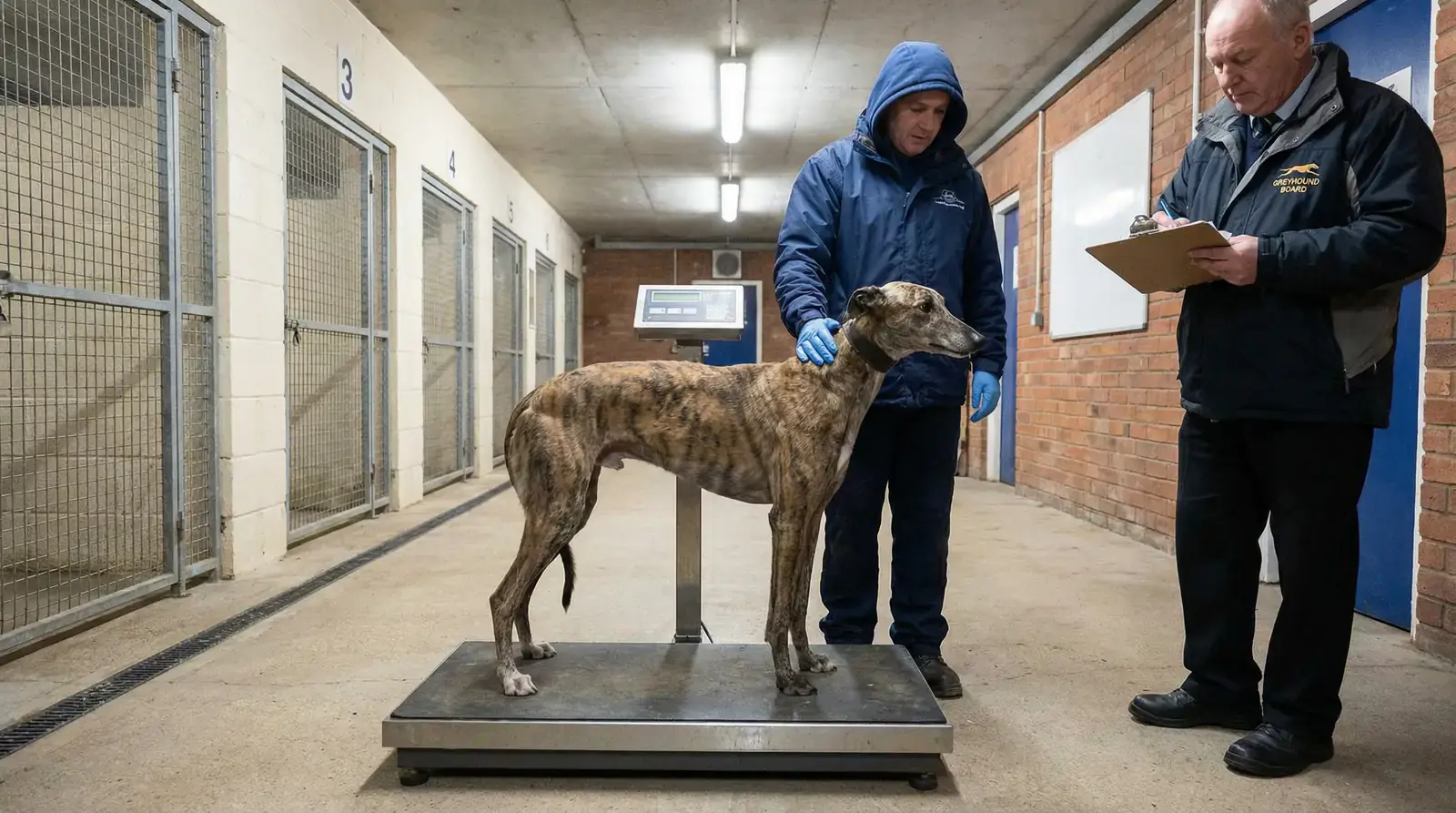
Every greyhound is weighed before every race. The number is printed on the race card, recorded in the form history, and governed by regulation. Yet most bettors treat weight as background noise — a figure to glance at and move past. That is a missed opportunity. Weight data, read correctly, tells you about a dog’s physical condition, its readiness to race, and whether something has changed since its last outing that the market may not have noticed.
A greyhound’s weight is not like a jockey’s weight in horse racing, where a few extra pounds translate directly into a mechanical handicap. In greyhound racing, the dogs carry their own weight, and the relationship between mass and performance is more subtle. What matters is not the absolute number but the pattern — the stability or instability of a dog’s weight across its recent runs.
GBGB Weight Rules: The 1kg Threshold
The GBGB mandates that every greyhound registered at a licensed track must be weighed before each race. The weight is recorded to the nearest 0.1 kilogram and compared to the dog’s previously declared racing weight. If the variance exceeds the threshold — one kilogram above or below the last declared weight — the dog may be withdrawn from the race under Rule 52.
This threshold exists to protect race integrity and dog welfare. A sudden change of more than one kilogram between races, which may be only three to seven days apart, is unusual and potentially signals a problem. Illness, dehydration, digestive issues, or inadequate nutrition can produce rapid weight loss. Overfeeding, lack of exercise during a rest period, or fluid retention can produce rapid gain. Either direction, the change suggests the dog is not in its normal racing condition, and the regulation prevents it from competing until the cause is identified and the weight stabilises.
The practical consequence for bettors is that Rule 52 withdrawals happen at the track, after the dog has been weighed but before the race. If you have placed an early-price bet on a dog that is subsequently withdrawn for a weight violation, your bet is voided. If the withdrawal triggers Rule 4 deductions on the remaining field, your bet on another runner in the same race may return less than expected. Late withdrawals are uncommon in greyhound racing, but weight-related withdrawals are one of the more frequent causes when they do occur.
The weight data on the race card serves as an early warning system. If a dog has been fluctuating by 0.8 or 0.9 kilograms between recent races, it is close to the threshold. Another half-kilo swing in either direction could trigger a withdrawal. Noting this pattern before you bet allows you to factor in the possibility, however small, that the dog may not run.
What Weight Changes Signal
Small weight fluctuations of 0.2 to 0.5 kilograms between races are normal and generally insignificant. They reflect natural variation from hydration levels, meal timing, and bowel emptying before the weigh-in. The race card might show a dog at 31.2kg one week and 31.5kg the next, and neither figure tells you anything meaningful. This is noise, not signal.
Changes of 0.5 to 1.0 kilogram start to enter the territory of potential significance, particularly if they form a pattern. A dog that has lost half a kilogram in each of its last three races — going from 32.0 to 31.5 to 31.0 — is on a downward trajectory. That progressive loss could indicate a dog being trained harder, which might mean the trainer is targeting a specific race or distance. It could also indicate stress, overracing, or a subclinical health issue that is gradually affecting the dog’s condition.
Weight gain following a rest period is common and often benign. A dog returning after two or three weeks away from racing typically carries a little more weight from reduced exercise and maintained feeding. If the gain is within normal range and the dog’s trial time is competitive, the extra weight is unlikely to affect performance. If the gain is at the upper end of the threshold and the dog looks sluggish in its first run back, the weight may be reflecting a genuine fitness deficit.
The direction of change matters as much as the magnitude. A dog steadily gaining weight across multiple races may be maturing physically, which is positive for a young dog developing into its frame. The same pattern in a mature dog may indicate declining fitness. A dog steadily losing weight during a busy racing period may be struggling to maintain condition under the demands of frequent competition. Each pattern requires a different interpretation depending on the dog’s age, career stage, and recent activity level.
One signal that experienced form readers value is weight stability. A dog that arrives at every race within 0.2kg of the same figure is a dog in consistent physical condition. Its trainer has the nutrition and exercise balance right, and the dog is coping with the racing schedule without stress. Stability correlates with consistent form because the physical platform is unchanged from one race to the next. When a previously stable weight suddenly moves, it is worth asking why.
Weight Differences Between Dogs and Bitches
Male greyhounds are typically heavier than female greyhounds, and this difference affects performance characteristics in ways that matter for betting. An average racing dog weighs between 30 and 36 kilograms. An average racing bitch weighs between 25 and 31 kilograms. The overlap exists, but the central tendency is distinct.
The weight difference translates into different running profiles. Heavier dogs generally produce more power per stride, which can translate to higher top speed on a firm surface. Lighter bitches tend to accelerate more quickly relative to their body mass and may handle bends more nimbly because there is less centrifugal force pulling them wide. These are generalisations with many individual exceptions, but they explain why some trainers prefer to run dogs at sprint distances where raw power matters and bitches at standard or staying distances where agility and efficiency over bends provide an advantage.
When dogs and bitches race together in mixed fields, the weight differential is a factor to consider alongside form and trap draw. A heavier dog on the outside may struggle to hold a bend against a lighter bitch on the inside, not because it is slower in a straight line but because the physics of cornering favour the lighter animal at the same speed. Conversely, in a straight sprint with minimal bending, the heavier dog’s power advantage may be decisive.
Weight data should be compared within sex rather than across it. A bitch at 27.0kg and a dog at 33.0kg are both normal. Comparing their weights directly tells you nothing useful. Comparing the bitch’s 27.0kg to her previous race weight of 27.8 tells you something meaningful. Always assess weight changes relative to the individual dog’s own recent history, not relative to the rest of the field.
Using Weight as a Betting Indicator
Weight is a supporting indicator, not a primary selection tool. You would not back a dog solely because its weight is stable, any more than you would back one solely because it drew Trap 1. But when weight data aligns with other form indicators, it strengthens the case for a selection. When it conflicts, it raises a question worth answering before committing money.
The most practical application is as a negative filter. Before backing any dog, check its weight trajectory over the last three to four races. If the weight has been stable within 0.3kg, proceed with your form analysis. If it has shifted by more than 0.5kg in either direction, investigate. Check whether the dog has been rested, whether the distance or grade has changed, and whether the trainer has made any publicly noted changes. If no explanation is obvious, reduce your confidence in the selection. You are not necessarily abandoning the bet. You are acknowledging an additional uncertainty that the weight data has flagged.
For each-way and forecast betting, weight stability is particularly valuable. These bet types depend on a dog performing consistently — finishing in the first two or three places with reliability. A dog whose weight is stable across its recent runs is more likely to reproduce its established form level. A dog with erratic weight is more likely to produce an erratic performance, which could be a surprising win at long odds or an equally surprising failure. If your bet requires consistency, the weight data helps you identify which dogs are most likely to deliver it.
Going conditions interact with weight in a way that few bettors consider. Heavier dogs may handle soft, wet ground better than lighter ones because their greater mass provides more traction on a loose surface. Lighter dogs may find heavy going more energy-sapping because they lack the power to drive through soft sand without tiring. This is not an absolute rule, and individual conditioning matters more than weight alone. But on a wet evening when the track is running slow, noting which dogs carry more natural mass and which are lighter can provide a tiebreaker between otherwise comparable selections.
The discipline with weight, as with every form variable, is to use it in combination rather than isolation. Weight plus consistent CalcTm plus a favourable trap draw plus appropriate going conditions builds a compelling case. Weight alone builds nothing. But ignoring it entirely means missing one of the few objective, pre-race data points that the sport gives you for free.
