 Available in US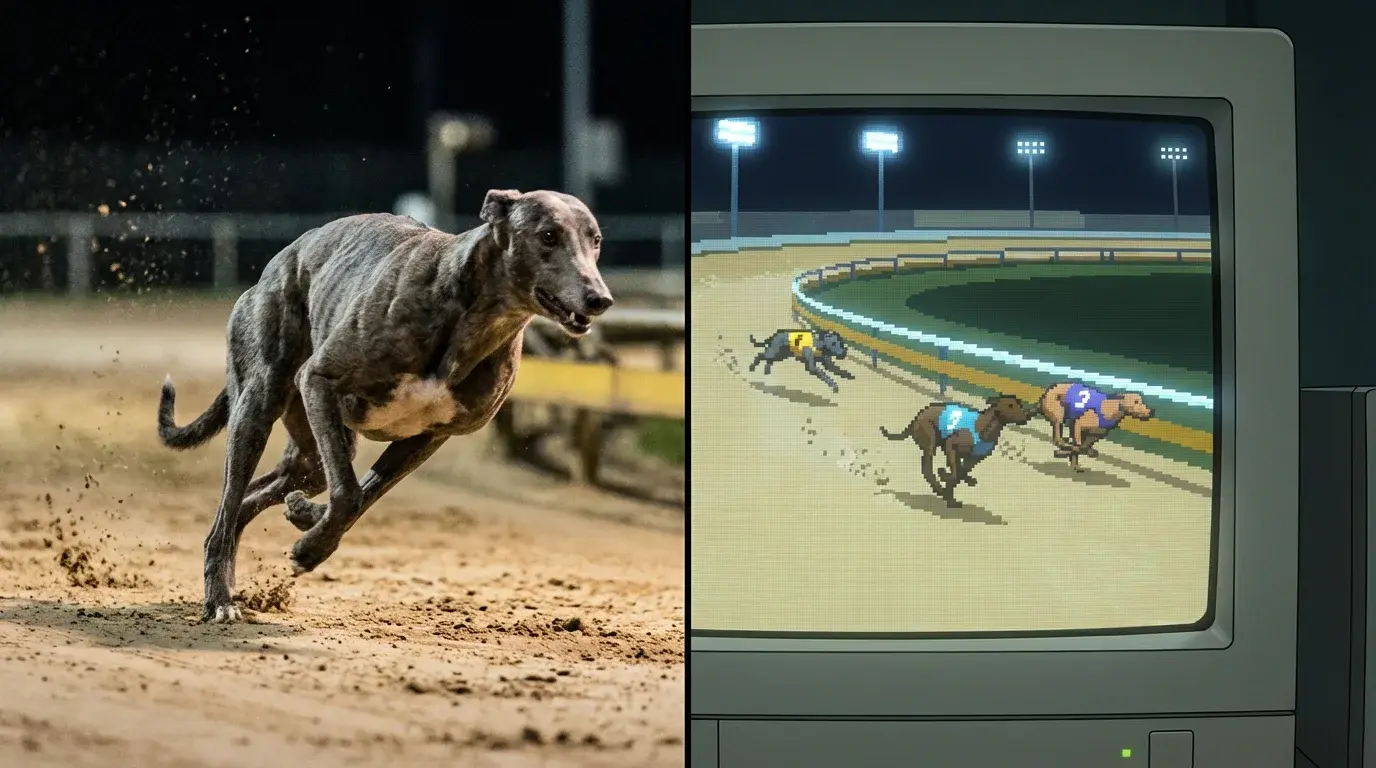
Virtual greyhound racing runs 24 hours a day, seven days a week, with a new race every three minutes. There are no weather delays, no late withdrawals, and no waiting for the next meeting. The dogs are computer-generated, the outcomes are determined by algorithms, and the form data printed on the virtual race card is fictional. Yet virtual greyhound betting accounts for a significant share of bookmaker turnover, and some bettors treat it as interchangeable with real racing.
It is not. The two products share a visual format and a vocabulary, but they have almost nothing in common beneath the surface. Understanding the difference is essential for anyone who bets on greyhounds, because confusing the two will lead to money spent on the wrong assumptions.
How Virtual Greyhound Racing Works
Virtual greyhound races are produced by software providers who supply content to bookmakers. The leading platforms generate races using a random number generator that determines the outcome before the visual animation begins. The animation you watch on screen is a rendering of a predetermined result, not a simulation of competitive racing. When the traps open and the virtual dogs run around the virtual track, the finishing order has already been decided by the RNG.
Each virtual race is assigned a set of fictional form data: dog names, trap draws, recent results, and odds. This information is presented in a format that mimics a real race card, and the visual presentation is designed to resemble live greyhound racing as closely as possible. The dogs have different colours, numbers, and running animations. There is commentary, a track graphic, and a results screen. The intention is to provide an experience that feels like real racing while operating on entirely different principles.
The odds on virtual races are set by the provider’s software based on the probability weightings assigned to each virtual dog. These weightings are pre-programmed and determine both the outcome of the race and the prices offered. Unlike real racing, where odds reflect the aggregate view of a betting market shaped by punter activity, virtual odds are a direct output of the algorithm. The bookmaker’s margin is built into the odds structure, and there is no independent market to create inefficiency.
The cycle time between virtual races is typically two to four minutes. A new race card is generated automatically, the race runs, results are declared, and the next card appears. There is no gap in the schedule. This continuous availability is the primary commercial appeal of virtual racing: it provides constant content for bettors who want action between real meetings or outside of live racing hours.
Key Differences: RNG vs Real Form
The fundamental difference between virtual and real greyhound racing is the relationship between past performance and future outcomes. In real racing, a dog’s form — its times, positions, running style, weight, and going preferences — provides genuine predictive information. A dog that has won three of its last six races at this distance and track is more likely to be competitive today than a dog that has lost five in a row. The data is real because the underlying factors are real. The dog’s physical condition, the trainer’s preparation, and the track’s characteristics all carry forward from one race to the next.
In virtual racing, the form data printed on the card is cosmetic. It is generated by the same algorithm that determines the race outcome, and it has no predictive value beyond the probability weightings the software has assigned. A virtual dog’s past results do not reflect a real training programme, genuine fitness, or actual competitive ability. They are numerical decoration designed to give the product the appearance of depth. Analysing virtual form as if it were real form is not just ineffective — it is fundamentally misguided, because the form does not cause the outcome. Both the form and the outcome are outputs of the same system.
This means that the skills which make a successful real-greyhound bettor — form analysis, trap bias knowledge, going assessment, running style identification — are irrelevant in virtual racing. There is no trap bias because there is no physical track with geometric properties. There is no going because there is no sand surface affected by weather. There is no running style because there is no real dog with physical tendencies. Every variable that a real-racing bettor studies has been replaced by a random number wrapped in an animation.
The RNG itself is regulated. Virtual racing providers operating in the UK market must have their software certified by independent testing houses and licensed by the UK Gambling Commission. The RNG must produce statistically random outcomes within the declared return-to-player parameters. This means the results are genuinely random within the system’s rules — the provider is not manipulating individual race outcomes. But statistical randomness is precisely what makes form analysis useless. You cannot predict a random outcome by studying the previous random outcomes that the same generator produced.
Odds and Markets: Virtual vs Live
Virtual greyhound odds are fixed by algorithm, and the bookmaker’s margin is typically higher than on real racing. The overround on a virtual six-dog race can exceed 130 percent, compared to 115 to 125 percent for a real greyhound race with competitive market pricing. This difference reflects the absence of market competition. Real greyhound odds are shaped by multiple bookmakers competing for business, with BOG promotions, early prices, and SP mechanisms all exerting downward pressure on the margin. Virtual odds face no such competition because the bookmaker is the sole price-setter.
Best Odds Guaranteed does not apply to virtual racing. There is no Starting Price because there is no market to form a consensus. You take the price displayed on screen, and that is what you receive if you win. Price promotions that apply to real greyhound racing — BOG, enhanced odds, free bet triggers — are typically excluded from virtual products.
The bet types available on virtual races generally mirror those on real racing: win, forecast, tricast, and sometimes each-way. The returns on forecasts and tricasts are calculated by the software rather than by CSF, so the payout structure is different. Virtual forecast returns tend to be more predictable because they are derived from the pre-set odds rather than a market-driven algorithm. This predictability cuts both ways: there are no outsized CSF windfalls from unexpected results, but there are also no occasions where the CSF algorithm underpays relative to the result.
Which Offers Better Value for UK Bettors?
Real greyhound racing offers better value on every measurable dimension that matters for serious bettors.
The overround is lower. The market is more competitive. BOG and other promotions reduce the effective margin further. Most importantly, real racing is analysable. The form data is genuine, the track conditions are measurable, the trainers and dogs are real entities with trackable records. A skilled bettor can identify value by finding situations where the market has mispriced a dog’s chances relative to the available evidence. That opportunity does not exist in virtual racing because there is no evidence to analyse. The odds are the odds. The margin is the margin. No amount of research changes the expected return.
Virtual racing’s only advantage is availability. It runs when real racing does not. If you want to place a bet at 3am on a Wednesday, virtual racing is there. Real racing is not. For bettors who view gambling as entertainment and accept the cost of the margin as the price of that entertainment, virtual racing fills a schedule gap. There is nothing inherently wrong with placing a virtual bet for fun, as long as you understand that the product is closer to a slot machine with a racing theme than to an actual competitive sport.
The risk lies in treating virtual racing as a substitute for real racing. A bettor who develops a discipline around form analysis, trap bias, and going conditions in real racing may be tempted to apply those same habits to virtual racing during off-hours. That transfer does not work. The skills are not portable because the underlying product is different. Betting on virtual greyhounds with the same seriousness and stake size as real greyhounds is a recipe for losses, because the analytical edge that justifies higher stakes in real racing simply does not exist in a random-number environment.
The practical boundary is straightforward. Treat real greyhound racing as a sport you can study, analyse, and bet on with conviction when your research supports a selection. Treat virtual racing as what it is: a random product with a higher margin and no analytical pathway to long-term profit. Keep the two separate in your mind, in your betting account, and in your bankroll. The dogs may look the same on screen. The bet is entirely different.
