 Available in US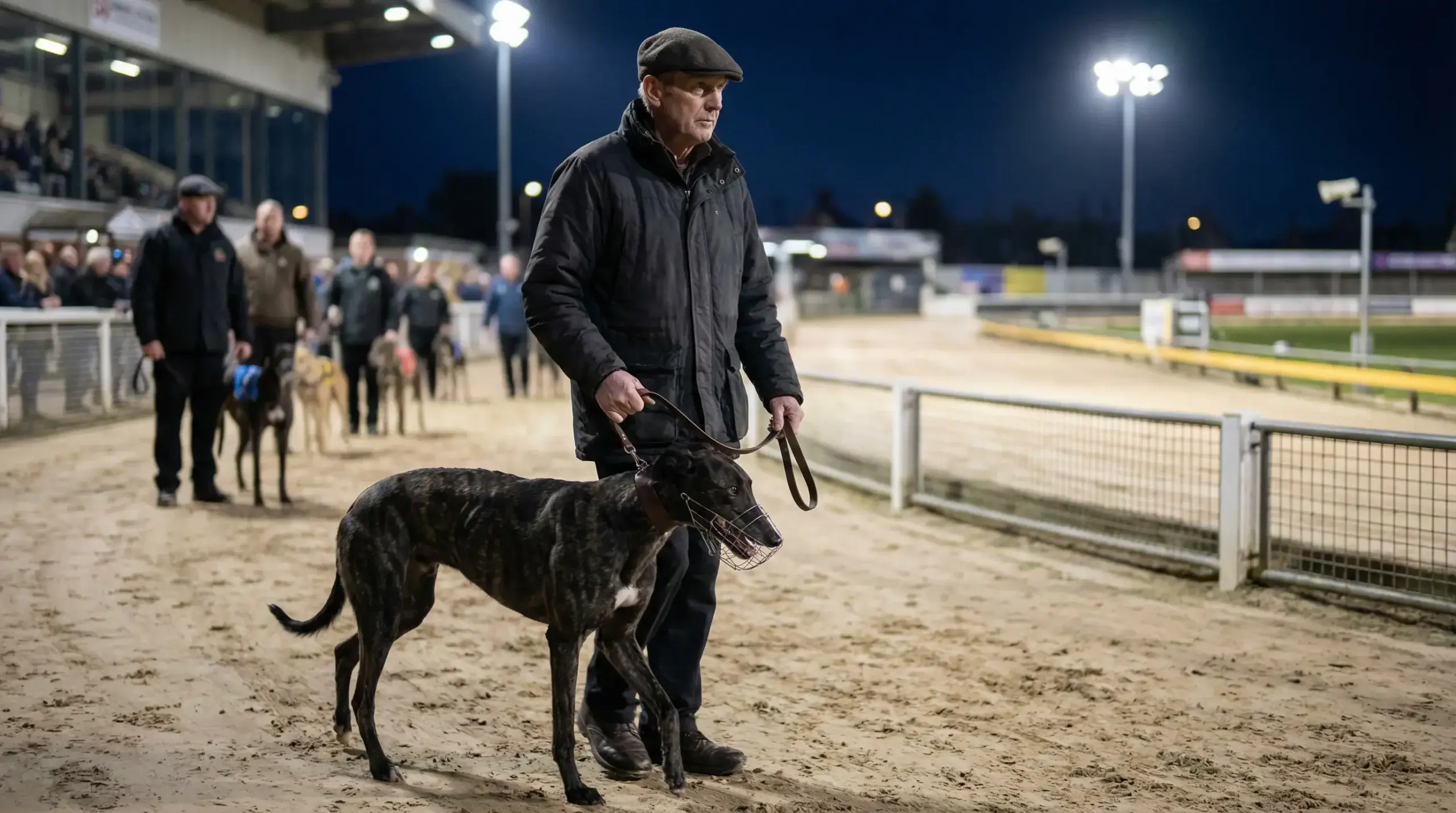
The trainer’s name sits on every race card, and most bettors glance past it. That is a mistake. In greyhound racing, the trainer is the single most influential human factor in a dog’s performance. They control the diet, the exercise regime, the racing schedule, the distance selection, and the recovery between races. Two dogs of equal raw ability can produce very different results depending on who trains them, how they are managed, and how well their racing programme is tailored to their strengths.
Trainer data is available, measurable, and consistently underused by the betting public. That makes it a source of edge for anyone willing to look.
What a Greyhound Trainer Does
A greyhound trainer is responsible for the complete management of their racing string — the group of dogs registered to their kennel and competing under their name. The role covers physical conditioning, race preparation, recovery management, and the strategic decisions about where, when, and how often each dog races.
Day-to-day, the trainer oversees feeding, exercise, and health monitoring. Greyhounds are athletes with specific nutritional requirements that change based on their racing schedule, their weight targets, and their energy demands. A trainer who gets the nutrition right produces dogs that arrive at the track in consistent condition, at the correct weight, with the energy reserves to perform. A trainer who gets it wrong produces dogs that fluctuate in weight, tire in the final straight, or lack the sharpness to break cleanly from the traps.
Race selection is where the trainer’s judgement most directly affects betting outcomes. The trainer decides which meetings to enter, which distances to run, and which grades to target. A good trainer places their dogs in races they can win — matching the dog’s current form, fitness, and running style to the conditions of a specific race. This includes managing the grading system by timing entries to coincide with grade drops, preferred trap draws, or favourable going conditions. The strategic placement of a dog in the right race is as important as the dog’s raw ability, and it is entirely within the trainer’s control.
Recovery management between races is another area where trainer quality shows. Greyhounds typically race once or twice per week. The interval between races, the recovery protocols used, and the management of minor niggles all affect whether a dog arrives at its next race at full capacity or slightly below par. Trainers who race their dogs too frequently risk fatigue-related underperformance. Trainers who space races too far apart risk their dogs losing competitive sharpness.
Trainer Form and Strike Rates
Trainer form is quantifiable. Over any given period, you can measure a trainer’s win strike rate (percentage of runners that win), place strike rate (percentage that finish first or second), and return on investment (profit or loss per pound staked on their runners at SP). These metrics reveal patterns that individual dog form alone cannot.
A trainer with a 25 percent win strike rate is producing winners from one in four runners. That is significantly above the base rate for a six-dog race (16.7 percent) and indicates a kennel that is consistently competitive. Conversely, a trainer with a 10 percent win strike rate is underperforming the base rate, which suggests that their dogs are either not well placed, not well prepared, or both.
Strike rates are most informative when broken down by track and distance. Some trainers specialise in specific venues, having their kennel located near a particular track and running the majority of their dogs there. A trainer with a 30 percent win rate at their home track and a 12 percent rate at away tracks is a very different proposition depending on where the race takes place. If you are betting on a race at the trainer’s home venue, their runners deserve extra respect. If the race is at an unfamiliar track, the form may not transfer.
Seasonal patterns also emerge in trainer data. Some kennels perform best during the summer months when fast going suits their dogs. Others peak in winter with dogs conditioned for heavier surfaces. Tracking a trainer’s monthly or quarterly strike rate across a full year reveals whether their current runners are in a hot or cold cycle, which is additional information that sits beneath individual dog form.
Top UK Trainers and Their Track Records
The UK greyhound training ranks include a small number of dominant operations and a larger pool of competitive professionals. The leading trainers are well known within the sport, and their runners attract market attention and often shorter prices as a result.
The concentration of quality among top kennels is a structural feature of the sport. A leading trainer at a major track may handle 30 or more dogs, with a team of kennel hands and a well-funded operation that supports optimal nutrition, veterinary care, and racing management. This scale produces statistical advantages: more dogs means more opportunities to place runners in favourable conditions, and the best dogs in the kennel benefit from the experience gained across the entire string.
However, market awareness of top trainers creates its own dynamic. When a well-known trainer enters a dog in a graded race, the market often shortens the price based on the trainer’s reputation rather than the specific dog’s merit. This means the value on top-trainer runners can be thin, because the price already reflects the kennel’s general quality. The edge, paradoxically, sometimes lies with less prominent trainers whose runners are underpriced because the market does not factor in a smaller kennel’s competence at a specific track or distance.
A trainer’s record with specific dog types is also revealing. Some trainers excel at developing young dogs and bringing them through the grades quickly. Others specialise in managing older dogs whose careers require careful distance and grade management to maintain competitiveness. Knowing a trainer’s strengths helps you assess whether a particular dog, at a particular stage of its career, is in the right hands to maximise its potential.
Using Trainer Data in Your Betting
Trainer analysis is most useful as a secondary filter applied after form analysis, not as a primary selection method. You would not back a dog solely because its trainer has a high strike rate, any more than you would back a horse solely because its trainer is Aidan O’Brien. But when two dogs are closely matched on form and the other factors are comparable, the trainer data can tip the balance.
Start by identifying which trainers operate at the tracks you bet on most frequently. Build a simple record of their strike rates over the past three to six months, focusing on the specific distance and grade categories that make up your betting activity. Most racing data sites provide trainer statistics that can be filtered by track, distance, and period. This is a one-time setup that takes an hour or two and produces a reference you can update monthly.
Look for specific patterns that have betting applications. A trainer whose dogs consistently improve on their second run at a new grade is telling you that their conditioning programme needs one competitive outing to reach peak. Backing that trainer’s runners on their second start after a grade change, rather than the first, is a data-driven angle. A trainer whose dogs show better form on fast going than slow going is telling you something about their preparation and the type of dog they breed or acquire. Matching that trainer’s entries to favourable going conditions is another systematic edge.
Kennel moves deserve attention. When a dog transfers from one trainer to another, the new trainer’s profile becomes relevant. A dog that was underperforming with a lower-strike-rate trainer may improve under a more accomplished operation. The reverse is also true. Track the first few runs after a kennel transfer and assess whether the new trainer’s methods are producing measurable improvement, such as faster CalcTm figures, better trapping, or more consistent weight.
The most sophisticated use of trainer data is in combination with market pricing. If a trainer’s overall strike rate at a specific track is 24 percent but the market prices their runners as if the strike rate were 30 percent, you are paying a premium for the trainer’s reputation. The value is elsewhere in the field. If the market prices their runners at 15 percent implied probability but the data says 24 percent, there is a gap between perception and reality, and that gap is where profit sits.
Trainer data does not replace form analysis. It enriches it. The best selections emerge when the dog’s form, the trainer’s record, the track conditions, and the price all align. That alignment does not happen in every race. But when it does, the confidence behind the bet is built on multiple independent factors rather than a single data point, and that is the closest thing to a robust edge in a sport where uncertainty is constant.
