 Available in US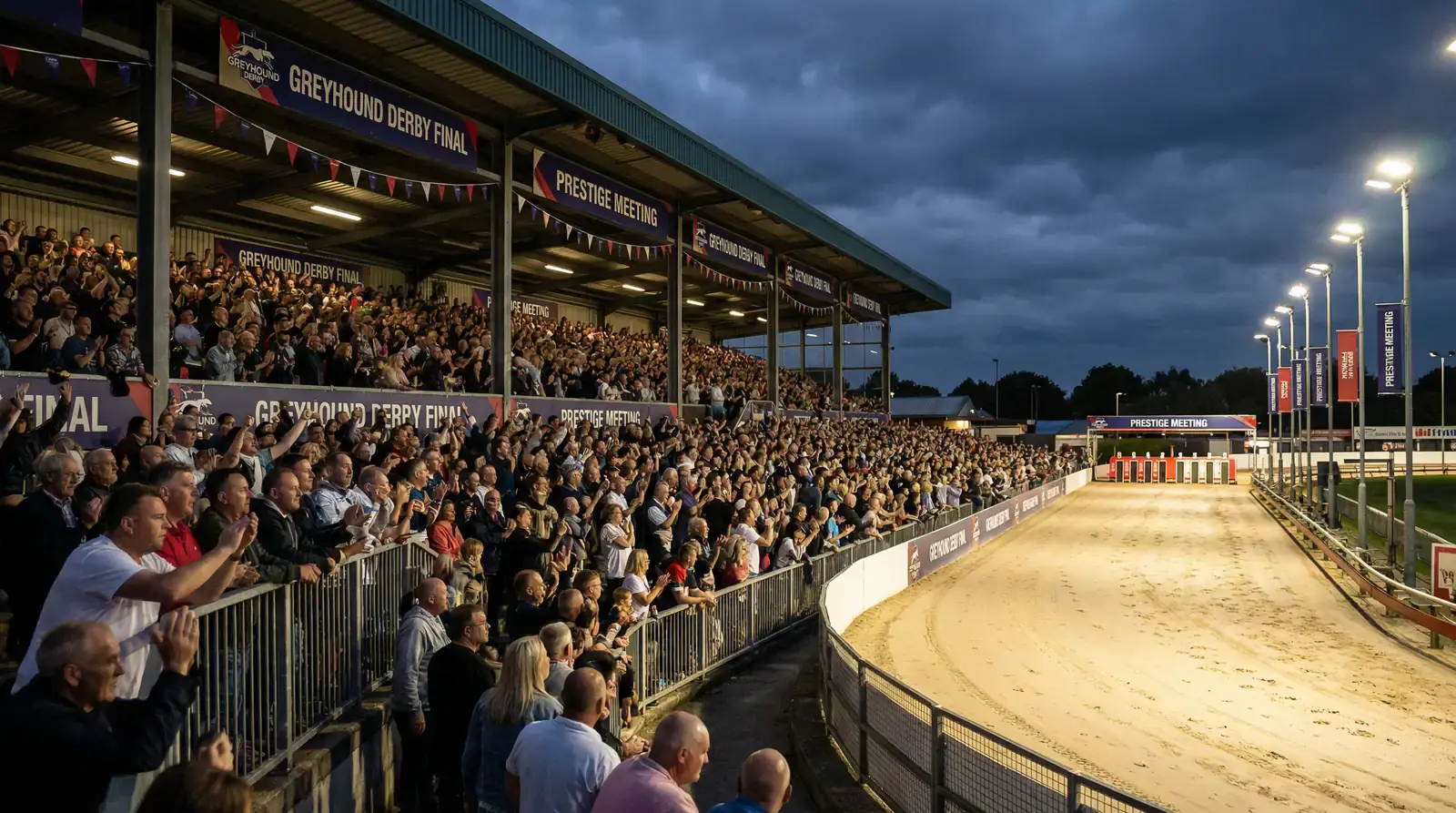
Greyhound racing in the UK runs year-round, with meetings every day of the week at tracks across the country. But within that constant schedule, a handful of events stand above the rest. The English Greyhound Derby, the St Leger, the Essex Vase, the TV Trophy — these are the races that attract the best dogs, the biggest prize funds, and the widest betting markets. They are also the events where ante-post betting opens weeks in advance, where form analysis requires deeper research, and where the returns can justify the effort.
Knowing when and where these events take place is essential for any bettor who wants to plan their activity around the sport’s most competitive racing.
The English Greyhound Derby
The Derby is the single most prestigious event in British greyhound racing. Run over 500 metres at Towcester, it carries a first prize of 175,000 pounds, making it by far the richest race in the sport. The competition is structured as a multi-round event, with heats, quarter-finals, semi-finals, and a final held over several weeks during the summer, typically in June and July.
Entry is open to greyhounds from across the country, and the initial entry list can include several hundred dogs, narrowed through qualifying rounds to a final field of six. The quality of the final is consistently the highest of any greyhound race in the UK. Derby winners are the sport’s equivalent of Grand National or Champions League winners — the best dogs in the country, tested across multiple rounds, at the same venue, over the same distance.
The Derby offers a unique market structure. Ante-post odds are available from the initial entry stage, with prices fluctuating as dogs progress through or are eliminated from each round. Early ante-post betting can offer substantial value because the field is large and the market is less efficient in its assessment of outsiders. By the semi-final stage, the market tightens and the prices become more reflective of genuine ability. The final itself is typically a tight betting heat with well-analysed form and narrow price differentials.
One consideration specific to the Derby: because all rounds are run at the same venue, track familiarity becomes a factor. Dogs that have raced multiple rounds at Towcester have more form at the track than any external data can provide. Their times, trap preferences, and running lines at this specific venue are well established by the final. Bettors who study the heat and semi-final performances rather than relying on pre-tournament graded form will have a clearer picture of each finalist’s chances.
Greyhound St Leger and Other Classics
The Greyhound St Leger is the premier staying event, run over 730 metres at Nottingham. It tests endurance and tactical intelligence over a longer distance than any other major competition, and it often produces different winners than the Derby because the demands are fundamentally different. A dog that excels over 500 metres may lack the stamina for the St Leger distance. Conversely, a genuine stayer that cannot match the pace of Derby sprinters may dominate the St Leger field.
The St Leger typically runs in the autumn, providing a marquee staying event that bookends the summer Derby season. Like the Derby, it is structured across multiple rounds, with heats leading to a final. Ante-post markets open early, and the staying specialists are well known within the sport, making the form research somewhat more contained than the Derby’s sprawling entry list.
Other classic events in the calendar include the Oaks, restricted to bitches, which mirrors the Derby in prestige within female racing. The Essex Vase, traditionally run at Romford, is a prestigious middle-distance event that attracts strong fields. The Cesarewitch, run over marathon distance, is the ultimate test of stamina in the sport. Each classic has its own character and its own type of specialist, which means the betting markets for each event are shaped by a different subset of the greyhound population.
Category 1 and Category 2 Events
Below the classics, the GBGB classifies events by prize fund into categories. Category 1 events are the highest tier outside the classics themselves, with first prizes of 500 pounds or more and total prize funds that attract quality fields from across the country. Category 2 events are the next tier down, still offering competitive prize money and drawing entries beyond the host track’s regular runners.
Category 1 events run throughout the year at major tracks and often carry their own ante-post markets. The TV Trophy, typically broadcast on Sky Sports, is one of the most high-profile Category 1 events and serves as a showcase for the sport to a wider audience. Other notable Category 1 events include the Champion Stakes, the Select Stakes, and various invitation events at Hove, Romford, Nottingham, and other major venues.
Category 1 and 2 events offer a middle ground between the intensity of the classics and the routine of graded racing. The fields are stronger than a typical Tuesday evening card, the form is more extensively studied, and the markets are more liquid. But the prices are not as compressed as in the classic finals, which means value can still be found if your form analysis goes deeper than the majority of the betting public.
These events also serve as form guides for the major classics. A dog that wins a Category 1 event over 500 metres in April may emerge as a Derby contender by June. Tracking performance in Category 1 races throughout the spring provides an early view of which dogs are peaking at the right time for the summer’s major events.
The Full Racing Calendar: When and Where
The UK greyhound racing calendar runs 365 days a year. There is no off-season. Daily racing includes BAGS meetings at multiple tracks from mid-morning through the afternoon, followed by evening cards at the larger venues. This continuous schedule means there is always racing to bet on, but the quality and betting value vary significantly by time of day, day of week, and time of year.
Evening meetings at major tracks tend to feature the strongest fields. Saturday evening cards at Hove, Nottingham, Romford, and others regularly include Category 2 events and competitive graded racing. Weekday evenings at the same venues offer solid graded racing with established form lines. Afternoon BAGS meetings are more utilitarian, providing content for bookmaker markets with fields that are generally lower in quality but higher in frequency.
The major event season runs from spring through autumn. The Derby heats begin in late spring, the final is typically in early summer, and the St Leger and other staying events follow through the autumn. Winter months continue with graded racing and Category events but fewer marquee competitions. The Christmas and New Year period often features special meetings and additional Category events at major tracks.
Ante-Post Betting on Major Events
Ante-post markets on the English Greyhound Derby, the St Leger, and other major events open weeks before the competition begins, and they present a different betting proposition to standard race-day markets.
The fundamental difference is that ante-post bets are placed before the final field is confirmed. If your selection does not make the final — through elimination in an earlier round, injury, or withdrawal — your stake is typically lost. There is no refund. This is the core risk of ante-post betting, and it is why ante-post prices are generally longer than the equivalent prices would be if the bet were placed on the final day.
That longer price is the compensation for the additional risk, and it is where value can be found. If your analysis identifies a dog that is likely to reach the final and is underpriced at the ante-post stage, the expected value of the bet can be positive despite the non-runner risk. The key is to assess not just the dog’s ability but its probability of making the final. A brilliant dog with a history of injuries or inconsistent form in multi-round competitions is a riskier ante-post proposition than a slightly less talented but consistently reliable one.
Market movements in ante-post betting for greyhound events tend to be sharper than in horse racing because the fields are smaller and the information flow between rounds is rapid. After each heat, the market reprices dramatically based on the results. Dogs that qualify impressively shorten. Dogs that scrape through lengthen. This creates opportunities for bettors who can assess performance quality rather than just results. A dog that won its heat comfortably may be a weaker ante-post bet than one that qualified in second but ran a faster sectional time in a stronger heat. The market does not always distinguish between the two.
