 Available in US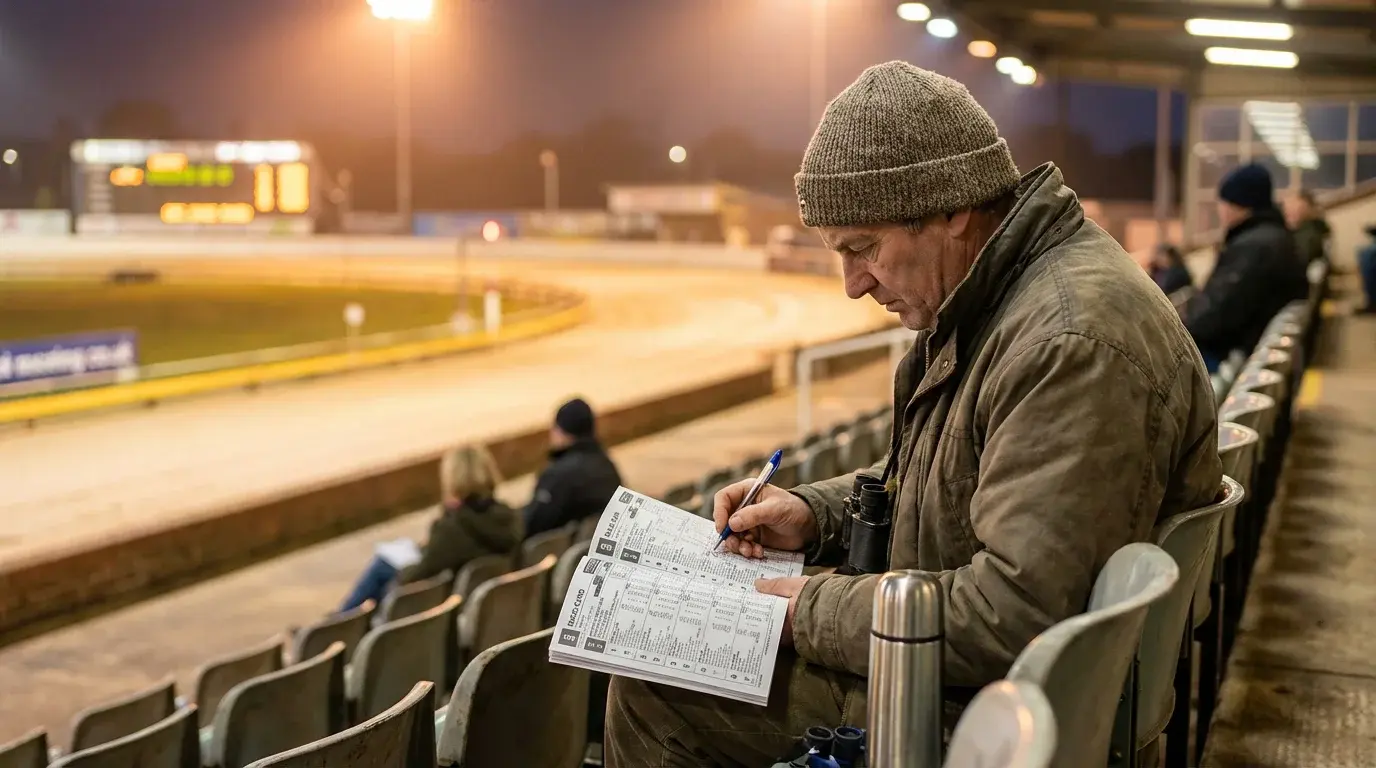
Form is the record of what a greyhound has actually done, and it is the closest thing to objective evidence available to any dog racing bettor. Every race a dog runs generates data: finishing position, race time, split time, weight, trap draw, going conditions, and a shorthand description of how it ran. That data accumulates into a form profile, and reading it accurately is the single most important skill in greyhound betting.
The challenge is not finding form data. It is printed on every race card and available through every bookmaker app. The challenge is knowing which numbers matter, which patterns are meaningful, and which apparent trends are just noise. This is where casual bettors and serious ones part company.
The Six-Run Form Window
Most UK race cards display a dog’s last six runs as the standard form reference. This is not arbitrary. Six runs typically covers two to four weeks of racing for an active dog, providing enough data to assess current ability without reaching so far back that the information becomes stale. Greyhounds can change form quickly. An injury, a rest period, a change in distance or grade can shift performance within a few races. Six runs captures the dog’s present condition with reasonable reliability.
Read the six-run form line from right to left: the most recent run is on the left, and the oldest is on the right. Each entry shows the finishing position (1st through 6th), and the card may also display the trap number, grade, distance, time, and a comment abbreviation for each run. A form line of 1-2-3-1-4-2 tells you the dog has won twice, placed twice, and finished mid-field twice in its last six outings. That is useful, but it is only the surface layer.
Dig into the context behind each result. A first-place finish in an A6 race at 480 metres on fast going is a different achievement than a first-place finish in an A3 race at 640 metres on slow going. The finishing position alone does not tell you the grade, the distance, the conditions, or the quality of the field. Two dogs with identical 1-1-2-1-3-1 form lines may be operating at completely different levels. The form window tells you what happened. The details tell you what it means.
Pay attention to the sequence. Form that reads 1-1-2-1-2-1 shows a dog that is consistently competitive. Form that reads 6-5-4-3-2-1 shows a dog that is improving sharply. Form that reads 1-2-3-4-5-6 shows a dog in decline. The direction of the trend matters as much as the individual results, sometimes more. A dog with a recent win followed by deteriorating positions may be past its peak at the current grade. A dog with a string of thirds and seconds that just broke through with a win may be hitting a new level.
Key Metrics: Times, Positions, Weight, Going
Finishing position gets the most attention. Race time gets the most value. A dog that wins in 29.50 seconds has beaten its field, but a dog that finishes third in 29.40 in a stronger race may be the better selection going forward. Times allow comparison across races, grades, and meetings in a way that positions alone cannot.
The calculated time, listed as CalcTm on most race cards, is the race time adjusted for going conditions. This is the number to use when comparing performances across different days. A raw time of 29.80 on slow going with a going adjustment of -0.40 produces a CalcTm of 29.40, which is directly comparable to a 29.40 run on normal going. Without this adjustment, you would be comparing a dog’s ability to the weather rather than to its rivals.
Split times record how quickly the dog reached a specific point on the track, usually the winning line on its first pass. A fast split indicates early pace — the dog was near the front through the first bend and into the back straight. A slower split with a strong finishing position suggests the dog comes from behind. Both profiles can produce winners, but they suit different race conditions and different distances. Early-pace dogs thrive in sprints and at tracks with short run-ins. Closers perform better over longer distances and at tracks where the field tends to bunch on the bends.
Weight is recorded for every run and typically displayed to the nearest half kilogram. Small fluctuations of half a kilo between runs are normal and usually insignificant. A change of one kilogram or more in either direction warrants attention. Weight loss can indicate illness, stress, or a change in training regime. Weight gain may suggest a dog returning from rest or being moved to a longer distance where additional bulk helps sustain effort. The GBGB requires dogs to be weighed before every race, and a dog more than one kilogram heavier or lighter than its last declared weight may be withdrawn under Rule 52.
Going conditions provide the final contextual layer. A dog’s form on fast going may not transfer to slow going and vice versa. When assessing form, note which conditions produced the best performances. Some dogs are demonstrably better on fast ground, running their quickest CalcTm figures when the going is firm. Others handle heavy conditions with less loss of time. If tonight’s going is slow and your selection’s best runs have all come on fast ground, that is a factor worth weighing.
Pattern Recognition: Improving, Declining, Consistent
The three most useful form patterns are improvement, decline, and consistency. Each has different implications for betting.
An improving dog is one whose recent runs show a clear upward trajectory in either finishing positions, race times, or both. The improvement may be driven by a drop in grade, a return to a preferred distance, a recovery from injury, or simple maturation in a younger dog. Improving form is the most attractive pattern for bettors because the market often lags behind the trajectory. A dog that finished fifth, fourth, third, and second in its last four runs may still be priced as a mid-field runner because the market is averaging its recent form rather than projecting its trajectory. If your analysis identifies the reason for the improvement and believes it will continue, the current price may represent value.
Declining form is the opposite trajectory and requires a different assessment. A dog whose finishing positions have deteriorated from firsts and seconds to fourths and fifths may be struggling with an injury, facing tougher opposition after grade promotions, or simply past its competitive peak. The market is generally quicker to react to declining form than improving form, which means dogs on a downward trend are often appropriately priced or even slightly overbet by bettors who remember the earlier wins. The exception is when the decline has a correctable cause. A dog that declined after being moved to an unsuitable distance and is now returned to its preferred trip may reverse the trend.
Consistent form is the most reliable but least exciting pattern. A dog that finishes first, second, or third in most of its races without dramatic swings in either direction is a known quantity. The market prices these dogs efficiently, which makes finding value harder. Consistent dogs are best suited to each-way betting, where their reliable placing record generates steady returns. They are less useful for win-only betting because their consistent performances mean the price rarely offers substantial value.
From Form to Selection: A Practical Framework
Form analysis is only useful if it produces a decision. The goal is not to know everything about every dog in the race. The goal is to identify which dog has the best chance of winning or placing, given the specific conditions of this race, and whether the price offered represents value relative to that chance.
Start by eliminating dogs with clear negatives. Any dog showing a pronounced declining trend across its last three or four runs is unlikely to reverse that decline tonight without an obvious reason, such as a significant grade drop or a return to a strongly preferred distance. Any dog with a recent weight change of more than one kilogram should be treated with caution unless the change has an obvious benign explanation.
Next, compare the remaining dogs on CalcTm at the relevant distance. The dog with the fastest recent CalcTm figures is the form pick, but only if those times were recorded in comparable conditions. A CalcTm of 29.30 recorded in an A2 race carries more weight than a 29.30 in an A7 race because the dog achieved it against stronger opposition.
Factor in trap draw and running style. Does the form pick’s preferred racing line match its trap draw? If the best dog on form is a natural railer drawn in Trap 1, the alignment is ideal. If it is drawn in Trap 5, the form edge may be offset by the positional disadvantage. This is where form analysis intersects with trap bias and running style analysis, and where the richest betting decisions are made.
Finally, check the going. If conditions tonight differ significantly from the conditions in which the form pick recorded its best performances, adjust your confidence accordingly. A dog whose best CalcTm figures came on fast going is a less certain selection when the track is running slow. The adjustment does not have to be dramatic. It might mean reducing your stake rather than abandoning the selection. But it should be conscious and deliberate, not an afterthought.
The framework is simple: form first, context second, price third. Identify the strongest recent form in the field. Assess whether the race conditions support that form. Then check whether the price being offered is fair or generous. If all three align, you have a selection. If one or more elements are missing, move on to the next race. Discipline in selection is more valuable than brilliance in analysis, and form provides the foundation for both.
