 Available in US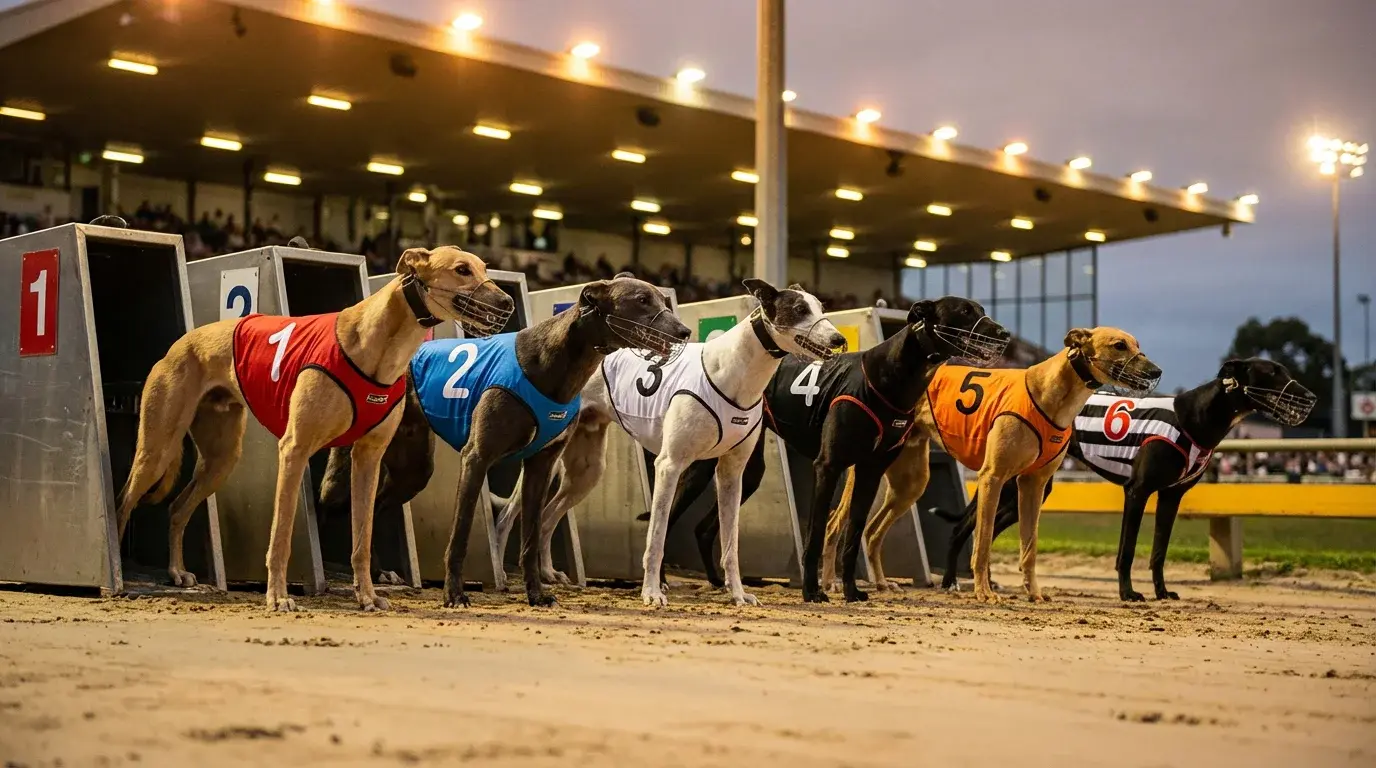
Colour-coded racing has not changed in a century, and for good reason. When six greyhounds explode from the traps at close to 45 miles per hour and hit the first bend within four seconds, there is no time to squint at ear tattoos or read a name on a blanket. The system needs to work instantly, from the grandstand, from a grainy live stream, and from any angle on the track.
At every GBGB-licensed meeting in England, Scotland, and Wales, each starting trap is assigned a fixed colour and number. The greyhound drawn in that trap wears a jacket in the corresponding colour with a numeral printed on each side. This is not tradition for tradition’s sake. It is a functional identification system that allows race officials, trackside bookmakers, TV commentators, and bettors to follow the action in real time. Once you know the six colours, you can track any dog in any race at any UK track without hesitation.
The same scheme has been used since the earliest days of organised greyhound racing in Britain, and it applies to every graded race, open race, and trial. If you plan to bet on greyhounds in any capacity, this is where your visual literacy starts.
The Six Trap Colours: Red to Stripes
Red, Blue, White, Black, Orange, Stripes. In that order, every race. The sequence never varies at any GBGB track, and the jacket design follows a consistent pattern: each jacket displays the trap number in a contrasting colour that is readable at distance and at speed.
Trap 1 wears a red jacket with a white numeral. This is the innermost starting position, closest to the inside rail. In most races, the Trap 1 runner will attempt to secure the rail early, and the red jacket is typically the first colour you notice when the traps open on a bend start. Trap 2 is blue with a white numeral. Positioned next to the rail runner, the blue jacket often appears in close quarters with the red during the first few strides. Trap 3 is white with a black numeral, and occupies the middle of the inside group. The contrast of a white jacket with black lettering makes it one of the easiest to spot even on a washed-out stream.
Trap 4 wears black with a white numeral. This is the first of the outside positions and sits at the transition point between the inside and wide runners. Trap 5 is orange with a black numeral. The bright colour stands out particularly well under floodlights, which is useful given that most UK greyhound meetings take place in the evening. Trap 6, the widest draw, wears black and white stripes with a red numeral. It is the most visually distinctive jacket of the six and easy to pick out even in a tightly bunched field approaching a bend.
The numeral colours are not random. Each combination is chosen for maximum contrast against the jacket base: white numbers on red, blue, and black; black numbers on white and orange; red on the striped jacket. The entire system is designed to be legible in poor light, at speed, and at distance.
There were historically two additional trap colours. Trap 7 wore green with a red numeral, and Trap 8 wore yellow and black with a white numeral. These existed during an era when eight-dog races were common in the UK. That format is now almost entirely obsolete. Towcester has introduced some eight-runner events in recent years, but the standard UK race features six dogs. The green and yellow jackets are effectively retired from regular competition.
The colour scheme is standardised across every GBGB venue. Whether you are watching a Monday afternoon BAGS meeting at Harlow or a Saturday evening open race at Hove, the colours and their meanings are identical. This consistency is part of what makes the system work: you learn it once and it applies everywhere.
Reserve Dogs and the ‘R’ Marking
An ‘R’ on the jacket changes the race, and potentially your bet. Reserve greyhounds are named on the race card as potential replacements in case a declared runner is withdrawn before the off. When a reserve steps in, it wears the jacket of the trap it fills, but with a prominent ‘R’ printed on each side alongside the numeral.
Reserves matter to bettors for several reasons. A reserve may not have been prepared specifically for this race. Its recent form might be at a different distance or grade. The trainer may have entered the dog as a reserve precisely because it was not expected to compete at this level on this card. None of this means the reserve cannot win. Dogs are sometimes held back as reserves for tactical reasons, particularly when trainers want to manage how frequently a dog races in a given week. But the default assumption should be caution. When you see an ‘R’ appear on a jacket that was not there when you studied the card, reassess before confirming the bet.
Late reserve replacements are announced before the off, but if you are betting online at early prices, the withdrawal and replacement may happen after your bet is placed. In that case, normal non-runner rules apply. Most bookmakers will void the bet on the withdrawn dog and may apply Rule 4 deductions to remaining bets in the race. Check your bookmaker’s specific terms, because handling of reserve replacements varies.
Why Trap Position Matters for Betting
The trap is not just a starting position. It is the first tactical variable in any greyhound race, and its influence extends well beyond the opening stride.
In a six-dog race on an oval or pear-shaped sand track, the inside traps have a geometric advantage on the bends. Trap 1 covers the shortest distance around every turn. Trap 6 covers the longest. On a tight circuit with sharp bends, this difference can amount to several lengths over the course of a race. On a wider, more galloping track, the effect is smaller but still measurable.
The data bears this out consistently. Across UK tracks, Trap 1 runners win approximately 25 to 33 percent of graded races. In a perfectly even field, each trap would win roughly 16.7 percent of the time. That gap represents a real and persistent inside-rail advantage. However, the size of the advantage varies significantly by track. At venues with wide sweeping bends, such as Nottingham, the trap bias is less pronounced. At tighter tracks like Crayford, inside draws carry a measurable edge.
The colour-coded system helps bettors track this advantage in real time. When you watch the first bend of a race, the red jacket tells you immediately whether the inside runner has secured the rail. If the blue jacket has moved across from Trap 2 to take the rail, or if the orange jacket from Trap 5 has shown enough early pace to challenge the inside dogs, you can see it happen. Without the colour system, following six greyhounds through a bend at speed would be nearly impossible.
Trap position also intersects with a dog’s preferred racing line. Some greyhounds are natural railers, performing best when they can hug the inside. Others are middle runners who prefer space, or wide runners who come from the outside. The race card indicates a dog’s preferred line through its form abbreviations: Rls for rails, Mid for middle, W for wide. When a natural railer is drawn in Trap 1, the alignment between trap position and running style is ideal. When the same dog is drawn in Trap 5, it has to cross four rivals to reach its preferred rail, and that creates risk.
For bettors, the key is to read trap draw in combination with running style and track characteristics. A fast-breaking railer in Trap 1 at a tight track is a very different proposition to the same dog in Trap 6 at the same venue. The jacket tells you the starting position. The form tells you whether the dog can make that position work.
Beyond the Starting Box
The colours tell you where each dog starts. Form tells you where they finish. But between the trap and the line, the jacket is your only visual anchor.
This is especially true if you watch live racing to evaluate dogs for future wagers. Commentary can help, but commentary follows the leaders. If you are interested in how the Trap 4 runner handles the second bend, or whether the Trap 6 dog found any room on the outside, you need to track the black jacket or the striped jacket yourself. The colour system makes that possible.
Understanding trap colours also helps when reviewing race replays. Most UK greyhound meetings are available as replays through bookmaker apps or Racing Post Greyhound TV, and the visual clarity of the jacket system means you can follow any dog through the entire race without relying on the result graphic. This is particularly useful for form analysis. Reading that a dog finished fourth after being crowded at the second bend is one thing. Watching the orange jacket get shut out by the white and black jackets at that bend is another. The visual evidence adds a dimension that numbers alone cannot capture.
There is a broader point here too. Greyhound racing is a fast, compressed sport. Races last around 30 seconds. The margins between first and sixth can be measured in lengths, not furlongs. In that compressed window, every piece of information you can process quickly matters. The trap colour system removes one layer of confusion. It means you arrive at every race already knowing the visual identity of every runner, before the card is read, before the odds are set, before the traps open.
For anyone moving from casually watching the dogs to actively betting on them, learning the six colours is the smallest investment with the most immediate return. Red, Blue, White, Black, Orange, Stripes. Commit it to memory and every race becomes legible from the first stride.
